You might have heard the old story: move to Portugal is a European country known for its mild climate and historically favorable tax regimes for digital nomads and investors, get your residency, and pay zero tax on your Bitcoin gains. If you are reading this in June 2026, that specific dream is dead. The original Non-Habitual Resident (NHR) program closed its doors to new applicants years ago, replaced by a stricter system called IFICI. But does that mean Portugal is no longer worth it for crypto investors? Not necessarily. It just means the rules have changed from a wide-open invitation to a selective club.
The landscape shifted dramatically when the Portuguese government announced the end of the original NHR scheme. For those who missed the March 31, 2025 deadline, the era of broad tax exemptions is over. Today, we are looking at the reality of living in Lisbon or Porto as a crypto holder under the current laws. We will break down what the new IFICI is the Tax Incentive for Scientific Research and Innovation, often referred to as NHR 2.0, which replaced the original NHR regime with stricter eligibility criteria focused on high-value professions actually offers, how the 28% short-term capital gains tax works, and whether you can still optimize your taxes if you hold your assets long enough.
The Death of the Original NHR and Rise of IFICI
To understand where you stand today, you need to know what you lost. The original NHR Program is a former Portuguese tax regime established in 2009 that offered a flat 20% tax rate on domestic income and exemptions on foreign-sourced income for ten years was a magnet for remote workers and crypto traders. It allowed eligible residents to pay a flat 20% tax on Portuguese-sourced income and enjoy total exemption on most foreign income, provided double taxation treaties existed. For crypto investors, this meant that if you were not considered a professional trader, your foreign crypto gains could potentially be tax-free.
That window closed. New applications stopped being accepted after March 31, 2025. If you did not secure your status by then, you cannot join the original NHR. Instead, Portugal introduced IFICI. This is not a simple rebranding; it is a fundamental shift in policy. While the original NHR was relatively accessible to anyone with a decent job or passive income, IFICI targets specific sectors. It prioritizes individuals involved in scientific research, technological development, and highly qualified professions.
For the average crypto investor, this is a hurdle. Under IFICI, simply holding Bitcoin or Ethereum does not automatically qualify you for the tax benefits. You must demonstrate that your activities align with the approved categories. If you are a full-time trader making €150,000 a year but do not fit into the "highly qualified profession" list defined by the Portuguese authorities, you likely fall through the cracks. The benefit is no longer universal; it is merit-based and sector-specific.
How Portugal Taxes Crypto in 2026
Let’s talk numbers. Regardless of whether you have NHR or IFICI status, the baseline tax treatment for cryptocurrencies in Portugal follows the rules set by the national budget reform of 2023. These rules integrate digital assets into the standard personal income tax system, known as IRS (IRS is Imposto sobre o Rendimento das Pessoas Singulares, the Portuguese individual income tax code that governs how personal earnings, including capital gains, are taxed).
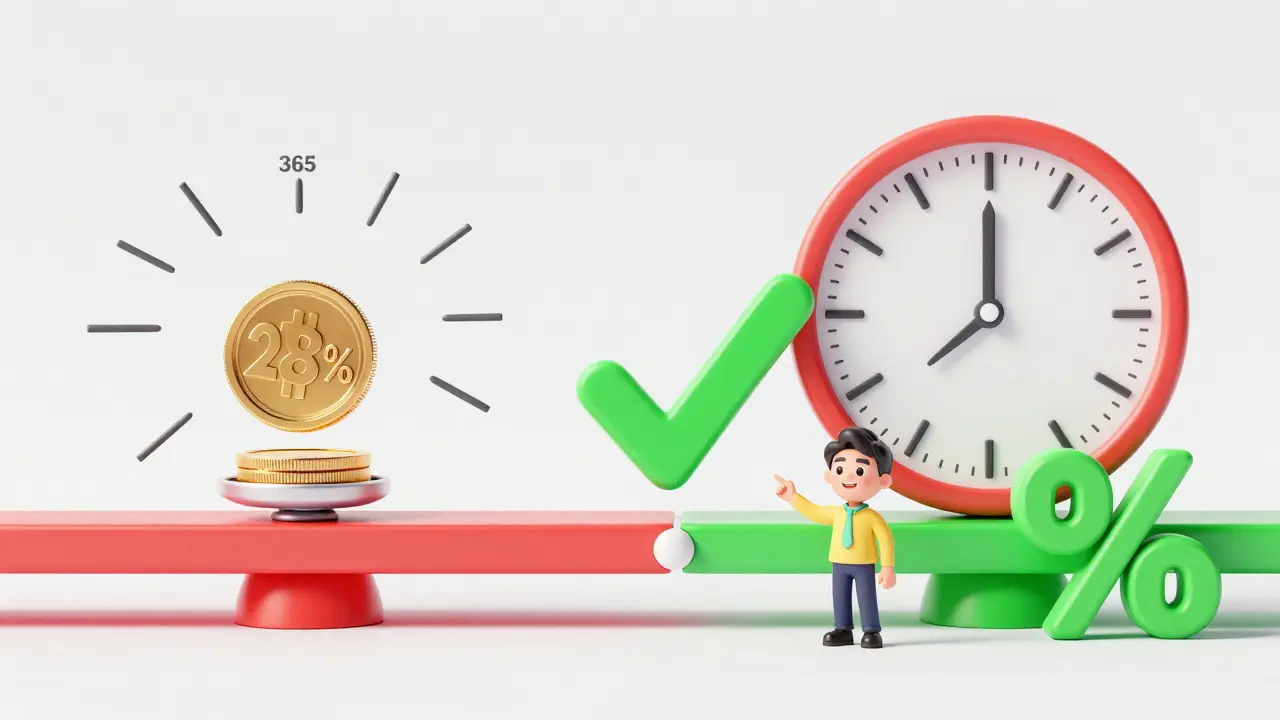
Here is the core rule you need to memorize: time matters more than anything else.
- Short-Term Holdings (Less than 365 Days): If you buy crypto and sell it for a profit within one year, that gain is taxable. It falls under Category G of the IRS. The tax rate is a flat 28%. This applies to both spot trades and conversions to fiat currency.
- Long-Term Holdings (More than 365 Days): If you hold your asset for more than a year before selling, the capital gain is generally tax-free. This is the golden rule for non-professional investors. It remains one of the most attractive features of the Portuguese system compared to neighbors like France or Italy.
This distinction creates a clear strategy. You do not need special tax status to avoid tax on long-term gains; you just need patience. However, the definition of "professional" is tricky. If the tax authority determines that your trading activity is systematic, frequent, and generates significant income relative to your other sources, they may classify you as a professional trader. Professionals are taxed on their progressive income scale, which can go up to 48%, regardless of holding period. Most casual investors and even many active traders avoid this classification by keeping their activity below certain thresholds or ensuring it is not their primary livelihood source in a way that resembles employment.
Passive Income: Staking, Lending, and Airdrops
Crypto is not just about buying and holding. Many investors earn yield through staking, lending protocols, or receiving airdrops. How does Portugal treat this?
Under current regulations, passive crypto income is taxed differently from capital gains. Income derived from staking rewards, DeFi lending interest, and airdrops is typically classified as miscellaneous income or capital gains depending on the specific nature of the reward. As of late 2025 guidance, these are generally subject to a flat 28% tax rate. Unlike capital gains, there is no "long-term" exemption for staking rewards. If you stake ETH and receive rewards every month, each reward event is a taxable event at 28%.
This makes record-keeping critical. You cannot simply ignore the small amounts. Over a year, these micro-transactions add up. Using specialized software to track cost basis and fair market value at the time of receipt is essential. Without this data, you risk underreporting income, which can lead to penalties during an audit by the Portuguese Tax Authority is Agência Tributária (AT), the government body responsible for tax collection and enforcement in Portugal.
| Activity | Holding Period | Tax Rate | Notes |
|---|---|---|---|
| Sell Crypto for Fiat | < 365 Days | 28% | Taxed as Capital Gain (Category G) |
| Sell Crypto for Fiat | > 365 Days | 0% | Tax-free for non-professionals |
| Crypto-to-Crypto Trade | Any | Deferred | No immediate tax until conversion to fiat or goods |
| Staking Rewards | N/A | 28% | Taxed upon receipt based on FMV |
| Airdrops | N/A | 28% | Taxed upon receipt based on FMV |
Does IFICI Help Crypto Investors?
If you qualify for IFICI, does it change the math above? Here is the nuance. IFICI maintains the flat 20% tax rate for qualifying Portuguese-sourced income. However, cryptocurrency held in foreign wallets or exchanges is often considered foreign-sourced income or capital gains. Under the original NHR, foreign-sourced income was exempt. Under IFICI, the exemption for foreign-sourced income is much narrower and depends heavily on double taxation treaties and the specific classification of the income.
As of October 2025, the Portuguese Tax Authority had not issued specific guidelines clarifying how IFICI treats crypto capital gains explicitly. This creates uncertainty. Some advisors argue that if you are a qualified researcher or tech professional under IFICI, you might still leverage the regime to reduce overall tax liability, but relying on it for crypto-specific exemptions is risky without direct confirmation from the AT. The safe bet is to assume the standard 28%/0% rule applies unless you have written confirmation otherwise.

Practical Steps for Residency and Compliance
Moving to Portugal involves more than just buying a house. To be a tax resident, you must spend at least 183 days in the country per year, or have your center of vital interests there. Once you are a resident, you must file annual tax returns declaring worldwide income.
For crypto investors, compliance starts with documentation. You need:
- Transaction History: Export complete records from all exchanges and wallets. Include timestamps, wallet addresses, and the fiat value (EUR) at the time of each transaction.
- Holding Period Tracking: Clearly map the acquisition date versus the disposal date for every asset to prove the 365-day hold where applicable.
- Fiat Conversion Records: Keep proof of when you converted crypto to Euros, as this is the taxable event for short-term gains.
Many expats hire a local accountant familiar with crypto. Expect to pay between €1,200 and €2,500 annually for professional tax preparation and filing. This cost is justified given the complexity of cross-border reporting and the potential for audits. Do not attempt to DIY this if your portfolio exceeds €50,000 in annual turnover.
Is Portugal Still Worth It?
Compared to 2023, Portugal is less aggressive in its incentives. The Digital Nomad Index ranks it lower due to these tax changes. Countries like Germany offer similar tax-free long-term gains without the residency hassle, and Switzerland has cantonal variations that can be competitive.
However, Portugal retains strong advantages. The Golden Visa program (though evolving) still offers a path to EU residency. The quality of life, healthcare, and safety remain top-tier. For a crypto investor who plans to hold assets for more than a year, the 0% tax rate on long-term gains is still a powerful tool. It is not the "zero tax everywhere" paradise of the past, but it is a stable, transparent, and legally sound environment for wealth preservation, provided you play by the 365-day rule.
Can I still apply for the NHR program in 2026?
No. The original NHR program is closed to new applicants. The deadline for new applications was March 31, 2025. Any new residents must apply under the IFICI regime or standard tax rules.
What is the tax rate on crypto profits in Portugal?
If you hold crypto for less than 365 days, the tax rate is 28%. If you hold for more than 365 days, the capital gain is generally tax-free for non-professional investors.
Do I pay tax on staking rewards?
Yes. Staking rewards, lending interest, and airdrops are typically taxed at a flat rate of 28% upon receipt, regardless of how long you hold the resulting assets.
Who qualifies for the IFICI tax regime?
IFICI is designed for individuals in scientific research, technological development, and highly qualified professions. Pure crypto investors may not qualify unless their activities align with these specific professional categories.
Are crypto-to-crypto trades taxable events?
No, swapping one cryptocurrency for another is not an immediate taxable event in Portugal. Tax is only triggered when you convert crypto to fiat currency (like Euros) or use it to purchase goods/services.
How do I become a tax resident in Portugal?
You must spend at least 183 days in Portugal within a 12-month period, or establish your center of vital interests (family, economic ties) in the country. You then register with the Portuguese Tax Authority (AT) and obtain a NIF.
Is there a wealth tax on crypto in Portugal?
No, Portugal does not have a general wealth tax. You are taxed on income and capital gains, but not on the total value of your assets held.
What happens if I am a US citizen living in Portugal?
US citizens are taxed on worldwide income by the IRS regardless of residency. You must file US taxes and report foreign bank accounts (FBAR/FATCA). Portugal's tax breaks may help with local liability, but you still owe the US government according to US law.
dan kaffeman
June 9, 2026 AT 04:28Portugal is just another place for Americans to dump their money while pretending they are sophisticated global citizens. You think you are clever moving there to avoid taxes? The government will always find a way to squeeze you. It is pathetic how people chase these 'paradises' only to realize the grass is not greener, it is just different shade of expensive.
Meg Gran
June 9, 2026 AT 14:17oh wow such a detailed post about tax codes who asked lol
i mean its interesting but like why do we care so much about saving a few percent on gains when the whole system is rigged anyway
typical capitalist anxiety
JEVON HALL
June 10, 2026 AT 12:36The 365-day rule is still the golden ticket here 🎟️ Most people overcomplicate it by trying to qualify for IFICI when they dont need to. Just hold your bags for a year and enjoy the sunshine ☀️ Simple as that. No need for fancy lawyers unless you are trading daily like a day trader 📉
Alexander DeVries
June 10, 2026 AT 13:32This is a crucial update for anyone considering relocation. The shift from NHR to IFICI fundamentally changes the risk profile for crypto investors. While the long-term capital gains exemption remains intact, the uncertainty surrounding foreign-sourced income under IFICI requires careful legal counsel. Do not assume the old rules apply. Verify your specific situation with a qualified professional in Lisbon before making any moves. The cost of compliance is high, but the cost of error is higher.
Mark Corpuz
June 11, 2026 AT 05:24I have been following this closely. The distinction between short-term and long-term holdings is clear, but the definition of a 'professional trader' remains vague. If you are generating significant income from staking or DeFi, you might be classified as having business income rather than capital gains. This could push you into the progressive tax brackets up to 48%. It is important to document every transaction meticulously to prove your intent was investment, not trade.
Steven Jacobowitz
June 12, 2026 AT 16:23So basically if I just sit on my Bitcoin for a year I pay nothing? That sounds too good to be true. Is there really no catch? What if I sell some ETH after 11 months and then buy more? Does that reset the clock? I am confused about the wash sale rules or if they even exist there. Can someone clarify the mechanics of the holding period calculation?
Yogendra Dwivedi
June 14, 2026 AT 03:01The transition from NHR to IFICI marks a significant policy shift towards attracting high-value skills rather than passive wealth. For those in tech or research, the benefits are still substantial. However, pure crypto investors must rely on the standard IRS rules. The 28% flat tax on short-term gains is competitive compared to many EU countries, but the lack of clarity on IFICI's treatment of foreign crypto gains is concerning. Patience and proper documentation are key.
Sylvia Mossman
June 14, 2026 AT 04:31Everyone is panicking about the end of NHR like it is the apocalypse. Newsflash: taxes exist everywhere. If you cannot handle paying 28% on short-term gains, maybe you should not be investing in volatile assets. Portugal is still one of the best places in Europe for quality of life. Stop whining and start planning your exit strategy properly instead of looking for loopholes that no longer exist.
Alexis Abster
June 15, 2026 AT 12:09I am so excited to move to Lisbon next month! The food looks amazing and the weather is perfect. I read this article and I feel a bit worried about the taxes though. But hey, if I just hold my coins for a year, I am safe right? I hope so because I want to enjoy my new life without stressing about the AT. Let us hope everything goes smoothly!
Brad Ranks
June 17, 2026 AT 07:24My accountant told me last week that the Portuguese authorities are getting stricter on audits. He said they are cross-referencing exchange data with residency records. If you are not careful, you could get hit with back taxes and penalties. It is not worth the risk to DIY your taxes if you have more than a few thousand euros in transactions. Hire someone who knows the local laws inside out.
Lee Paige
June 18, 2026 AT 01:26This is all part of the globalist agenda to track our digital assets. They want to know exactly where your money is coming from and going to. The NHR was a mistake they made when they were desperate for cash, and now they are closing the door. Trust me, the surveillance state is expanding. Keep your keys private and your transactions minimal. Do not give them anything to use against you.
Caitlin Donahue
June 19, 2026 AT 10:44honestly i think people are overthinking this. if u r just holding btc for the long term u r fine. the 28% tax is not that bad compared to what u pay in the us on capital gains plus state taxes. plus the lifestyle in portugal is so much better. less stress, better food, nice people. worth the small tax bill imo. just keep ur receipts organized tho.
Karthikeyan S
June 19, 2026 AT 21:21stake rewards are taxed at 28% 😡 this is so unfair. why do they tax passive income so heavily? it feels like they are punishing people for earning yield. i am thinking of moving my staking to a jurisdiction with better laws. portugal used to be friendly but now it feels hostile to crypto natives. very disappointed with the direction they are taking. 📉💸
Dinesh Pattigilli
June 20, 2026 AT 05:39only fools think they can beat the system forever. the elites know that tax havens are disappearing. if u r relying on nhr u r already behind. the real winners are those who have diversified globally and have multiple residencies. portugal is just one piece of the puzzle. do not put all ur eggs in one basket. also watch out for the inflation eating ur gains.
Madhu Menon
June 21, 2026 AT 23:02The philosophy of taxation is evolving. We are moving from a model of territoriality to one of comprehensive worldwide reporting. Portugal is adapting to this reality. The IFICI regime reflects a desire to attract talent and innovation rather than just capital. For the individual investor, this means greater responsibility and transparency. Embrace the change and plan accordingly. 🙏
Narendra Kulkarni
June 23, 2026 AT 07:04thanks for sharing this info. it is really helpful for those of us planning to move. i agree that hiring an accountant is essential. the complexity of the tax code is overwhelming for non-experts. i will make sure to keep detailed records of all my transactions. hopefully the process will be smooth and i can enjoy my time in portugal without any legal issues.
verna kennedy
June 24, 2026 AT 20:27You people are missing the point. The issue is not just the tax rate, it is the principle. Why should you pay tax on gains that are essentially paper profits until realized? And why is the definition of 'professional' so arbitrary? It gives too much power to the tax officials to decide who pays what. This needs to be addressed through legislation, not just administrative guidance.
Kelly Tenney
June 25, 2026 AT 13:16I understand the concerns about the changing regulations. It is important to stay informed and adapt to the new landscape. Remember that every country has its own tax laws and requirements. Portugal offers a unique opportunity for those who qualify for IFICI or who are willing to hold their assets long-term. Let us support each other in navigating these challenges and building a sustainable future in our new home.
Caralee Robertson
June 26, 2026 AT 09:59i moved to portugal last year and i am loving it. the tax situation is confusing but i found a good accountant who helped me sort everything out. yes u have to pay taxes but the quality of life is worth it. the air is fresh, the people are friendly, and the food is delicious. dont let the tax talk scare u away from a great adventure.
Greg Lewis
June 26, 2026 AT 20:54why do you trust the government to treat you fairly? they lie and cheat. the nhr was a trap to get u to move there and then they changed the rules. typical. i would never move to a place where the laws can change overnight. keep ur money in stablecoins and live off the grid. thats the only way to stay free.
Dr Lynea LaVoy
June 27, 2026 AT 09:47As a tax professional, I can confirm that the documentation requirements are strict. You must maintain a clear audit trail for every transaction. This includes dates, amounts, and fair market values in EUR. Failure to do so can result in significant penalties. I recommend using specialized software to automate this process. It is an investment in your peace of mind.
Matthew Malone
June 28, 2026 AT 20:08Americans should stay in America. We built this country. Running to europe to hide from taxes is cowardly. Pay your fair share here and stop complaining. The rest of the world is watching us and we need to set an example. Portugal is for tourists, not for tax evaders.
aaliyah zahid
June 30, 2026 AT 11:27i think the sarcasm is unnecessary. everyone wants to optimize their finances. it is smart to look for opportunities abroad. portugal has a lot to offer culturally and socially. the tax changes are unfortunate but not insurmountable. we should focus on the positives and help each other navigate the new rules.
Erik Kirana
July 2, 2026 AT 08:35This article is poorly written and lacks depth. The author does not understand the nuances of international tax law. The comparison to germany and switzerland is superficial. A true expert would analyze the bilateral treaties and the specific case law. I expect better analysis from this platform. Do not waste your time reading this fluff.
Joe Clements
July 4, 2026 AT 03:41Hey guys, thanks for all the comments. It is good to see so many perspectives. I am planning to move soon and this information is really helpful. I will definitely hire an accountant. Good luck to everyone making the move!