When you look at a DeFi dashboard and see a protocol claiming $2 billion in TVL, what does that number actually mean? It’s not just a fancy stat-it’s the total amount of crypto locked up in smart contracts. But here’s the catch: not all TVL numbers are created equal. Some are accurate. Others are inflated, double-counted, or based on outdated prices. If you’re trying to figure out which DeFi project is truly strong, you need to understand how TVL is calculated-and where it goes wrong.
What TVL Really Measures
Total Value Locked (TVL) is the sum of all crypto assets deposited into a DeFi protocol. That includes tokens staked for yield, assets locked in liquidity pools, or collateral posted for loans. It’s not revenue. It’s not profit. It’s just money sitting there-locked by users who want to earn interest, trade tokens, or borrow against their holdings. Think of it like a bank vault. If 1,000 people deposit $1,000 each into a savings account, the bank’s total deposits are $1 million. TVL works the same way, except instead of dollars, it’s ETH, USDC, DAI, or even rare tokens like WBTC. The more money locked, the more trust users have in the protocol. That’s why TVL is the go-to metric for comparing DeFi platforms.The Four-Step TVL Calculation
There’s a simple formula behind TVL: TVL = ∑ (Quantity of Asset × Current Market Price). But breaking it down step by step makes it real.- Identify all assets-Find every token held by the protocol. This could be stablecoins, ETH, wrapped Bitcoin, or even obscure tokens like LDO or AAVE.
- Count the units-Check the smart contract to see exactly how many tokens are locked. For example, a lending protocol might hold 15,000 DAI and 8.2 ETH.
- Get the current price-Pull the latest market price for each token from a reliable price feed. If ETH is trading at $3,200, that’s the number you use-not yesterday’s price.
- Multiply and add-Multiply each asset’s quantity by its price, then sum them all up. 15,000 DAI × $1 = $15,000. 8.2 ETH × $3,200 = $26,240. Total TVL = $41,240.
Why TVL Numbers Don’t Always Add Up
Here’s where things get tricky. TVL isn’t regulated. There’s no official standard. Different aggregators like DeFiLlama, CoinGecko, and DefiPrime use different rules. And that leads to big discrepancies. For example, some protocols issue derivative tokens when you deposit assets. Say you lock ETH in a yield farm and get back “yETH” as a receipt. Should yETH count toward TVL? Some platforms say yes. Others say no-it’s not the real asset, just a claim. That alone can swing TVL by millions. Then there’s double counting. A user might deposit USDC into a lending protocol, then use that loan to buy more ETH and deposit it into a liquidity pool. The same USDC gets counted twice: once in the lender, once in the pool. That inflates the total TVL across the ecosystem. A 2024 study by the Bank for International Settlements looked at nearly 1,000 DeFi protocols and found that 10.5% relied on external servers to report data-not on-chain. That means anyone could fake a number. Worse, 240 protocols used identical balance queries, suggesting they copied each other’s code without verifying the data. Only 46.5% of protocols had TVL figures that could be independently verified using just blockchain data.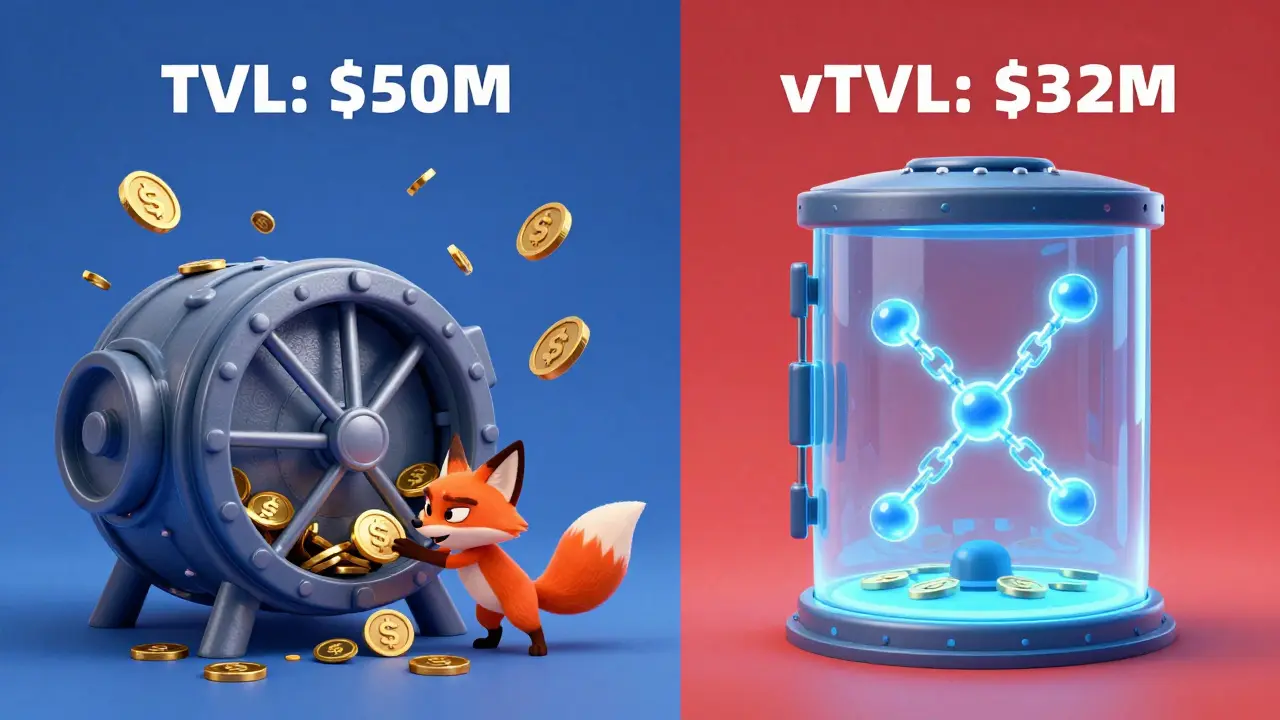
What Is vTVL-and Why It Matters
To fix this mess, researchers introduced verifiable TVL (vTVL). This version only counts assets that can be proven on-chain using standard blockchain queries. No self-reported numbers. No third-party APIs. Just raw, public data. If a protocol’s TVL matches its vTVL, you know it’s transparent. If it doesn’t, something’s off. Maybe they’re inflating numbers. Maybe they’re using fake tokens. Maybe they just don’t track properly. For example, a protocol might report $50 million in TVL. But when you check the blockchain, only $32 million is actually locked. That’s a 36% gap. That’s not a rounding error-that’s a red flag. vTVL isn’t perfect. It doesn’t account for all nuances, like token bridging or multi-chain deposits. But it’s the closest thing we have to a trustworthy baseline.TVL Isn’t a Measure of Success-It’s a Measure of Lock-In
A lot of people think high TVL = good project. Not necessarily. A protocol could have $1 billion in TVL because it’s offering 100% APY. That’s not sustainable. It’s a yield farm designed to attract quick cash, then vanish. TVL drops the moment the rewards stop. Compare that to a protocol like Aave, which has lower TVL but steady growth, real users, and real utility. It doesn’t need to pay insane yields because people trust it. That’s the difference between hype and health. TVL tells you how much money is in the door. It doesn’t tell you if the door stays open. For that, you need to look at:- Trading volume
- User retention
- Revenue generation
- Protocol fees
- Security audits

How Price Volatility Skews TVL
Crypto prices swing wildly. ETH can jump 15% in a day. USDC stays stable. But TVL tools don’t always update in real time. If a protocol holds 10,000 ETH and ETH drops from $3,500 to $3,000 overnight, the TVL falls by $5 million-even though no one withdrew a single token. That’s not a loss. It’s just a price change. But most dashboards treat it like a collapse. This makes TVL misleading during market crashes. A protocol might look like it’s dying because TVL dropped 40%. But if users didn’t leave, and the protocol is still earning fees, it’s fine. The problem is the metric, not the project. That’s why smart analysts look at TVL trends over weeks-not hours. A sudden spike? Probably a whale deposit. A steady climb? That’s real adoption.What You Should Do With TVL
Don’t ignore TVL. But don’t trust it blindly. Here’s how to use it right:- Compare TVL across similar protocols-don’t compare a lending platform to a DEX.
- Check if the TVL matches the vTVL. If not, dig deeper.
- Look at the asset mix. Is 80% of TVL in stablecoins? That’s safer than 80% in a volatile memecoin.
- Watch for sudden spikes. If TVL jumps 200% in 24 hours, check if it’s tied to a new token launch or airdrop.
- Use TVL as a filter, not a decision-maker. Combine it with volume, fees, and user activity.
The Future of TVL
The DeFi space is growing. More institutions are watching. Regulators are starting to ask questions. That means pressure is building to standardize TVL. Some projects are already adopting vTVL. Others are publishing on-chain proofs. Tools like Etherscan and blockchain explorers are making it easier to verify balances yourself. In the next two years, we’ll likely see:- More protocols publishing verifiable TVL reports
- Aggregators dropping unverified data
- Regulators pushing for minimum transparency standards
- TVL becoming one of many metrics-not the only one
Is TVL the same as market cap?
No. Market cap is the total value of all tokens in circulation. TVL is only the value of tokens locked in DeFi protocols. A token can have a high market cap but low TVL if most holders aren’t using it in DeFi.
Can TVL be manipulated?
Yes. Projects can borrow large amounts of tokens temporarily to inflate TVL, then return them after a few hours. This is called “TVL washing.” It’s common in low-liquidity protocols offering high yields.
Why do different sites show different TVL for the same protocol?
Because they use different methods. Some include derivative tokens. Others exclude them. Some use outdated prices. Some rely on self-reported data. Always cross-check multiple sources and look for vTVL.
Does high TVL mean a DeFi project is safe?
Not at all. High TVL can mean high risk. A protocol with $1 billion in TVL might be paying unsustainable yields, making it a target for exploits or rug pulls. Always check audits, team history, and code reviews.
How often should I check TVL?
For active users, check weekly. For long-term investors, monthly is enough. Daily checks are noisy-TVL swings with market volatility, not protocol health. Look for trends over time, not daily spikes.
Mandy McDonald Hodge
December 30, 2025 AT 09:30TVL is just the shiny wrapper on a candy bar that’s actually just sugar and disappointment. I’ve seen protocols with $500M TVL vanish in a week because they were paying 2000% APY with their own tokens. No substance, just smoke.
Bianca Martins
January 1, 2026 AT 01:42Really glad someone broke this down. I used to take TVL at face value until I saw a project’s TVL drop $80M overnight after ETH dipped 12%. Turns out, no one withdrew - the price feed just lagged. Always check the asset mix and the time horizon.
alvin mislang
January 1, 2026 AT 11:09Of course TVL is manipulated. The whole DeFi space is a casino run by guys in hoodies who think ‘smart contracts’ means ‘no consequences.’ If you’re not checking vTVL, you’re just funding rug pulls with your FOMO.
Monty Burn
January 2, 2026 AT 16:49TVL measures trust but not wisdom. People lock money in because they’re scared of missing out or because they’re told it’s safe. But safety isn’t in the number. It’s in the code. And most code is just borrowed from someone else’s mistake.
Kenneth Mclaren
January 3, 2026 AT 08:57Did you know some aggregators use bots to scrape data from defunct contracts? I’ve seen TVL numbers that include tokens from protocols that shut down in 2021. The whole system is a house of cards built on Excel sheets and wishful thinking. The regulators will come. And when they do, we’ll all be holding vaporware.
Raja Oleholeh
January 4, 2026 AT 19:19India has better blockchain transparency than most US DeFi projects. We don’t need fake TVL. We need real audits. And we need to stop pretending that a 10x yield means anything.
Prateek Chitransh
January 5, 2026 AT 02:18Oh wow, so TVL is like a LinkedIn profile with 500 connections but zero actual work done? Interesting. I guess that’s why the top 5 protocols by TVL have 30% of the total users. The rest are just ghosts with wallets.
Michelle Slayden
January 6, 2026 AT 22:09It is imperative to underscore the critical distinction between verifiable TVL and unverified TVL. The former is grounded in immutable on-chain data, whereas the latter is susceptible to systemic manipulation through third-party oracles and derivative token inflation. One must approach all TVL metrics with epistemic caution.
christopher charles
January 8, 2026 AT 19:27Bro, I just checked my portfolio and realized I put $20k into a protocol with $120M TVL… but only $48M vTVL. I felt like an idiot. But hey - at least I learned. Now I check DeFiLlama’s vTVL column before I even click ‘Deposit.’ Save your money. Don’t be the guy who gets rekt because he trusted a pretty graph.
Vernon Hughes
January 10, 2026 AT 19:11TVL is the new GDP. Everyone cites it. No one understands how it’s calculated. And half the countries are fudging the numbers. We need a standard. Not because it’s perfect - but because we need something to argue about.
Alison Hall
January 12, 2026 AT 15:33Good reminder to look beyond the number. I check volume and fees weekly - TVL just tells me if people are still showing up. Not if they’re happy.
Andy Reynolds
January 12, 2026 AT 19:32Think of TVL like a party. Everyone’s showing up because there’s free booze. But nobody’s talking. Nobody’s dancing. Just holding cups. And when the bartender leaves, everyone ghosts. vTVL is the guest list with IDs. If you can’t verify who’s there, you’re just hosting ghosts.
Alex Strachan
January 13, 2026 AT 22:49So TVL is basically DeFi’s version of Instagram followers? Cool. I’ll just ignore it and check the actual trades. Who cares if a protocol has $5B locked if no one’s swapping anything? 🤡
Rick Hengehold
January 15, 2026 AT 21:50Don’t be naive. If your project’s TVL is higher than its revenue, it’s a Ponzi. Period. No amount of ‘vTVL’ buzzwords fixes that. Stop pretending this is finance. It’s a casino with better UI.
Brandon Woodard
January 17, 2026 AT 13:09It’s ironic. We built DeFi to be transparent. Then we created metrics so opaque they make Wall Street look like an open book. The real innovation isn’t in the smart contracts - it’s in the auditing tools we still haven’t built.
Adam Hull
January 18, 2026 AT 09:33Let’s be brutally honest - TVL is a marketing KPI masquerading as a financial metric. The entire DeFi ecosystem has been engineered to optimize for this number because it attracts capital, not because it reflects utility. You see a $2B TVL protocol? That’s not a sign of strength - it’s a sign that someone spent millions on yield farming bots, incentivized liquidity mining, and paid influencers to post screenshots of their wallets. The real question isn’t how much is locked - it’s who locked it, and why. Was it a whale with a 12-hour window? A bot farm? A rug-pull artist preparing to exit? The numbers don’t tell you that. The blockchain might. But most people don’t bother looking. They just trust the dashboard. And that’s how you lose everything. The only reason TVL persists is because it’s easy to understand. But simplicity is the enemy of truth. We’ve turned finance into a TikTok trend. And the algorithm rewards volume over value. The next crash won’t come from a smart contract exploit. It’ll come from the moment everyone realizes the emperor has no clothes - and the TVL chart is just a projection of collective delusion.
christopher charles
January 18, 2026 AT 12:11^^^ this. I read your comment and realized I’ve been doing everything wrong. I used to chase TVL like it was a trophy. Now I check: 1) vTVL ratio, 2) token distribution (is 5 wallets holding 80%?), 3) if the dev team has been active on GitHub in the last 30 days. TVL? Just the opening line. The story’s in the details.