Remember when you had to trust a bank with your money just because it was the only way to move value? In the early days of Bitcoin, many people thought moving to cryptocurrency meant trading one set of middlemen for another. Fast forward to 2026, and the landscape has shifted dramatically. You now have a choice between established custodial gateways like BitPay is a widely recognized crypto payment processor that offers fiat settlement services and handles custody of funds on behalf of merchants, making it a familiar name for businesses looking to bridge traditional banking with digital assets. and a growing wave of self-custody solutions that promise total control over your private keys.
The core question isn't just about which technology is "better." It's about what kind of risk you are willing to take as a business owner. Do you want someone else to handle the regulatory headaches and volatility in exchange for a fee and access to their infrastructure? Or do you want to hold your own keys, accept the responsibility of key management, and eliminate counterparty risk entirely?
Understanding Custody Models in Payment Processing
To make sense of this comparison, we need to strip away the marketing jargon and look at where the money actually sits during a transaction. This concept is known as custody. In the financial world, custody refers to who holds the private keys necessary to move the funds.
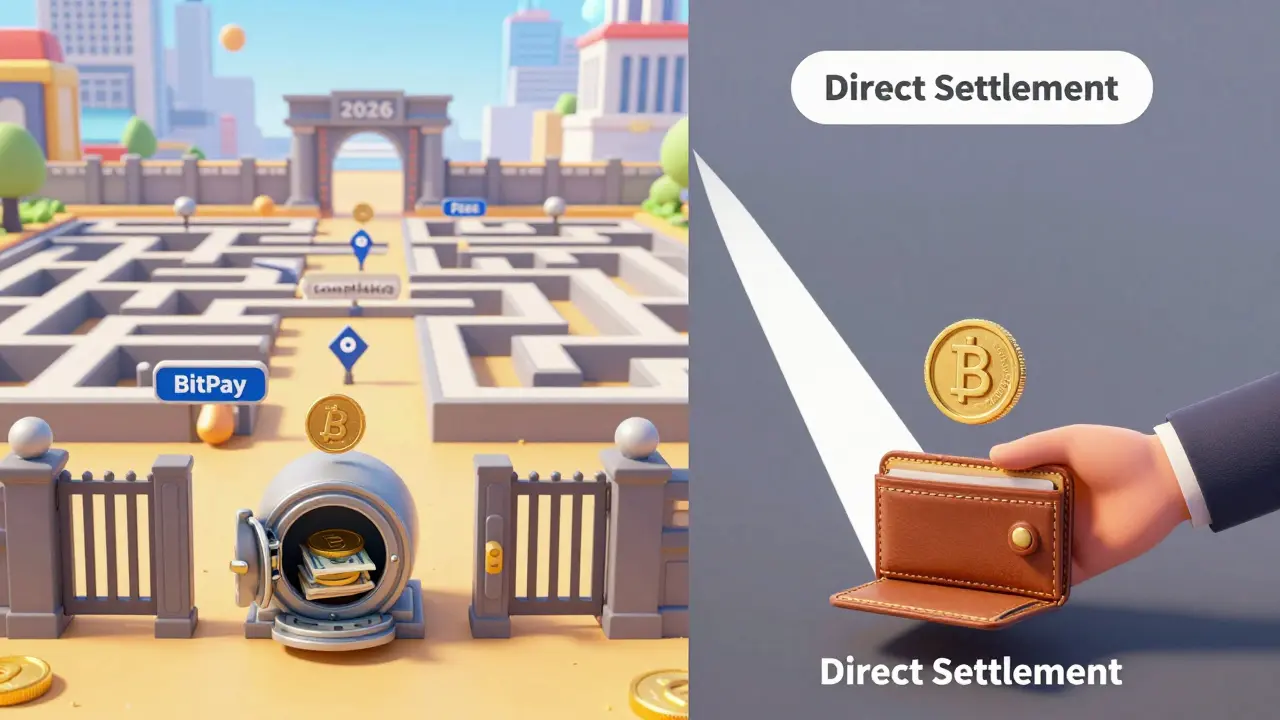
Custodial Model is a system where a third-party service provider holds the private keys and controls the funds until they are settled to the merchant, acting as an intermediary between the customer and the seller. When a customer pays through BitPay, the crypto lands in BitPay's wallet first. BitPay then converts it (if requested) and sends the fiat equivalent to your bank account. During that window, BitPay controls the asset. If BitPay faces a regulatory freeze, a security breach, or simply decides to pause withdrawals, your money is stuck. This is the same risk model that led to high-profile failures at centralized exchanges in previous years.
On the other side of the spectrum, you have Self-Custody Model is an architecture where the merchant retains full control of private keys, and payment processors route transactions directly to addresses derived from those keys without ever holding the funds. With self-custody processors, the software generates an invoice, but the funds go straight to a wallet address you control. The processor never touches the money. There is no platform balance to hack. There is no central ledger to freeze. Your revenue is yours the moment the blockchain confirms the transaction.
BitPay: The Fiat Bridge for Traditional Businesses
Founded by Tony Gallippi and Stephen Pair, BitPay has been around since 2011. They built their reputation by being the friendly face of crypto for mainstream merchants. Their primary value proposition in 2026 remains the same: they absorb the complexity of crypto so you don't have to.
If you run a coffee shop or a small e-commerce store and you hate the idea of Bitcoin's price swinging 5% while you're trying to pay rent, BitPay makes sense. They offer automatic conversion to fiat currency. A customer pays in Bitcoin, Ethereum, or a stablecoin, and BitPay instantly swaps it for USD, EUR, or GBP, depositing it into your bank account. You get the sales volume of crypto users without the headache of managing a treasury of volatile assets.
However, this convenience comes with structural trade-offs:
- KYC Requirements: Because BitPay acts as a Money Service Business (MSB), they must comply with Anti-Money Laundering (AML) laws. You will need to provide identity documents and business registration details. For solo founders or indie hackers who operate under a personal name, this can be a significant barrier to entry.
- Fees: BitPay typically charges around 1% per transaction. While this sounds low compared to credit card processing, it applies to every single sale. Over time, these fees compound, especially if you factor in potential withdrawal fees or delays.
- Counterparty Risk: As mentioned, your funds pass through their hands. You are trusting their security protocols and their relationship with regulators. If they decide your business model is too risky, they can close your account and hold your pending settlements.
BitPay also offers a non-custodial consumer wallet app, which allows individuals to hold their own keys. But for the merchant processing side-the part that matters for your business revenue-their infrastructure is fundamentally custodial.
The Rise of Self-Custody Processors
In 2026, the term "self-custody processor" covers two distinct types of solutions: open-source self-hosted software and modern non-custodial SaaS gateways. Both share the same goal: sending payments directly to your wallet without an intermediary holding the funds.
BTCPay Server is an open-source, self-hosted payment processor that allows merchants to run their own node, generate invoices, and receive payments directly to their wallets without any third-party involvement or fees. Think of BTCPay as building your own bank. You install the software on your own server, connect it to your Bitcoin node, and start accepting payments. There are no transaction fees charged by the software. There is no KYC because there is no company collecting your data. It is the gold standard for sovereignty.
But let's be honest about the reality of running BTCPay. It requires technical expertise. You need to manage a server, keep the software updated, handle backups, and ensure your node stays synchronized with the blockchain. For a developer or a tech-savvy founder, this is empowering. For a regular business owner who just wants to sell products, it can feel like a full-time IT job.
This gap in the market has given rise to non-custodial SaaS gateways like Aurpay and newer entrants such as TxNod. These platforms offer the ease of use of a hosted solution like BitPay-dashboards, APIs, plugins-but they architecturally refuse to touch your private keys. They act as a routing layer. They generate the invoice, watch the blockchain for the payment, and send you a notification. The money goes from the customer's wallet directly to yours.

Comparing the Core Dimensions
| Feature | BitPay | BTCPay Server | Non-Custodial SaaS (e.g., TxNod) |
|---|---|---|---|
| Custody Model | Custodial (Funds held by BitPay) | Non-Custodial (Merchant holds keys) | Non-Custodial (Merchant holds keys) |
| KYC Required | Yes (Strict MSB compliance) | No (Software, not a service) | No (No funds held = no MSB status) |
| Transaction Fees | ~1% per transaction | 0% (Only network miner fees) | Varies (Often flat subscription or lower %) |
| Fiat Settlement | Yes (Automatic conversion) | No (Crypto only) | No (Crypto only, though integrations exist) |
| Technical Complexity | Low (Plug-and-play) | High (Self-hosted infrastructure) | Medium (API/Plugin integration) |
| Counterparty Risk | High (Dependent on BitPay's stability) | None (You control everything) | None (Funds bypass the platform) |
Why Solo Founders Are Choosing Self-Custody
There is a massive shift happening among indie hackers, vibe-coders, and solo founders. These are builders who launch projects quickly, often without registering a formal LLC or dealing with corporate bureaucracy. For them, BitPay's requirement for business documentation and KYC is a dealbreaker. They don't want to prove their identity to a payment processor just to accept a few hundred dollars in crypto tips or subscriptions.
Enter solutions like TxNod is a non-custodial multi-chain payment gateway designed for developers and solo founders, allowing them to connect hardware wallets via extended public keys and accept payments without KYC or company registration. Platforms like this have gained traction because they align with the ethos of the modern web3 builder. You plug in your Ledger or Trezor, derive your public keys, and start generating invoices. No forms. No waiting for approval. No monthly minimums.
The economic argument is also compelling. If you are charging a 1% fee to BitPay on every transaction, that adds up fast. Many non-custodial SaaS providers operate on a flat subscription model (for example, $20/month with zero take-rate on volume). If you process more than $2,000 a month, the math heavily favors the flat-fee, non-custodial model. Plus, you avoid the hidden costs of chargebacks or account freezes, which are structurally impossible in a non-custodial setup because the money never enters the platform's custody.
Risk Management: Key Loss vs. Platform Failure
Choosing self-custody means accepting a different type of risk. With BitPay, if you lose your password, you call support and they reset it. If you lose your private keys in a self-custody setup, the funds are gone forever. There is no customer service hotline to save you.
However, the industry has evolved to mitigate this. Modern self-custody wallets use Multi-Party Computation (MPC) and social recovery features. Furthermore, the insurance market for self-custody is maturing. At the 2026 Bitcoin Conference, experts discussed insurance products specifically for self-custody key loss, with premiums hovering around 0.3% of the insured amount. This is significantly cheaper than the implicit cost of using a custodian, where you are paying for their overhead, compliance team, and profit margin, all while still facing the risk of a catastrophic hack or regulatory seizure.
The consensus among sophisticated operators is clear: the risk of losing your own keys is manageable with proper backup procedures (like Shamir's Secret Sharing or secure hardware storage). The risk of relying on a centralized entity that can freeze your assets, change its terms of service overnight, or suffer a systemic failure is far less acceptable.
Integration and Developer Experience
If you are a developer, the integration experience matters. BitPay offers mature plugins for WooCommerce, Shopify, and Magento. It's easy to set up if you are already using those platforms. But if you are building a custom application, you are tied to their REST API, which is functional but doesn't always prioritize transparency.
Self-custody solutions are increasingly built for developers. BTCPay Server provides a robust API, but again, you are hosting it yourself. Newer non-custodial gateways are focusing on seamless SDKs. For instance, TxNod offers a TypeScript SDK that independently re-verifies payment addresses locally before displaying them to customers. This means you don't have to trust the server's claim about where the money is going; your code checks it against your own extended public key. This level of cryptographic verification is becoming a standard expectation for serious crypto-native applications.
Additionally, the rise of AI coding agents has changed how integrations happen. Developers can now drop a prompt into tools like Cursor or Claude Code, and within minutes, have a fully functioning crypto checkout integrated into their app. Non-custodial gateways that provide clear, LLM-readable documentation and sandbox environments are winning this race. They allow solo founders to ship features faster without getting bogged down in payments infrastructure.
Which Path Should You Take?
Your decision ultimately depends on your business model and your tolerance for responsibility.
Choose BitPay if:
- You absolutely need fiat settlement and cannot handle crypto volatility.
- You are a traditional business with a registered entity and dedicated accounting staff.
- You want the simplest possible integration with major e-commerce platforms and don't mind the 1% fee.
- You prefer outsourcing security and compliance to a regulated third party.
Choose a Self-Custody Processor if:
- You are a solo founder, indie hacker, or privacy-focused organization.
- You want to avoid KYC, business registration requirements, and censorship risks.
- You are comfortable managing your own private keys and understanding basic blockchain concepts.
- You want to minimize fees, especially at higher transaction volumes.
- You believe in the principle of "not your keys, not your coins" and want to eliminate counterparty risk from your revenue stream.
In 2026, the trend is clearly moving toward self-custody. The technology is mature enough that you no longer need to be a cryptographer to use it safely. Whether you choose to self-host with BTCPay Server or use a modern non-custodial gateway like TxNod or Aurpay, the ability to accept payments directly into your own wallet is no longer a niche feature-it's becoming the standard for anyone serious about financial sovereignty in the digital age.
Is BitPay safe for merchants in 2026?
BitPay is a legitimate and regulated company with a long track record. However, "safe" is relative. From a security standpoint, they employ strong measures to protect funds. From a sovereignty standpoint, you face counterparty risk. Because they hold your funds temporarily, you are subject to their compliance policies. If they determine your business violates their terms, they can freeze your account. For many merchants, this is an acceptable trade-off for fiat settlement, but it is a risk inherent to the custodial model.
Do I need a registered company to use self-custody crypto processors?
Generally, no. Since self-custody processors like BTCPay Server or non-custodial gateways like TxNod do not hold your funds, they are not classified as Money Service Businesses (MSBs) in the same way BitPay is. Therefore, they do not require KYC (Know Your Customer) checks or business registration documents. You can operate as a private individual. Always check the specific terms of service of the gateway you choose, but the lack of KYC is a defining feature of this category.
What happens if I lose my private keys with a self-custody processor?
If you lose your private keys and have no backup, your funds are permanently inaccessible. There is no customer support team that can reset your password. This is why self-custody requires diligent key management. Most modern solutions recommend using hardware wallets (like Ledger or Trezor) and creating secure backups (such as seed phrases stored in fireproof safes or using Shamir's Secret Sharing). Some advanced wallets also offer social recovery options where trusted contacts can help restore access.
How do self-custody processors handle transaction fees?
Open-source solutions like BTCPay Server charge 0% in processing fees; you only pay the blockchain network miner fees. Hosted non-custodial gateways may charge a small percentage fee or a flat monthly subscription. For example, some newer platforms operate on a flat $20/month subscription with no take-rate on transaction volume. This model is often cheaper for high-volume merchants compared to the ~1% per-transaction fee charged by custodial providers like BitPay.
Can I accept stablecoins with self-custody processors?
Yes. Most modern self-custody processors support multiple blockchains, including Ethereum, Polygon, BNB Chain, and TRON. This allows you to accept major stablecoins like USDT and USDC. Accepting stablecoins gives you the benefits of self-custody (no counterparty risk, direct wallet settlement) while avoiding the volatility of cryptocurrencies like Bitcoin or Ethereum. The funds land in your wallet as stablecoins, which you can then swap or spend as needed.