The VisionGame (VISION) crypto coin isn’t just another digital token-it’s built around a full Web3 gaming ecosystem. Unlike many cryptocurrencies that exist only as speculative assets, VISION is tied to real products: games, wallets, NFT marketplaces, and blockchain infrastructure designed to change how games are built and played. If you’ve ever wondered how blockchain could actually improve gaming-instead of just adding flashy logos-VisionGame offers one of the clearest attempts yet.
What VisionGame Actually Does
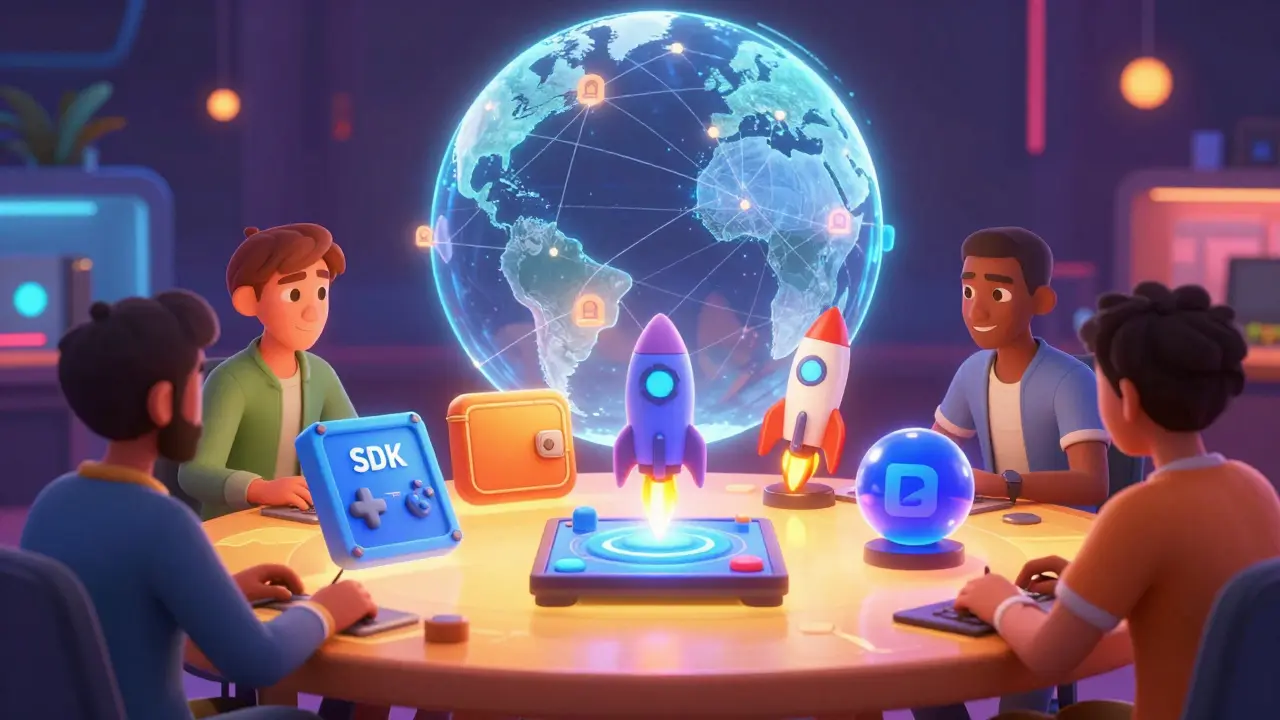
VisionGame isn’t a single game. It’s a platform. Think of it like an app store for blockchain games, but with its own blockchain and tools built from the ground up. The team behind it wants developers to build better games and players to own their in-game items-not just rent them from a company that can delete them tomorrow.
The core idea is simple: what if your sword from one game could be used in another? Or sold for real money outside the game’s server? VisionGame says yes, and it’s building the tech to make that possible.
The Two-Layer Foundation: LayerVision and VisionNexus
VisionGame’s tech stack has two main parts: LayerVision and VisionNexus.
LayerVision is their custom blockchain. It’s EVM-compatible, meaning it works with tools like MetaMask and wallets built for Ethereum. But it’s not just a copy. It’s optimized for gaming. Players don’t pay gas fees. Developers can set their own fees. Transactions are fast and cheap. This matters because most blockchain games fail not because they’re boring, but because players get scared off by $5 fees just to swing a sword.
VisionNexus is the hidden engine. It’s a decentralized physical infrastructure (DePin) system. Instead of relying on expensive cloud servers, VisionGame lets its community share storage and computing power through nodes. Think of it like BitTorrent for game data. Players who run nodes earn rewards. Developers get cheaper hosting. It’s a way to make the whole system self-sustaining without needing venture capital to pay for servers forever.
The Four Core Tools for Developers
VisionGame gives developers four free tools to build on its platform:
- Vision.SDK - A toolkit to plug blockchain features into any game, like NFT minting or token rewards.
- Vision.Wallet - A simple wallet built for gamers, not crypto traders. No complex private keys needed.
- Vision.Offering - A launchpad for new games to raise funds by selling tokens or NFTs directly to players.
- Vision.Community - A governance system where token holders vote on game updates, new features, or how funds are spent.
These aren’t just buzzwords. They’re working products. Developers have already used them to build games like CryptoShowdown and Visionaries. There’s even VisionMove, a fitness app that rewards users for walking or running with VISION tokens.
The VISION Token: Supply, Distribution, and Value
The VISION token is the glue holding the ecosystem together. Here’s what you need to know:
- Total supply: 1 billion VISION tokens (no more will ever be created).
- Circulating supply: About 9.8 million tokens are in hands of traders and players right now.
- Where the rest are: Over 90% of tokens are locked up in vesting schedules for private investors, team members, and future ecosystem growth. They’ll be released slowly over years.
Token distribution looks like this:
- 23.8% went to private and pre-sale investors.
- 2% was sold to the public.
- The rest is reserved for development, partnerships, and community rewards.
When VISION first launched, the price was $0.03. At one point, it hit a peak of $0.60. That’s a 20x gain. But as of March 2026, it’s trading around $0.0006. That’s a steep drop. Why? Mostly because the market hasn’t caught up yet. Most people still don’t know about it. Trading volume is low-under $30,000 per day on KuCoin. Liquidity is thin. That means big price swings on small trades.
Where to Buy VISION and How to Use It
You can only buy VISION on one major exchange: KuCoin. The trading pair is VISION/USDT. The contract address is 0x332e78c687c3fcd91494c6b13f0fc685b2a57434. If you’re using MetaMask or another Web3 wallet, you can add this token manually to track your holdings.
But buying VISION isn’t the main point. The real value comes from using it:
- Buying in-game NFTs on VisionTrade, the built-in NFT marketplace.
- Staking tokens to earn rewards from game fees.
- Using it to vote on game updates through Vision.Community.
- Buying FounderNode access, which unlocks exclusive game content and higher rewards.
Right now, most people who hold VISION are either early backers or speculators. There’s still little real-world usage. That’s the challenge VisionGame faces: turning tokens into tools.
Is VisionGame a Scam? What We Know and What We Don’t
No one’s proven VisionGame is a scam. But it’s also not a sure thing.
Here’s what’s solid:
- The tech stack is real-LayerVision and VisionNexus are documented and functional.
- Games like CryptoShowdown exist and are playable.
- The team has released public funding data, tokenomics, and contract addresses.
- It’s listed on KuCoin, which has strict listing standards.
Here’s what’s missing:
- No third-party security audits for the smart contracts.
- No public info on the team’s background-are they ex-EA, Ubisoft, or crypto veterans?
- No clear roadmap beyond 2025.
- No partnerships with major gaming studios or hardware companies.
- Community engagement is quiet. Reddit, Twitter, and Discord have low activity.
That’s not proof of fraud. But it’s proof of risk. VisionGame is a high-risk, high-reward play. If their games catch on, VISION could surge. If they don’t, the token may keep drifting lower.
Who Is VisionGame For?
This isn’t for casual crypto investors. If you’re looking to flip a coin for quick profit, look elsewhere. The VISION token’s price swings are too wild, and volume too low.
This is for:
- Players who want to own their game items and trade them across titles.
- Developers tired of relying on Apple, Google, or Steam to control their games.
- Early adopters who believe in blockchain gaming and are willing to wait years for it to grow.
If you’re curious, try playing one of their free games. See if the experience feels smoother than other Web3 titles. If it does, then VISION might be worth holding. If it feels clunky or forced? Walk away.
The Big Picture: VisionGame in the Web3 Gaming Wars
VisionGame isn’t the only player in Web3 gaming. Projects like Gala, Immutable, and Axie Infinity have more users and brand recognition. But VisionGame’s approach is different. It doesn’t just slap blockchain onto a game. It rebuilds the entire stack-from the blockchain layer up to the wallet and marketplace.
That’s ambitious. And risky. But if it works, it could be the first truly independent gaming ecosystem. Not owned by a company. Not controlled by a platform. Just a network of players, devs, and nodes working together.
Right now, it’s still early. The token is cheap. The games are small. But the vision is real. Whether it becomes the next big thing-or fades into obscurity-depends on one thing: whether enough gamers actually want to own their swords.
Pradip Solanki
March 24, 2026 AT 03:00Brad Zenner
March 25, 2026 AT 15:07Tony Phillips
March 26, 2026 AT 15:50Abhishek Thakur
March 27, 2026 AT 00:56YANG YUE
March 28, 2026 AT 11:43Alice Clancy
March 29, 2026 AT 09:50Marie Mapilar
March 30, 2026 AT 13:26Shelley Dunbrook
March 31, 2026 AT 02:56Aman Kulshreshtha
March 31, 2026 AT 07:08Neil MacLeod
March 31, 2026 AT 13:22Misty Williams
April 1, 2026 AT 14:14Anand Makawana
April 2, 2026 AT 18:08Mohammed Tahseen Shaikh
April 4, 2026 AT 10:26kavya barikar
April 5, 2026 AT 10:11Andrea Zaszczynski
April 7, 2026 AT 05:43Andy Green
April 7, 2026 AT 08:49Zion Banks
April 8, 2026 AT 17:29John Alde
April 9, 2026 AT 14:17manoj kumar
April 9, 2026 AT 20:39Jenni Moss
April 11, 2026 AT 12:44Andrew Midwood
April 12, 2026 AT 19:43Brijendra Kumar
April 14, 2026 AT 06:56Florence Pardo
April 16, 2026 AT 03:26Tammy Stevens
April 16, 2026 AT 17:35Brad Zenner
April 18, 2026 AT 17:33