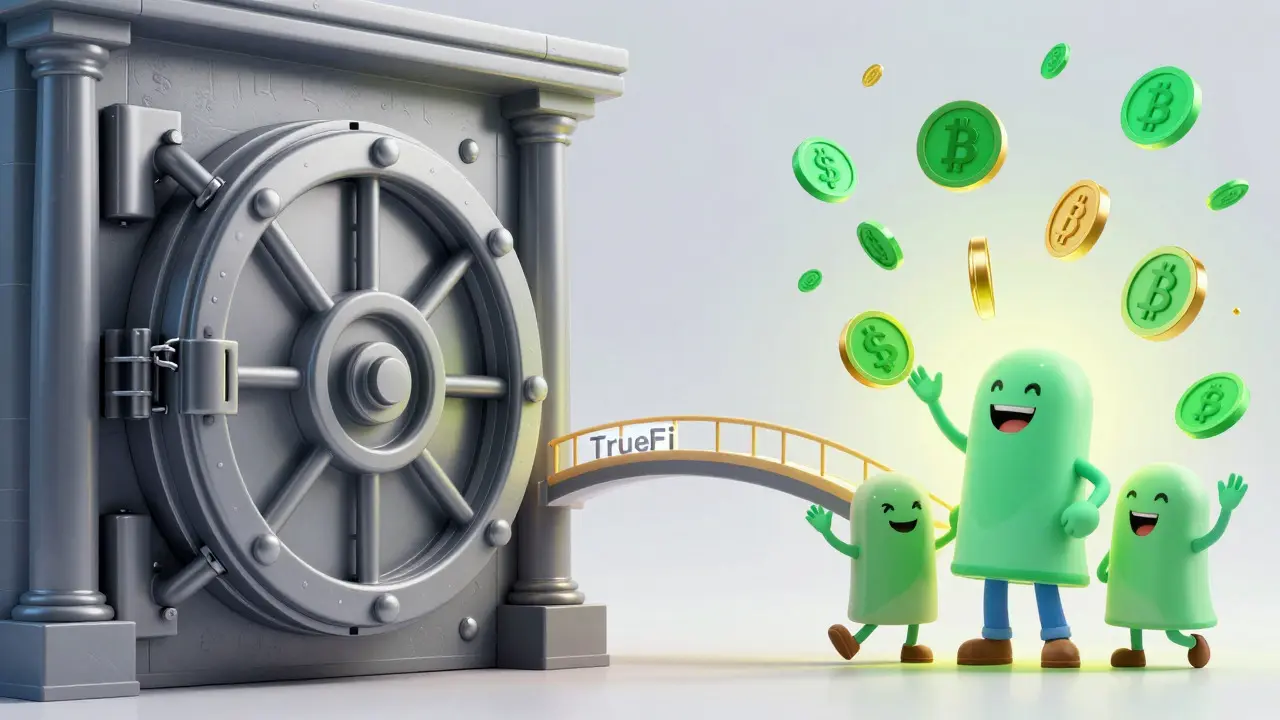
Imagine taking out a loan without having to lock up your Bitcoin or Ethereum as collateral. In the world of traditional banking, this happens all the time based on your credit score and income. But in decentralized finance (DeFi), loans usually require you to deposit more crypto than you borrow-often 150% or more-to cover potential losses. TrueFi is a decentralized finance protocol that provides uncollateralized loans to institutional borrowers using on-chain credit scoring and community governance. It aims to bridge the gap between traditional credit models and blockchain technology. The native token, TRU is the governance and utility token of the TrueFi ecosystem used for voting, staking, and earning rewards, powers this system by allowing investors to vote on who gets funded and earn yield from those loans.
How TrueFi Works: The Mechanics of Uncollateralized Lending
Most DeFi platforms like Aave or Compound rely on overcollateralization. If you want to borrow $1,000 worth of stablecoins, you might need to lock up $1,500 worth of ETH. If the price of ETH drops too much, your collateral gets liquidated. TrueFi flips this model. It offers fixed-term, zero-collateral loans to vetted institutional borrowers. Think of it as a corporate bond market, but built on the blockchain.
Here is how the process flows:
- Borrower Application: An institutional borrower submits a request for funds. They don't lock up assets; instead, they provide financial data and undergo an off-chain assessment by independent portfolio managers.
- Credit Scoring: The protocol uses on-chain credit scores and external data to evaluate the risk. This isn't just a guess; it’s a structured underwriting process similar to what banks use, but transparent and governed by code.
- Governance Voting: This is where TRU holders come in. Investors stake their tokens to vote "Yes" or "No" on specific loan proposals. If the majority votes yes, the loan is approved and funded from the liquidity pool.
- Yield Distribution: When the borrower repays the loan with interest, that yield is distributed back to the lenders and the stakers who backed the decision.
This mechanism shifts the risk from algorithmic liquidation to collective human judgment. You aren't betting on the stability of a smart contract's math alone; you're betting on the creditworthiness of a company, validated by the community.
The Role of the TRU Token
The TRU token is not just a currency for trading; it is the engine of the TrueFi ecosystem. Without active participation from TRU holders, the protocol cannot function because there would be no one to approve loans or set parameters. Here are the primary utilities of holding TRU:
- Governance: Holders vote on critical decisions, including which borrowers receive funding, interest rate caps, and protocol upgrades. Your voting power is proportional to the amount of TRU you stake.
- Staking Rewards: By staking TRU into the protocol’s pools, you help secure the network and participate in credit assessments. In return, you earn a share of the fees generated by the loans.
- Credit Assessment: TRU holders can rate credit for third parties. This helps build a permissionless credit system where reputation and historical performance matter more than locked-up capital.
If you hold TRU, you are essentially acting as a fractional bank manager. You have the power to approve risky ventures or stick to safe bets, directly influencing the health of the platform.
Tokenomics and Supply Details
Understanding the supply dynamics of a token is crucial for evaluating its long-term value. TRU has a maximum supply of 1.45 billion tokens. As of mid-2026, the circulating supply stands at approximately 1.14 billion to 1.33 billion TRU, depending on the data source. This means roughly 78% to 92% of the total possible supply is already in circulation.
Because the vast majority of tokens are already unlocked, there is minimal inflationary pressure from new token emissions compared to projects that release millions of new tokens monthly. However, the high circulating supply also means that for the price to rise significantly, demand needs to increase substantially across the entire market cap.
| Metric | Value |
|---|---|
| Maximum Supply | 1.45 Billion TRU |
| Circulating Supply (Mid-2026) | ~1.14 - 1.33 Billion TRU |
| Blockchains | Ethereum, Optimism |
| Primary Use Case | Uncollateralized Institutional Lending |
| Token Standard | ERC-20 |

Market Performance and Liquidity
As of August 2026, TRU trades in the sub-cent range, typically between $0.0008 and $0.0020 USD. The market capitalization hovers around $2.5 million. While these numbers seem small compared to giants like Ethereum or Solana, they reflect the niche nature of the project. TrueFi is not aiming to be a general-purpose currency; it is a specialized financial instrument.
Liquidity is another factor to consider. On decentralized exchanges like Uniswap V2, the daily trading volume for the TRU/WETH pair is relatively modest, often under $1,000 per day. This indicates that while the token is available for trade, large movements could cause significant slippage. Most trading activity occurs on centralized exchanges such as Binance, Coinbase, and KuCoin, where deeper order books exist.
Historically, TRU reached much higher valuations during the 2021 bull run, with prices exceeding $0.03. The subsequent decline mirrors the broader correction in many DeFi governance tokens. For current investors, this presents a low-entry-point scenario, but it also highlights the speculative risk associated with smaller-cap DeFi protocols.
Risks and Considerations for Investors
Before diving into TrueFi, it is essential to understand the risks. Unlike overcollateralized lending, where your downside is limited to the loss of your principal if the smart contract fails, uncollateralized lending carries credit risk. If a borrower defaults, the money may not be recovered. While TrueFi employs professional underwriters, no system is immune to bad debt.
Additionally, governance risk is real. If the TRU holder community makes poor lending decisions consistently, the protocol’s reputation and financial health will suffer. This requires active engagement from token holders, not just passive holding. If voter turnout is low, a small group could potentially manipulate loan approvals.
Smart contract risk also applies. Although TrueFi is built on Ethereum and has been audited, bugs in the code can lead to exploits. Always verify the contract address (0x4C19596f5aAfF459fA38B0f7eD92F11AE6543784) before interacting with the protocol to avoid phishing scams.
How to Get Started with TrueFi
If you decide to participate in the TrueFi ecosystem, here are the practical steps to get involved:
- Acquire TRU: Buy TRU on a supported centralized exchange like Binance, Coinbase, or Kraken. Alternatively, use a decentralized exchange like Uniswap if you already hold ETH or USDC.
- Set Up a Wallet: Transfer your TRU to a non-custodial wallet like MetaMask or Ledger. Ensure your wallet is connected to the Ethereum network (or Optimism for lower gas fees).
- Verify the Contract: Double-check the ERC-20 contract address to ensure you are sending tokens to the correct destination.
- Stake Your Tokens: Visit the official TrueFi dashboard. Connect your wallet and stake your TRU to begin earning rewards and gaining voting power.
- Participate in Governance: Review loan proposals. Look at the borrower’s credit profile, the proposed interest rate, and the term length. Cast your vote to either approve or reject the loan.
Start small. Treat your initial stake as a learning investment. Understand how the voting interface works and how rewards are calculated before committing significant capital.
Comparison: TrueFi vs. Traditional DeFi Lending
To better understand TrueFi’s position in the market, let’s compare it with traditional DeFi lending protocols.
| Feature | TrueFi (TRU) | Traditional DeFi (e.g., Aave) |
|---|---|---|
| Collateral Requirement | None (Uncollateralized) | Required (Overcollateralized) |
| Borrower Type | Institutional / Vetted Entities | Retail / Any Crypto Holder |
| Approval Mechanism | Governance Voting by TRU Holders | Automated Smart Contracts |
| Risk Profile | Credit Risk (Default) | Price Volatility & Liquidation Risk |
| Yield Source | Interest from Borrowers | Interest from Borrowers + Fees |
This comparison shows that TrueFi appeals to investors looking for exposure to credit markets rather than just yield farming. It offers a different risk-reward dynamic that complements a diversified DeFi portfolio.
Is TrueFi a good investment in 2026?
Whether TrueFi is a good investment depends on your risk tolerance. It is a high-risk, high-reward asset within the DeFi sector. With a small market cap and sub-cent price, it has room for growth if adoption of uncollateralized lending increases. However, it also faces significant competition and credit risk. Conduct your own due diligence and only invest what you can afford to lose.
What happens if a TrueFi borrower defaults?
If a borrower defaults, the protocol relies on off-chain collection efforts by independent portfolio managers. Since there is no collateral to liquidate, recovery is not guaranteed. Losses may be absorbed by the liquidity pool, potentially reducing yields for lenders and stakers. This is why thorough governance voting is critical.
Can I use TrueFi on mobile devices?
Yes, the TrueFi dashboard is web-based and accessible via mobile browsers. You can connect wallets like MetaMask Mobile or Trust Wallet to manage your stakes and votes on the go. Ensure you are using the official URL to avoid phishing sites.
How does TrueFi differ from Centrifuge?
Both protocols bring real-world assets onto the blockchain, but they operate differently. Centrifuge focuses on tokenizing real-world assets like invoices and real estate as collateral. TrueFi focuses on uncollateralized credit lines for institutions, relying on governance voting rather than asset-backed security.
Where can I buy TRU tokens?
TRU is listed on major centralized exchanges including Binance, Coinbase, KuCoin, and Crypto.com. You can also trade it on decentralized exchanges like Uniswap and Sushiswap using the Ethereum network. Always verify the contract address before swapping.
Matt Kay
August 9, 2026 AT 19:38looks like another rug pull waiting to happen tbh
Paul Smith
August 9, 2026 AT 19:59Hey everyone! 👋 This is actually a really interesting concept for those of us who are tired of overcollateralization. It feels like we are finally seeing some real innovation in the DeFi space that mimics traditional banking but keeps it decentralized. 🚀 The idea of community governance deciding who gets funded is pretty cool, don't you think? I've been staking TRU for a bit and the yields are decent compared to just sitting on stablecoins. 💰 Let's keep this thread going with more insights!
Rita Dutta
August 10, 2026 AT 12:40oh my gosh u guys r so naive lol its not about the tech its about the soul of the blockchain u see when u lock up ur assets u r locking up ur potential energy ur chi if u will truefi allows the spirit of commerce to flow freely without the shackles of collateral which is basically digital chains binding ur wealth to the past instead of letting it fly into the future like a majestic eagle soaring above the clouds of mediocrity also the tokenomics r kinda sus but whatever vibes r good i guess
Carl Michaud
August 11, 2026 AT 23:27The entire premise is fundamentally flawed because it relies on human underwriters who are inherently corruptible entities within a system designed to eliminate trust intermediaries. You are essentially reintroducing the very centralization risks that blockchain sought to eradicate by allowing a select few portfolio managers to dictate creditworthiness based on opaque off-chain data. The 'community governance' aspect is a facade; with such low voter turnout, a small syndicate can easily manipulate loan approvals to favor their own affiliated entities, effectively turning the protocol into a private lending club disguised as a public good. Furthermore, the lack of collateral means that default risk is entirely externalized onto the liquidity providers, creating a negative-sum game where the house always wins unless you are part of the inner circle.
Rodmun Tarnowski
August 13, 2026 AT 16:23Indeed! The structure seems quite robust! It is fascinating how TrueFi attempts to bridge the gap between institutional finance and decentralized protocols! One must consider the long-term implications of uncollateralized lending! It certainly offers a unique perspective on credit risk management! The yield distribution mechanism appears equitable! Investors should definitely look into the governance aspects! Participation is key to the ecosystem's health! Do not overlook the importance of active voting! The potential for growth is substantial if managed correctly! Keep an eye on the market trends! Stay informed and stay invested!
Prudence Flemming
August 13, 2026 AT 22:33the whole thing is just a giant experiment in social credit scoring masquerading as financial innovation we are basically building a panopticon where every borrower is watched by a crowd of speculators hoping for a payout its jargon heavy but the core issue is that we are trying to apply web2 logic to web3 infrastructure without understanding the philosophical disconnect between trustless systems and trust-based lending
Candice Cornett
August 14, 2026 AT 11:57everyone here is missing the point completely this isn't about helping businesses its about extracting value from retail investors who dont understand credit risk the moral hazard is immense because the people voting dont have skin in the game beyond their tokens which are highly volatile and likely manipulated by insiders
Lance Jantz
August 15, 2026 AT 21:02Absolutely darling! The sheer audacity of attempting to democratize credit through a tokenized governance model is nothing short of revolutionary! It’s like watching a symphony of financial instruments play out in real-time! I find myself utterly captivated by the intricate dance between risk and reward! Isn’t it thrilling to think that your humble stake could determine the fate of a corporate entity? It’s almost poetic in its chaos! We are standing on the precipice of a new era where the boundaries between lender and borrower blur into a beautiful, terrifying haze! Embrace the uncertainty, my friends! For in uncertainty lies the greatest opportunity!
Dave Kjendal
August 17, 2026 AT 12:15it's all noise at the end of the day most people just want free money and this is just another way to lose it simple as that
Don Fizy
August 17, 2026 AT 21:43Good luck to everyone diving in! :) Just remember to start small and learn the ropes before committing too much capital. The learning curve can be steep but the rewards for being early and educated are significant. Don't hesitate to ask questions if you get stuck with the wallet setup or staking process. We're all here to help each other succeed in this space! :)
Phil Babb
August 18, 2026 AT 11:20LISTEN UP!!! If you aren't paying attention to the governance votes you are leaving money on the table!!! This is not a drill!!! The yields are real and the risk is manageable if you do your homework!!! Stop sleeping on this opportunity and start engaging with the protocol!!! Your future self will thank you!!! Get in there and vote!!! Make your voice heard!!! The power is in your hands!!! DO NOT WAIT!!!
Matthew Smith
August 18, 2026 AT 21:09the ethical implications of outsourcing moral judgment to a token-weighted vote are deeply troubling we are essentially gamifying poverty alleviation or business survival depending on who you ask and reducing complex socioeconomic factors to a binary yes or no click it strips away the nuance of human interaction and replaces it with cold algorithmic efficiency masked as community consensus
Kat Bennett
August 19, 2026 AT 07:29I have been following this project for a while now and it is really fascinating to see how the dynamics play out over time especially when you consider the broader context of the cryptocurrency market which has been so volatile lately and it makes you wonder if this kind of model can truly sustain itself in the long run given the inherent risks involved with uncollateralized lending and the fact that many participants might not fully grasp the complexities of credit assessment which leads to potentially poor decision making by the governance body which could ultimately harm the protocol's reputation and financial stability thereby creating a vicious cycle of decreasing confidence and lower yields for stakeholders who are looking for consistent returns rather than speculative gains