Why does Bitcoin cost thousands of dollars while a newer coin with better technology might be worth pennies? It’s not just about the code. It’s about the people. In the world of cryptocurrency, value doesn’t come from profits or physical assets like it does for traditional companies. It comes from network effects. This is the economic force that makes a digital currency more valuable simply because more people are using it. If you want to understand why some projects survive and others vanish, you need to look past the hype and understand how these connections create real worth.
The Core Concept: Metcalfe’s Law Explained
To grasp why network effects matter, we have to look at an old rule from the telecom era. In the 1980s, Robert Metcalfe, the co-inventor of Ethernet, noticed something interesting about telephone networks. A single phone is useless. Two phones can talk. But as you add more phones, the number of possible connections explodes. This became known as Metcalfe’s Law, which states that the value of a network grows proportionally to the square of the number of users (N²).
In crypto, this principle is even more critical. Unlike a social media app where you might switch platforms easily, cryptocurrencies involve significant financial stakes and technical integration. When you apply Metcalfe’s Law to blockchain, you see that every new user adds value not just for themselves, but for everyone else on the network. They add liquidity, they secure the chain through mining or staking, and they attract developers who build tools that make the network easier to use. It’s a self-reinforcing cycle. The more people join, the more useful the network becomes, which attracts even more people.
However, there’s a catch. Not all networks grow equally. Some follow Reed’s Law, proposed by David P. Reed in 1999, which suggests that group-forming networks scale even faster than simple communication networks. For community-driven crypto projects, this means that if a project successfully builds strong social groups or governance structures, its value could theoretically outpace standard linear growth. But this requires active participation, not just passive holding.
Bitcoin vs. Ethereum: Different Flavors of Network Value
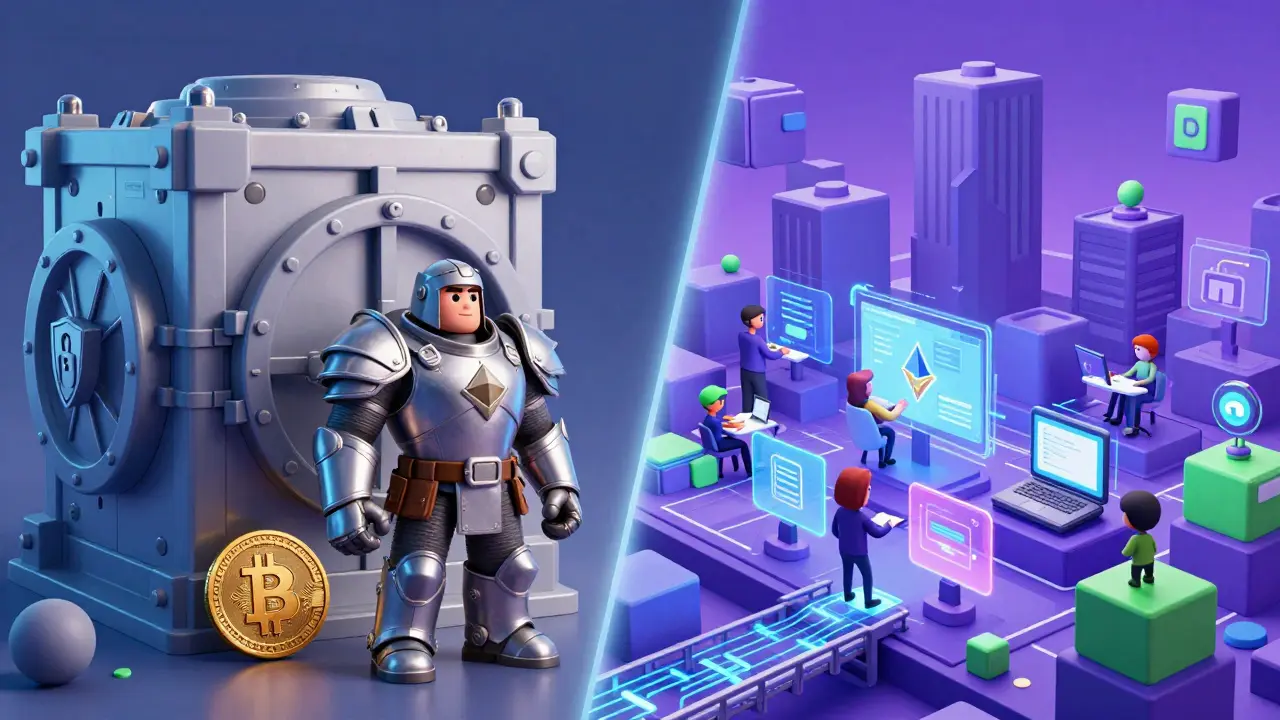
Not all network effects look the same. Bitcoin and Ethereum represent two distinct models of how these effects drive valuation.
| Feature | Bitcoin (BTC) | Ethereum (ETH) |
|---|---|---|
| Primary Value Driver | Store of Value & Payments | d>Developer Ecosystem & dApps|
| User Base Type | Holders, Merchants, Institutions | Developers, DeFi Users, NFT Collectors |
| Key Metric | Hash Rate & Active Addresses | Monthly Active Developers & TVL |
| Moat Source | Security & Brand Recognition | Code Libraries & Application Variety |
Bitcoin’s network effect is built on trust and security. As Lyn Alden noted in her analysis, Bitcoin acts as a "machine for generating market capitalization" through its predictable supply mechanics. Every four years, the block reward halves, creating a supply shock. But the real power comes from the fact that over 15 years, millions of users and institutions have bet their money on Bitcoin’s survival. This creates a massive barrier to entry for competitors. You can fork the code, as happened with Ethereum Classic, but you can’t fork the community. That’s why Ethereum Classic commands only a fraction of Ethereum’s market cap despite starting with identical code.
Ethereum, on the other hand, thrives on a multi-sided network effect. Developers build decentralized applications (dApps) because users are there. Users join because there are useful apps. By Q2 2023, there were over 4,000 active dApps on Ethereum. This ecosystem creates high switching costs. If you’ve invested time learning Solidity coding or building your portfolio in DeFi protocols, moving to a new chain is expensive and risky. This stickiness is what keeps Ethereum dominant, even when gas fees get high.
The Dark Side: When Network Effects Turn Negative
Network effects aren’t always positive. Sometimes, too much success can hurt a project. This is called a negative network effect. Imagine trying to send a transaction on Ethereum during the peak of the 2021 NFT boom. Gas fees spiked by nearly 1,900%, sometimes costing more than the item you were buying. Instead of attracting new users, the congestion drove them away.
This happens when the network’s infrastructure can’t keep up with demand. In traditional tech, Amazon Web Services scales automatically. In blockchain, scaling is harder. If the protocol doesn’t adjust quickly, the user experience degrades. High fees act as a tax on participation, effectively pricing out smaller users and centralizing power among those who can afford the costs. This breaks the virtuous cycle. Instead of more users adding value, more users subtract value by clogging the system.
Another risk is speculative bubbles. During the 2021 DeFi summer, Total Value Locked (TVL) grew by 3,000%. It looked like a massive network effect. But much of it was driven by yield farming incentives, not organic utility. When the rewards dried up, the users left. This teaches us a crucial lesson: distinguish between genuine network growth and incentivized participation. Real network effects persist even when the free money stops.
How to Measure True Network Strength
If you’re evaluating a crypto project, don’t just look at the price. Look at the metrics that prove the network is alive and growing. Here are the key indicators:
- Active Addresses: How many unique wallets are sending transactions daily? Bitcoin averaged 1.1 million daily active addresses in Q3 2023. This shows real usage, not just hoarding.
- Developer Activity: Are people building on the chain? Ethereum maintained over 2,300 monthly active developers in 2023. Developers are the lifeblood of innovation; without them, the network stagnates.
- Transaction Volume: How much value is moving through the system? Ethereum processed $1.2 trillion in quarterly transaction volume in Q2 2023. High volume indicates the network is being used for real economic activity.
- Revenue-to-Valuation Ratio: Does the network generate fees? Protocols that collect fees from users (like Ethereum’s gas fees) have a clearer path to sustainability than those relying solely on token issuance.
These metrics help you cut through the noise. A project might have a great website and a large Twitter following, but if no one is actually transacting or building, the network effect is weak. Always verify on-chain data rather than trusting marketing claims.

Scaling Solutions: Preserving the Moat
To avoid negative network effects, leading projects are evolving. Ethereum’s shift to Proof-of-Stake via The Merge reduced energy consumption by 99.95%, addressing environmental concerns that threatened its long-term adoption. More importantly, the rise of Layer 2 solutions like Arbitrum and Optimism allows the network to handle more transactions at lower costs. By October 2023, Layer 2 networks processed 68% of Ethereum transactions by volume. This isn’t diluting the network effect; it’s extending it. Users still settle on Ethereum, benefiting from its security, while enjoying cheaper speeds on Layer 2. This hybrid approach preserves the core network’s value while solving scalability issues.
Similarly, Bitcoin’s Lightning Network has grown to process $150 million daily by late 2023. This enables micro-payments and instant transfers, expanding Bitcoin’s use cases beyond just store-of-value. These secondary layers enhance the primary network effect by making the main chain more versatile without compromising its foundational security.
Future Outlook: Consolidation and Survival
As the crypto market matures, we’re seeing a "winner-takes-most" dynamic. Galaxy Digital forecasts that the top three blockchain networks will capture 85% of total crypto value by 2030, up from 70% today. This consolidation is a direct result of compounding network effects. Smaller projects struggle to compete because they lack the liquidity, developer talent, and user base to offer comparable utility.
However, risks remain. Regulatory actions can disrupt network effects by limiting access. For example, SEC lawsuits against projects like Ripple created uncertainty that affected exchange listings and institutional participation. Additionally, technological breakthroughs in competing chains could erode established advantages. The key is to watch for projects that adapt. Those that ignore scalability or regulatory realities may find their network effects reversing as users flee to better alternatives.
For investors and builders, the takeaway is clear. Don’t just buy the shiniest new token. Look for the networks with deep roots, active communities, and sustainable economics. The strongest moats are built over years, not days. In crypto, as in life, it’s not just about who you know, but how many people know you-and trust you enough to keep coming back.
What is a network effect in cryptocurrency?
A network effect in cryptocurrency occurs when a blockchain becomes more valuable and useful as more users join and interact with it. This increased value comes from greater liquidity, higher security, and a richer ecosystem of applications, creating a self-reinforcing cycle of growth.
How does Metcalfe's Law apply to crypto valuation?
Metcalfe's Law suggests that the value of a network is proportional to the square of its users (N²). In crypto, this means that doubling the user base doesn't just double the value-it quadruples it. This exponential growth potential is a key driver behind the high valuations of major cryptocurrencies like Bitcoin and Ethereum.
Can network effects be negative?
Yes. Negative network effects happen when increased usage degrades the user experience, such as through high transaction fees or network congestion. For example, during peak NFT trading periods, Ethereum's high gas fees deterred new users, temporarily reducing the network's appeal despite its large user base.
Why is Bitcoin's network effect considered so strong?
Bitcoin's network effect is strong due to its first-mover advantage, immense hash rate security, and widespread brand recognition. Over 15 years, it has accumulated millions of users and institutional trust, creating a deep economic moat that is difficult for newer competitors to replicate, even if they have superior technology.
How do Layer 2 solutions affect network effects?
Layer 2 solutions enhance network effects by solving scalability issues without compromising the security of the main chain. By enabling faster and cheaper transactions, they allow the underlying network (like Ethereum) to support more users and applications, thereby strengthening the overall ecosystem's value.
Sylvia Mossman
June 25, 2026 AT 16:49Metcalfe's Law is total garbage when applied to crypto. It assumes every user connects with every other user, which never happens. Most people just HODL and do nothing.
Erik Kirana
June 27, 2026 AT 00:25The article ignores the fact that Bitcoin is a Ponzi scheme dressed up in economic theory. The 'network effect' is just herd mentality. 📉
Steven Jacobowitz
June 28, 2026 AT 05:53You're missing the point about switching costs. Once you have liquidity and devs on ETH, it's hard to move. BTC has brand, but ETH has utility. That's why the N^2 growth matters more for apps than for store of value.
Karthikeyan S
June 28, 2026 AT 20:22u/2544 is right but let me add something. The real issue is centralization. When VCs control the nodes, the network effect is fake. Just look at the dev wallets. 😡
Dinesh Pattigilli
June 30, 2026 AT 01:07lol u guys are so naive. Network effects only work if the product is actually useful. Most dApps are useless games. The valuation is pure speculation driven by FOMO.
Lee Paige
July 2, 2026 AT 00:16This is all part of the globalist agenda to replace sovereign currency. They want you to believe in 'network effects' so you trust their digital IOUs instead of gold or cash. Wake up sheeple.
Dr Lynea LaVoy
July 2, 2026 AT 10:25I think it's important to look at the data objectively. While sentiment varies, the active developer count on Ethereum remains significantly higher than competitors. This suggests sustained interest beyond mere speculation.
Yogendra Dwivedi
July 3, 2026 AT 20:55Good points on the metrics. I often see people ignore the TVL drop during bear markets as proof of failure, but it's cyclical. The key is whether developers stay when rewards stop. That's the true test of network strength.
Alexis Abster
July 4, 2026 AT 03:02OMG this is such a huge realization! I always thought code was king, but clearly community is queen. The way Ethereum handles gas fees vs Bitcoin's simplicity is wild. We need more education like this!
Caitlin Donahue
July 5, 2026 AT 07:07idk man seems like a lot of jargon. but i guess if everyone uses it then its worth more? sounds like high school popularity contest tbh lol
Brad Ranks
July 6, 2026 AT 04:41Let me tell you what really happened in 2021. The NFT boom wasn't just hype, it was a cultural shift. But yeah, the gas fees were insane. I paid $200 to mint a bored ape. Never again. But the network held up. That's the thing. It didn't break.
Caralee Robertson
July 7, 2026 AT 10:00i agree with the layer 2 part. optimism and arbitrum are making things much cheaper. finally can use eth without crying over fees. great read tho!
Kelly Tenney
July 8, 2026 AT 00:56Love this breakdown! It’s so empowering to understand the mechanics behind the price action. Don’t let the haters get you down. Keep building and keep learning. The future is decentralized! 💪
Abby Sivertsen
July 8, 2026 AT 06:19Whatever.