Remember when swapping tokens felt like paying a toll booth fee on every highway exit? That was the reality for most crypto users just a few years ago. High gas fees, slow confirmations, and being stuck on one blockchain made decentralized trading frustrating. Enter LFJ, formerly known as Trader Joe. It is a non-custodial decentralized exchange built primarily on the Avalanche blockchain that now supports multiple networks. If you have been hearing about this platform but aren't sure if it's worth your time or money, you are not alone. The name change from Trader Joe to LFJ (which stands for 'Let's F***ing Joe') in late 2023 confused many long-time users. But beyond the edgy rebrand, is there actual value here for traders in 2026?
I have spent weeks testing LFJ across different networks, analyzing its fee structure, and comparing it to giants like Uniswap and PancakeSwap. This review cuts through the hype to tell you exactly what works, what doesn't, and who should actually use this platform today.
What Is LFJ and Why Did They Change the Name?
To understand where LFJ is going, you need to know where it started. Originally launched in 2021 exclusively on the Avalanche blockchain, a high-performance smart contract platform known for sub-second finality, the platform began life as Trader Joe. It was designed to solve a specific problem: Ethereum's network congestion. When Ethereum gas fees spiked to $50 or more per transaction, users needed a cheaper alternative. Avalanche offered near-zero costs and lightning-fast speeds.
In late 2023, the anonymous development team decided to rebrand. They dropped 'Trader Joe' for 'LFJ'. While the new name sounds aggressive, the core mission remained the same: provide a unified trading interface. However, they expanded significantly. What was once an Avalanche-only tool is now a multi-chain ecosystem supporting eight distinct networks. This shift marks LFJ's evolution from a niche local solution to a broader cross-chain aggregator.
Supported Networks and Token Availability
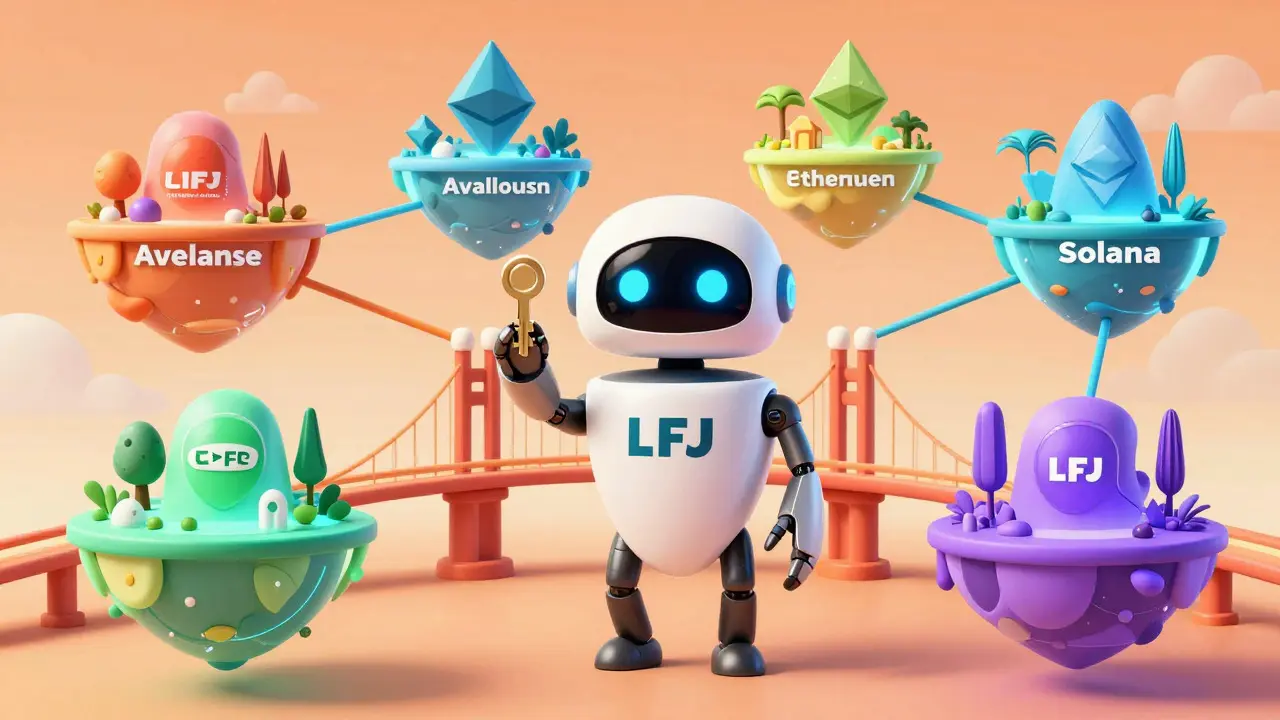
The biggest selling point of LFJ right now is its reach. You are no longer limited to just Avalanche assets. As of late 2025, the platform supports swaps across eight major blockchains:
- Avalanche (The home base)
- Base (Coinbase's Layer 2)
- Arbitrum One
- BNB Smart Chain
- Ethereum
- Berachain
- Sonic
- Solana
This multi-chain approach is crucial. Unlike Uniswap, which is primarily focused on Ethereum and its Layer 2 solutions with over 1,200 trading pairs, or PancakeSwap, which dominates the BNB Chain ecosystem with around 500+ tokens, LFJ acts as a bridge between these worlds. It lists over 1,135 cryptocurrencies. For a trader holding assets on Base who wants to move into a liquidity pool on Avalanche without using a separate bridge service, this saves significant time and reduces the risk of bridging errors.
Fees, Costs, and Hidden Expenses
Let's talk about the money. In DeFi, fees can eat your profits faster than bad trades. LFJ uses a flat fee structure that is transparent and generally competitive.
| Platform | Swap Fee | Limit Order Fee | Avg Gas Cost (Low Congestion) |
|---|---|---|---|
| LFJ (Avalanche/Base) | 0.3% | 0.2% | $0.01 - $0.05 |
| Uniswap (Ethereum L1) | 0.3% | N/A | $2.00 - $15.00+ |
| PancakeSwap (BNB Chain) | 0.25% | N/A | $0.10 - $0.50 |
Here is the breakdown. Swaps cost 0.3%. This is standard for Automated Market Makers (AMMs). However, LFJ offers limit orders for a 0.2% fee. Most DEXs do not offer true limit order books; they rely entirely on instant market execution. Having the ability to set a target price is a massive advantage for traders who want to avoid slippage during volatile markets.
But the real winner here is the gas fee. Because LFJ leverages Avalanche's architecture, transaction finality happens in under one second. The average cost per swap is roughly $0.01. Compare that to Ethereum mainnet, where you might pay $15 for the same action during peak hours. Even on Layer 2s like Arbitrum, while cheap, Avalanche often edges them out in raw speed and consistency. Note that if you swap on Ethereum via LFJ, you will still pay Ethereum gas fees, so always check which network you are connected to.
User Experience and Interface
Does it work well? Honestly, it depends on your experience level. If you are a crypto novice, expect a learning curve. Trustpilot reviews average 3.2 out of 5 stars, with many users citing confusion over navigation. One user, 'DeFiNewbie2023', reported spending three hours trying to complete their first swap due to unclear interface cues.
The interface is dense. It packs a lot of features-swapping, liquidity pools, staking, and analytics-into a single dashboard. For power users, this is efficient. For beginners, it feels cluttered. Connecting your wallet is straightforward; LFJ supports MetaMask, Core Wallet, and Trust Wallet. Once connected, selecting the correct network is critical. I found myself accidentally switching to Solana when I meant to stay on Avalanche twice before getting used to the toggle menu.
Documentation is rated 3.5/5 by the community. The swap tutorials are good, but liquidity pool documentation lacks depth. If you plan to provide liquidity rather than just swap, you will likely need to watch YouTube guides from creators like 'CryptoGuidePro' to understand the mechanics fully.
Pros and Cons: Who Should Use LFJ?
Not every platform is for everyone. Here is a realistic look at the strengths and weaknesses based on my testing and aggregated user feedback.
Why you should use LFJ:
- Multi-Chain Access: You hold assets on Base, Arbitrum, and Avalanche, and you want one place to manage swaps without juggling five different browser tabs.
- Low Fees: You trade frequently and small amounts. The $0.01 gas fee on Avalanche makes micro-trading viable.
- Limit Orders: You prefer setting entry prices rather than accepting immediate market rates.
- Token Discovery: With 1,135+ coins, you find newer altcoins listed here before they hit major centralized exchanges.
Why you should avoid LFJ:
- You Need Fiat On-Ramps: LFJ has no direct way to buy crypto with USD or GBP. You must already own crypto to start.
- You Are in the US or China: Due to regulatory constraints, LFJ explicitly blocks users from these regions. If you try to connect from an IP address in New York, you will be denied access.
- You Want Leverage: There is no margin trading or leverage up to 125x like you see on Binance. This is a spot-only DEX.
- You Hate Complexity: If you want a 'one-click' experience like Coinbase, LFJ's interface will frustrate you.
Security and Reliability
Since LFJ is non-custodial, you control your keys. This means if you lose your seed phrase, your funds are gone forever. The platform itself does not hold your assets. However, smart contract risk remains. Every time you interact with LFJ, you are approving transactions on the underlying blockchain.
The platform has maintained a relatively clean security record since its 2021 launch. The anonymous dev team has consistently audited their code, particularly after expanding to new chains like Solana and Berachain. Still, users report occasional failed transactions during network congestion spikes, particularly on the Ethereum layer. Always double-check transaction details before signing. Slippage tolerance settings can also cause issues if set too low during high volatility.
Future Outlook and Roadmap
Is LFJ staying relevant? The roadmap suggests yes. In September 2025, the team announced integration with Monad, a high-performance EVM-compatible blockchain gaining traction in 2026. Enhanced analytics tools are also scheduled for Q1 2026. Industry analysts predict multi-chain DEXs will capture 35% of the market by 2027. LFJ is positioning itself squarely in this growth sector.
However, risks remain. The platform relies heavily on the JOE token for fee distribution (16.66% of swap fees go to stakers). During the May 2024 market correction, JOE dropped 62% in 72 hours. This volatility can impact the sustainability of rewards for liquidity providers. Regulatory headwinds in key markets also pose a threat to expansion.
Is LFJ safe for beginners?
It is secure because it is non-custodial, meaning you hold your own keys. However, the interface is complex. Beginners should start with small amounts and watch tutorial videos before committing significant capital. The learning curve is steep compared to centralized exchanges.
Can I buy crypto with dollars on LFJ?
No. LFJ does not support fiat currency on-ramps. You must transfer cryptocurrency from another exchange or wallet to LFJ before you can swap or trade.
Why did Trader Joe change its name to LFJ?
The rebrand occurred in late 2023 to reflect the platform's expansion beyond a single brand identity into a multi-chain ecosystem. The new name, LFJ, stands for 'Let's F***ing Joe,' signaling a more aggressive and modern approach to DeFi.
Which blockchains does LFJ support?
As of 2026, LFJ supports Avalanche, Base, Arbitrum One, BNB Smart Chain, Ethereum, Berachain, Sonic, and Solana. This allows for cross-chain swapping within a single interface.
Are there any countries banned from using LFJ?
Yes. Users from the United States and China are currently excluded from using LFJ due to regulatory compliance requirements. Attempting to access the site from these regions may result in blocked connections.
How much does it cost to swap on LFJ?
Swaps incur a 0.3% fee. Limit orders cost 0.2%. Additionally, you pay network gas fees, which average $0.01 on Avalanche but vary depending on the selected blockchain.