NFT Minting Cost Calculator
Calculate Your NFT Minting Costs
See upfront costs for minting your NFT art on Ethereum, Solana, or Base in 2025.
Creating and selling NFT art isn’t about getting rich overnight. It’s about building something real-something that belongs to you, verified on the blockchain, and seen by people who actually value it. In 2025, the NFT market has settled down after the wild boom of 2021 and 2022. Sales aren’t hitting millions anymore, but they’re steady. The average NFT art sale now sits at $142.50, with most transactions happening between $25 and $250. This isn’t a lottery. It’s a business. And if you treat it like one, you can make it work.
What Exactly Is an NFT?
An NFT, or Non-Fungible Token, is a digital certificate of ownership. It doesn’t store your image or video-it points to it. Think of it like a deed to a house. The house is still out there, but the deed proves you own it. NFTs use blockchain technology-mostly Ethereum, Solana, or Base-to lock in who created the piece, who owns it, and what royalties the artist gets every time it’s resold.
The standard for most NFT art is ERC-721, created in 2018. Before that, projects like CryptoPunks (launched in 2017) proved that digital items could have scarcity and value. Today, over 48% of all NFT transactions run on Ethereum, followed by Solana at 29.7%. You don’t need to understand every detail, but you do need to know: if you mint an NFT, you’re attaching a verifiable history to your art.
Step 1: Set Up a Web3 Wallet
You can’t sell NFTs without a wallet. It’s your digital pocket for crypto and NFTs. The most popular choice is MetaMask, used by 82% of creators as of August 2025. It works on desktop and mobile, connects to almost every marketplace, and supports Ethereum, Base, and Polygon.
Here’s how to set it up:
- Download MetaMask from metamask.io (never from a Google ad-only the official site).
- Create a password and back up your 12-word recovery phrase. Write it on paper. Keep it in a safe place. If you lose it, you lose everything.
- Enable network settings for Ethereum, Base, and Polygon. Most marketplaces now support multiple chains.
Alternative wallets include Coinbase Wallet (easier for beginners) and Phantom (for Solana users). Avoid social login wallets like Rainbow unless you’re already familiar with crypto-recovery is trickier.
Step 2: Fund Your Wallet
You need crypto to pay for gas fees-small charges to record your NFT on the blockchain. You can’t use credit cards or PayPal. You need ETH, SOL, or MATIC.
Here’s what you’ll need based on the blockchain:
- Ethereum: $25-$125 (0.01-0.05 ETH). Minting one NFT costs $1.25-$3.75 during normal hours. But during peak times, it can spike to $40+.
- Solana: $0.50-$2 (0.01-0.04 SOL). Gas fees are tiny-around $0.00025 per transaction.
- Base: $1-$5 (0.1-0.5 ETH). Base is Ethereum’s cheaper sibling, built by Coinbase. OpenSea now runs mostly here, cutting fees by 87% compared to main Ethereum.
Buy crypto on Coinbase, Kraken, or Binance. Transfer it to your wallet. Don’t send crypto directly from an exchange to an NFT platform-always go through your wallet first.
Step 3: Prepare Your Artwork
Your art needs to be in the right format. Most platforms accept:
- Images: JPEG, PNG, SVG, WEBP
- Animations: GIF, MP4
- 3D: GLB
File size limits vary:
- OpenSea: up to 100MB
- Magic Eden: up to 35MB
- Foundation: up to 200MB
Don’t just upload a low-res JPEG. High-quality visuals matter. Use tools like Procreate (iPad), Adobe Photoshop, or Canva. Add metadata: title, description, and tags. This helps people find your art. If you’re making a collection, give it a name and theme. A collection of 10 pieces with a story (e.g., “Urban Ghosts: Abandoned London in 2040”) performs better than 10 random drawings.
Step 4: Choose Your Marketplace
Not all marketplaces are equal. Here’s what’s working in 2025:
| Platform | Blockchain | Fee | Approval Needed? | Best For |
|---|---|---|---|---|
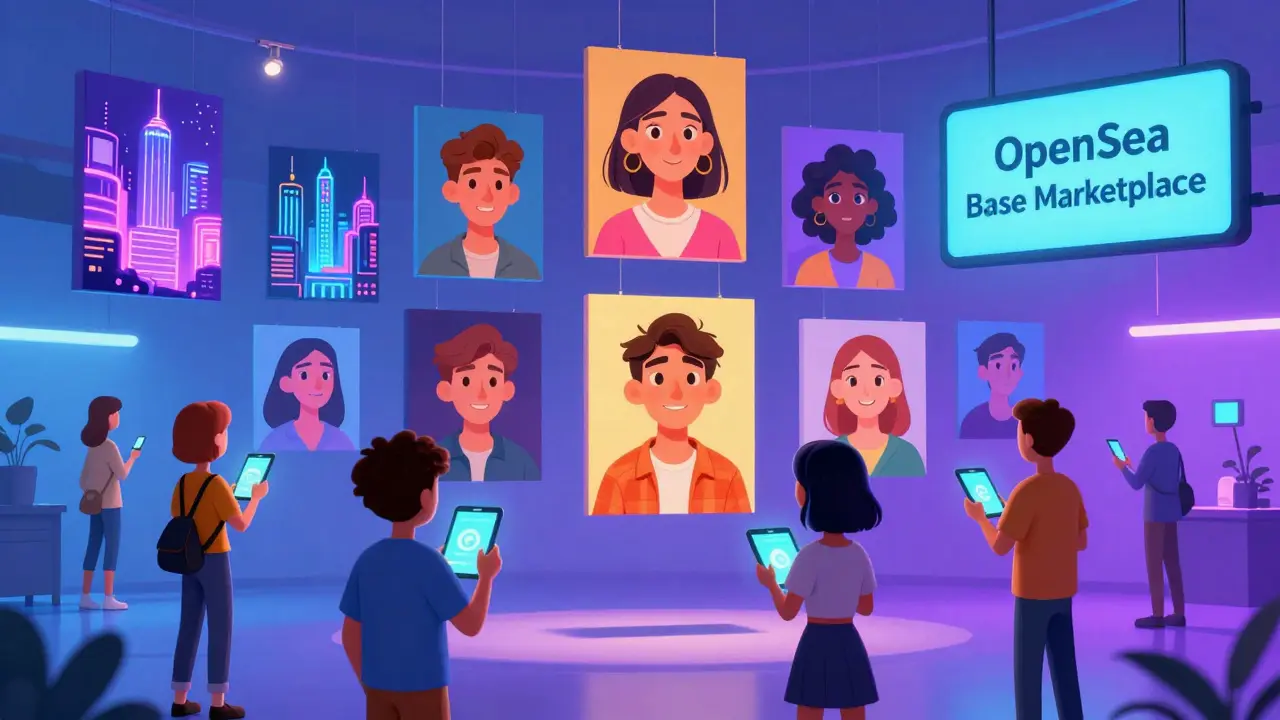
| OpenSea | Base (primary) | 2.5% | Yes (24-72 hours) | Beginners, cross-chain exposure |
| Magic Eden | Solana | 1.5% | No | Fast listing, mobile users |
| Blur | Ethereum | 0% | No | Professional collectors, analytics |
| Foundation | Ethereum | 15% | Yes (only 14.3% accepted) | High-end, curated artists |
| Tensor | Solana | 0% | No | Established Solana artists |
For beginners: Start with OpenSea on Base. It’s the biggest audience, lowest fees, and easiest to use. Magic Eden is great if you’re comfortable with Solana and want instant listing. Foundation is for artists who already have a following-getting in is hard.
Step 5: Mint and List Your NFT
Minting means turning your file into a blockchain asset. Here’s how:
- Connect your wallet to the marketplace.
- Click “Create” or “Mint.”
- Upload your file.
- Fill in the title, description, and properties (e.g., “Edition #3 of 10”).
- Set your royalty: 2.5%-10%. Most platforms now enforce a minimum of 2.5%. Magic Eden lets you go up to 10%. Don’t set it too high-buyers hate it.
- Choose how to sell: fixed price, timed auction, or Dutch auction.
- Confirm the transaction in your wallet. Pay the gas fee.
Pro tip: Mint during off-peak hours. On Ethereum, that’s 2-5 AM UTC. On Base, fees are low all day. Use Etherscan’s Gas Tracker to check real-time costs.
Step 6: Promote Like a Pro
This is where 79% of artists fail. You can make amazing art, but if no one sees it, it won’t sell.
Successful creators do three things:
- Post daily on Twitter/X and Instagram. Show your process-not just the final piece. Time-lapses, sketches, failures. People connect with the journey.
- Join Discord servers for your chosen platform. Engage. Don’t just drop your link. Answer questions. Give feedback.
- Use at least four platforms: Twitter, Instagram, Reddit (r/NFT), and a personal website or Linktree.
Reddit users report that NFTs with behind-the-scenes content get 3x more engagement. One artist, u/CyberGothic, posted daily progress on her “Neon Dreams” series. She sold all 10 pieces in 48 hours. Her secret? Consistency and honesty.
What You’ll Really Pay
Let’s say you want to mint 5 NFTs on OpenSea using Base:
- Gas fees: $1.50 per NFT × 5 = $7.50
- Platform fee: 2.5% of $142.50 average sale = $3.56 per NFT (but you only pay this if it sells)
- Wallet setup: free
- Crypto purchase: $50-$100 to cover gas and future listings
Total upfront cost: $57.50-$107.50. That’s it. No monthly fees. No subscriptions. You only pay when you act.
Compare that to traditional art: gallery commissions of 40-60%, printing costs, shipping, insurance. NFTs remove most of that.
Common Mistakes (And How to Avoid Them)
- High gas fees: Mint during off-peak hours. Use Base or Solana instead of Ethereum.
- No description: Write a story. Why did you make this? What does it mean?
- One-off drops: Don’t release one NFT and disappear. Create collections. Release weekly. Build momentum.
- Ignoring royalties: Set them at 5%. That’s fair. It means you earn every time your art changes hands.
- Buying your own NFT: Don’t. It looks fake. Marketplaces track this.
Is This Worth It?
In 2022, people bought NFTs hoping to flip them for 10x. That’s over. Now, artists succeed by building a loyal audience and treating their work like a craft.
According to a November 2025 Nansen.ai study, artists who post at least one NFT per week, spend 30 minutes daily engaging with their community, and use four or more platforms earn 6.3x more over 18 months than those who don’t.
And it’s growing. Christie’s sold $185 million in NFT art in 2025. Major galleries now have digital departments. The EU’s MiCA regulations (effective June 2025) are making the space safer. Artists with formal training now make up 57% of active creators-up from 32% in 2022.
This isn’t a trend. It’s a shift. Digital art has a permanent home now. And if you’re willing to show up, learn, and create consistently-you have a real shot.
What’s Next?
Dynamic NFTs are the next frontier. These are NFTs that change based on real-world data-like weather, time, or owner actions. In Q3 2025, 28% of new collections used this feature. Imagine a landscape NFT that changes with the seasons, or a portrait that evolves as the owner grows their collection.
Platforms like OpenSea Pro now use AI to suggest prices based on 2.1 million past sales. Magic Eden partnered with Artsy to let traditional galleries sell NFTs alongside physical paintings.
The future isn’t about speculation. It’s about integration. NFTs are becoming part of how artists earn, connect, and grow.
Can I make money selling NFT art in 2025?
Yes-but not by luck. Most sales are between $25 and $250. Success comes from consistent output, community engagement, and smart promotion. Artists who release one piece weekly and interact daily earn 6.3x more than those who don’t.
What’s the cheapest way to mint NFT art?
Use Solana or Base. Solana gas fees are $0.00025 per transaction. Base (used by OpenSea) averages $1.25-$3.75 per mint, down 87% from Ethereum mainnet. Avoid Ethereum during peak hours-it can cost $40+ in fees.
Do I need to be a professional artist to sell NFT art?
No. Many successful NFT artists started with basic tools like Canva or Procreate. What matters is originality, consistency, and storytelling. In 2025, 57% of NFT artists have formal art training-but 43% don’t. Your voice matters more than your credentials.
How do I avoid getting scammed?
Never share your wallet’s seed phrase. Only connect your wallet to official marketplaces. Beware of fake links on Twitter or Discord. Always check the official website URL. Use OpenSea or Magic Eden-they have buyer protection. And never buy your own NFTs to inflate prices.
What happens if my NFT doesn’t sell?
It stays in your wallet. You can relist it later, lower the price, or use it in a collection. Many artists hold unsold pieces and bundle them into future drops. The key is not to get discouraged. The market rewards persistence, not perfection.
Are NFTs bad for the environment?
Ethereum switched to proof-of-stake in 2022, cutting its energy use by 99.95%. Solana and Base are even more efficient. Today’s NFTs use less energy than streaming a video for an hour. The environmental impact is minimal compared to traditional art shipping and gallery lighting.
Sean Kerr
December 15, 2025 AT 18:31bro just minted my first NFT on Base today and it only cost me $1.87 😭 i used a canva template and called it "cat in a cyberpunk hoodie"... already got 3 bids at $35... i think i might be a genius?? 🤯💸
Jonny Cena
December 16, 2025 AT 07:15That’s actually really encouraging to hear. I’ve been scared to even try because I thought I needed to be a "real artist" to make it work. But seeing someone start with Canva and still get traction? That’s the whole point - it’s about showing up, not being perfect. Keep going, you’re doing great.
Tom Joyner
December 16, 2025 AT 15:57Canva? Really? You’re calling that art? I mean, I’m not surprised - the market’s flooded with low-effort JPEGs from people who think NFTs are just crypto bingo. The real artists are on Foundation, with hand-painted generative pieces that take months to refine. Your "cyberpunk cat" won’t even register on the blockchain’s radar in six months.
Amy Copeland
December 18, 2025 AT 06:07Oh sweet baby Tesla, another one who thinks NFTs are a free art gallery for toddlers. 🙄 At least have the decency to learn how to use Procreate before you spam the chain with your toddler’s crayon drawings. I’ve seen better work on a kindergarten iPad.
Timothy Slazyk
December 18, 2025 AT 16:01There’s a deeper truth here, and it’s not about tools or platforms - it’s about intention. The cat in the hoodie? It’s a symbol. A tiny rebellion against the idea that art must be elite to matter. The blockchain doesn’t care if it was made in Canva - it cares if it was made with honesty. And that’s why it sold. Not because it’s technically perfect, but because someone saw themselves in it. That’s the real revolution.
Cheyenne Cotter
December 19, 2025 AT 07:07Okay but let’s be real - if you’re using Canva, you’re not even in the game. I’ve been tracking NFT sales since 2021 and the only people who make consistent money are those who use Adobe Suite, have a portfolio of 50+ pieces, and know exactly how to write metadata that triggers algorithmic discovery on OpenSea. You can’t just slap a PNG on the chain and hope for the best - the market’s too smart now. The average sale is $142.50 because the bots are filtering out low-effort junk. Your cat is probably already buried under 12,000 other JPEGs.
Heather Turnbow
December 19, 2025 AT 22:19It’s important to acknowledge the emotional labor behind creative expression, regardless of the medium. The fact that someone felt compelled to create, share, and risk vulnerability in a space often dominated by speculation is itself an act of courage. The technology is merely a vessel - the value lies in the human intention behind it.
Jesse Messiah
December 21, 2025 AT 11:01yo sean you’re a legend. i just started too and i’m using procreate on my ipad mini - no idea what i’m doing but i posted a drawing of my dog wearing a space helmet and someone bought it for 0.1 eth 😭 i cried. thank you for making this feel possible. we’re all just learning together 💪🎨
Terrance Alan
December 23, 2025 AT 07:43Everyone’s acting like this is some kind of revolution when it’s just digital graffiti with a price tag. You think the blockchain gives your cat drawing meaning? Nah. It just makes it easier for rich guys to show off. The real artists are still in galleries. This whole thing is a distraction. You’re not building anything - you’re just buying digital status symbols. And don’t even get me started on the gas fees.
Sally Valdez
December 24, 2025 AT 00:03USA is the only country that thinks this is art. In Europe they laugh at this. We have real galleries, real museums, real history. You’re just slapping a QR code on a doodle and calling it culture. And you wonder why the world thinks Americans are delusional? This isn’t innovation - it’s capitalism with a blockchain tattoo.
Sammy Tam
December 25, 2025 AT 23:31Bro I just sold a 3D animated jellyfish that pulses to your heartbeat (yes, it’s synced to your wallet’s activity) for 1.2 ETH. Made it in Blender, coded the interaction in Python, and posted a 30-second timelapse on TikTok. The whole thing took 11 hours. The point isn’t the tool - it’s the *weirdness*. The market’s hungry for things that feel alive. Your cat’s cool. Mine’s got a soul. 🐠✨
George Cheetham
December 27, 2025 AT 22:00I’ve been an artist for 30 years. I’ve painted murals, taught kids, sold prints in markets. When I first heard of NFTs, I thought it was nonsense. But last month, I minted a series of my London street sketches on Base - 12 pieces, $50 each. Sold out in 72 hours. Not because I’m famous - because I told the story of each alley, each face. The blockchain didn’t make me an artist. It just gave my work a home.
Dionne Wilkinson
December 29, 2025 AT 03:56I think the most beautiful part is how quiet this movement is. No hype machines. No influencers screaming "TO THE MOON!" Just people sharing their work, one honest piece at a time. I don’t know if I’ll ever sell anything, but I’ve started posting a sketch every morning. It’s become my meditation. Maybe that’s the real win.
Mark Cook
December 29, 2025 AT 18:43lol i minted a picture of my cat and my dog holding hands and called it "relationship goals"... someone bought it for $200... i think the blockchain is broken?? 🤔😂
Jack Daniels
December 30, 2025 AT 12:15Why are you all so excited? You know the market’s rigged, right? The top 1% of wallets control 89% of the volume. You’re just feeding the machine. One day you’ll wake up and your NFT will be worth $0.03 and you’ll realize you spent $50 on gas for nothing. You’re not an artist - you’re a data point.
Bradley Cassidy
January 1, 2026 AT 02:40just wanted to say i made a collection called "lost texts from my grandma’s letters" - scanned her handwritten notes and turned them into glitch art. sold 4 outta 8 and the money went to a local literacy program. i didn’t expect anyone to care... but someone from germany bought one and wrote me a 3-page message about his mom. that’s why i keep doing this.
Samantha West
January 2, 2026 AT 09:11It is essential to recognize the structural inequities embedded within the NFT ecosystem. Access to capital, technical literacy, and digital infrastructure are not evenly distributed. To suggest that anyone can succeed with Canva is to ignore the systemic barriers faced by marginalized creators. The romanticization of "just showing up" is a dangerous neoliberal myth.
Donna Goines
January 2, 2026 AT 10:58Did you know that the government is using NFTs to track artists? The MiCA regulations? They’re not for protection - they’re for surveillance. Every time you mint, your IP address, wallet, and location get logged. They’re building a digital art registry so they can control what’s "valuable" and who gets to create it. This isn’t freedom - it’s digital feudalism. You’re being watched. You’re being monetized. Wake up.
Greg Knapp
January 4, 2026 AT 00:27you think you’re an artist but you’re just a data point for the algorithm. your cat drawing? it’s being used to train AI models. every time you mint, you’re feeding the machine that will replace you. you’re not selling art - you’re giving away your soul for 20 bucks
Shruti Sinha
January 4, 2026 AT 07:38As someone from India, I’ve seen artists here use WhatsApp to sell paintings for ₹500. Now, they’re using NFTs to reach global buyers for $100. It’s not about perfection. It’s about access. The blockchain doesn’t care where you’re from. It only cares if your work is real. That’s power.
Rebecca Kotnik
January 4, 2026 AT 23:18It is imperative to consider the psychological implications of commodifying creative expression through blockchain-based verification. The act of minting an NFT introduces a quantifiable metric of self-worth, which may lead to increased anxiety, identity fragmentation, and performance pressure among creators. While the technical framework is innovative, the human cost of algorithmic validation must not be overlooked.
Elvis Lam
January 6, 2026 AT 03:35Let me cut through the noise - if you’re spending more than $10 on gas to mint a single piece, you’re doing it wrong. Use Base. Use Solana. Use Magic Eden. Don’t waste time on Ethereum unless you’re selling for $5k+. And stop overthinking metadata. Write like you’re talking to a friend. People buy stories, not specs. And if you’re not posting daily? You’re not serious. The market rewards consistency, not genius.
Emma Sherwood
January 6, 2026 AT 04:04I’m a Black woman who grew up painting on cardboard because we couldn’t afford canvas. Now I sell NFTs of my ancestors’ quilts reimagined as digital tapestries. I don’t need a gallery. I don’t need permission. My art lives on the blockchain - and it’s mine. Forever. This isn’t a trend. It’s liberation.
Jonny Cena
January 8, 2026 AT 01:49Emma, your story just gave me chills. I’ve been hesitating to share my work because I felt like I didn’t belong. But you just proved that the blockchain doesn’t care about your background - it only cares about your truth. Thank you for saying that.