Quick Summary
- The 2021 ban shut down formal exchanges but left a legal gray area where owning crypto remains technically permissible.
- P2P trading has persisted through decentralized platforms like Paxful and Bisq, often accessed via VPNs to bypass the Great Firewall.
- Traders face high risks, including bank account freezes (reported in nearly 39% of transactions) and sophisticated scams like 'flash freezing.'
- Stablecoins, particularly USDT, dominate the market due to lower volatility compared to Bitcoin.
- Despite enforcement efforts, P2P volume rebounded, with Chinese users accounting for roughly 4-7% of global transaction activity post-ban.
The Legal Gray Area: Ownership vs. Transaction
When the People's Bank of China (PBOC) slammed the door on cryptocurrency in September 2021, it didn't just close the shops; it tried to erase the concept from the financial landscape. The official stance was clear: all crypto transactions and mining were prohibited to curb financial crime and prevent economic instability. Yet, if you think the ban wiped out crypto in China, you're missing the nuance that keeps the underground market alive.
Here is the catch that traders rely on: Chinese court rulings from Shenzhen, Hangzhou, and Shanghai established back in 2018 that citizens still have the legal right to own cryptocurrencies as virtual property. This distinction creates a fragile but functional loophole. You can hold the asset, but you cannot easily buy or sell it through regulated channels. This gap between ownership rights and transaction prohibitions forms the bedrock of today's peer-to-peer (P2P) ecosystem. Centralized exchanges were forced to shut down or leave, but decentralized peer-to-peer transactions proved far harder to eliminate entirely.
According to Chainalysis data, more than $50 billion worth of cryptocurrency left East Asian accounts for regions outside the area between 2019 and 2020. This massive capital flight suggests that the demand wasn't just speculative-it was structural. People needed a way to move value across borders when traditional banking channels felt too restrictive or monitored. The ban didn't kill the demand; it just pushed it into the shadows.
How the Underground Market Operates
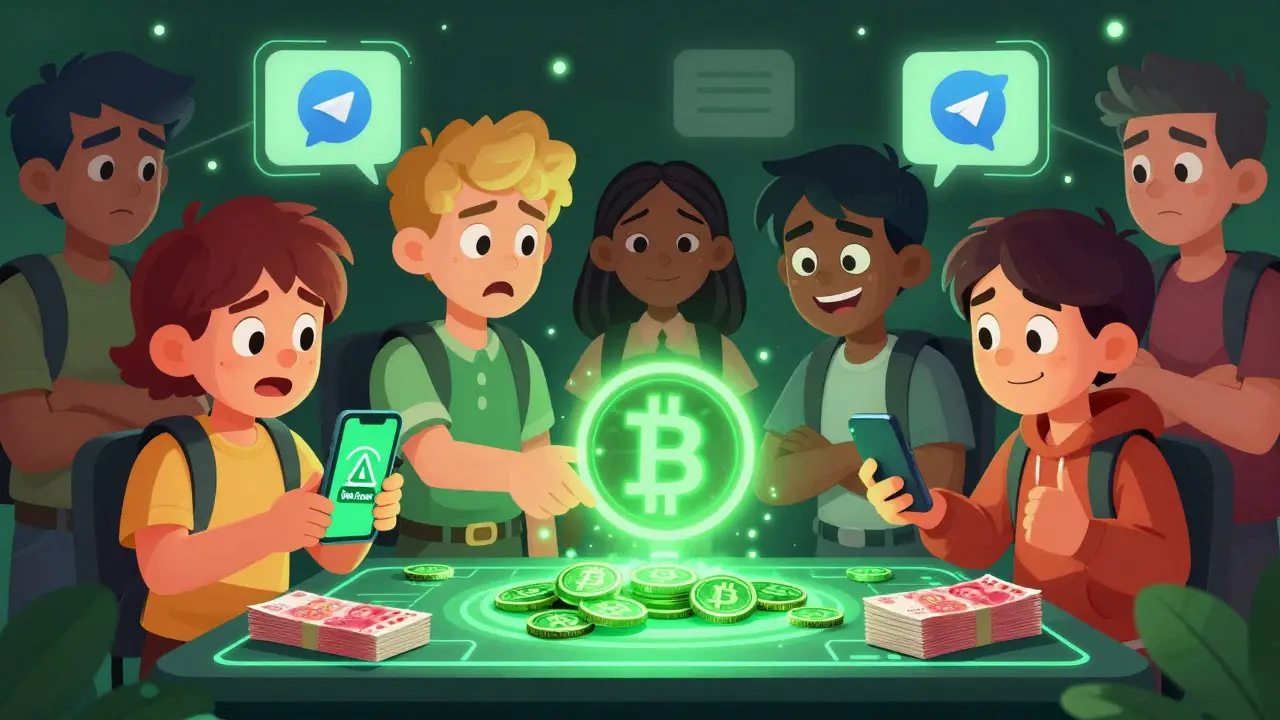
If you want to trade crypto in China today, you aren't logging into a familiar app like Coinbase or Binance (which restricted Chinese IPs). Instead, you are entering a world of encrypted messaging apps, burner phones, and code names. The technical characteristics of this market reveal a sophisticated adaptation to regulatory pressure.
Users primarily employ direct bank transfers combined with counterparty verification through Telegram and WeChat. But these aren't your average group chats. Numerous underground trading groups operate under pseudonyms to avoid detection by state monitoring algorithms. To access international P2P platforms like LocalBitcoins, Paxful, or the decentralized exchange Bisq, traders must first navigate the Great Firewall using reliable Virtual Private Networks (VPNs). NordVPN and ExpressVPN are frequently cited in community guides as the go-to tools for maintaining anonymity.
A critical shift in strategy has been the heavy reliance on stablecoins. While Bitcoin once dominated the conversation, its volatility makes it risky for daily transactions or short-term value storage. Traders now prefer USDT (Tether) because it maintains a 1:1 peg with the US dollar, reducing price risk while still enabling cross-border value transfer that potentially bypasses capital controls. This preference highlights a pragmatic approach: traders aren't always looking for moonshots; they are looking for liquidity and stability.
| Feature | Pre-2021 Ban | Post-2021 Ban (Current) |
|---|---|---|
| Primary Platforms | d>Local centralized exchanges (Huobi, OKX domestic interfaces)Decentralized platforms (Bisq), International P2P (Paxful, LocalBitcoins) | |
| Access Method | Direct app download, local KYC | VPN required, non-Chinese email/wallet setup |
| Dominant Asset | Bitcoin (BTC) | Tether (USDT) for stability |
| Transaction Fees | 0.5-1% | 3-5% (risk premium included) |
| Risk Level | Moderate (regulated environment) | High (counterparty fraud, bank freezes) |
The High Cost of Doing Business
Nothing comes free in the underground economy, and in China's P2P market, the cost is measured in time, complexity, and risk. Before the ban, transaction fees hovered around 0.5-1%. Today, those fees have skyrocketed to 3-5%. Why? Because you are paying a risk premium. The intermediaries and counterparties are charging extra to compensate for the threat of government crackdowns and the operational security required to stay safe.
User experiences paint a picture of a high-stakes game. On Reddit’s r/CryptoChina subreddit, archived discussions reveal traders completing hundreds of small transactions to stay under the radar. One user, 'ShanghaiTrader88', reported executing 147 transactions totaling approximately 1.2 million RMB ($170,000) since the ban. Their secret? Keeping individual transactions under 50,000 RMB and using Alipay’s "friend transfer" feature, which historically triggered fewer immediate alerts than standard merchant payments.
But for every success story, there is a cautionary tale. Another user, 'BeijingCryptoLoser', documented losing 180,000 RMB ($25,000) in a scam where a counterparty provided fake bank transfer screenshots. These scams are not random; they are sophisticated. A common tactic is 'flash freezing,' where a scammer initiates a transaction, receives the crypto, and then immediately reports the victim's account for fraud to local authorities. This triggers an automatic freeze on the victim's bank account, locking their funds for weeks or months while investigations proceed.
Data supports these anecdotes. A 2022 user survey by ForkLog found that sudden bank account freezes occurred in 38.7% of P2P transactions. Trustpilot reviews for platforms like Paxful show a sharp decline in satisfaction among Chinese users, dropping from 4.3 stars in mid-2021 to 2.7 stars by late 2022, largely due to increased fraud incidents. The learning curve is steep; new users typically need 3-4 weeks just to become proficient in avoiding detection, requiring an estimated 100-150 hours of dedicated study on blockchain mechanics, banking regulations, and operational security.
Who Is Still Trading?
You might wonder who is willing to take these risks. It isn't the average retail investor flipping coins for fun. A 2022 study by Peking University analyzing 1,200 cryptocurrency users revealed that P2P trading is concentrated among urban professionals aged 25-45 with higher education levels. These individuals often have international business connections or family abroad.
This demographic aligns with the primary driver of the market: capital flight. With strict capital controls limiting how much money can leave the country, crypto offers a digital escape valve. Chainalysis estimated that despite the ban, China still represented approximately 5-7% of global P2P crypto transaction volume in 2022. By 2023, this figure settled around 4.2% of global transaction volume-down from 23% in 2020, but certainly not zero.
The cultural familiarity with digital payments also plays a role. With smartphone penetration at 92% as of 2021, Chinese users are comfortable navigating complex digital interfaces. They integrated crypto trading into existing gray-market financial practices, often intersecting with underground banking networks that have historically facilitated off-book wealth movement.

Regulatory Cat and Mouse Game
The Chinese government has not sat idle. Enforcement has intensified, with the State Administration of Foreign Exchange (SAFE) reporting 1,247 cryptocurrency-related cases investigated in 2022, resulting in 895 convictions and over 1 billion RMB ($151 million) in fines. In January 2023, authorities issued new guidelines specifically targeting P2P transactions, expanding monitoring to include "any form of decentralized transaction."
Yet, as Dr. Camilla Russo noted in a CoinDesk interview, "China's ban created the world's largest natural experiment in cryptocurrency resilience, proving that decentralized networks cannot be fully extinguished by nation-state intervention." Traders have responded with innovation. We see the rise of 'crypto barter' systems, where digital assets are exchanged for physical goods as intermediaries, and the use of Non-Fungible Tokens (NFTs) as value transfer vehicles to obscure the true nature of the transaction.
Dr. Henry Sanderson of the Sino Institute argued that this persistence demonstrates the limitations of the regulatory approach, creating more dangerous, unmonitored financial activity rather than eliminating it. The Cambridge Centre for Alternative Finance documented that while China's Bitcoin hash rate dropped to 0% briefly after the ban, it rebounded to 21.7% within weeks as miners adapted through obfuscation techniques. Similarly, P2P volume saw a 300% year-over-year increase through Chinese IP addresses in Q1 2022, according to Kim Grauer at Chainalysis.
Future Outlook: Can It Be Stopped?
Looking ahead, the consensus among experts is that P2P trading will persist, albeit at a constrained level. Binance Research predicted in April 2023 that P2P trading volume would remain between 3-5% of global activity through 2025, sustained by persistent capital flight pressures. HSBC Global Research concluded that "the cat is out of the bag," noting that China cannot fully eliminate P2P crypto trading without implementing even more restrictive capital controls that would damage legitimate business activity.
The International Monetary Fund echoed this sentiment in October 2022, stating that the persistence of P2P trading demonstrates the fundamental challenge all nations face in regulating decentralized financial technologies that operate across borders. While the Chinese Academy of Social Sciences recommends increased investment in blockchain surveillance technology to "finally extinguish the remnants of cryptocurrency speculation," the reality is that the network effect and the desire for financial autonomy are powerful forces.
For the individual trader, the future means continued adaptation. Expect tighter bank monitoring, more sophisticated scams, and perhaps a shift toward even more decentralized protocols that require less interaction with traditional banking rails. The era of easy, regulated crypto trading in China is over, but the era of resilient, underground P2P commerce is just evolving.
Frequently Asked Questions
Is owning cryptocurrency illegal in China after the 2021 ban?
No, owning cryptocurrency is not explicitly illegal. Court rulings in major cities like Shenzhen and Shanghai have recognized crypto as virtual property. However, trading it through formal financial institutions is prohibited, pushing most activity into the P2P underground market.
What are the biggest risks of P2P trading in China?
The biggest risks include bank account freezes (occurring in nearly 39% of transactions), sophisticated scams like 'flash freezing,' and lack of dispute resolution mechanisms. Users also face higher transaction fees (3-5%) compared to pre-ban rates.
Which platforms do Chinese traders use for P2P crypto?
Traders primarily use international P2P platforms like Paxful, LocalBitcoins, and decentralized exchanges like Bisq. Access usually requires a VPN to bypass the Great Firewall, along with encrypted messaging apps like Telegram for coordination.
Why is USDT preferred over Bitcoin in China's P2P market?
USDT (Tether) is preferred because it is a stablecoin pegged to the US dollar, offering reduced volatility compared to Bitcoin. This makes it more suitable for preserving value during transfers and bypassing capital controls without the risk of price swings.
How has the Chinese government enforced the crypto ban?
Enforcement includes shutting down formal exchanges, monitoring bank transfers for suspicious patterns, and issuing fines. In 2022 alone, SAFE investigated over 1,200 cases. New guidelines in 2023 expanded monitoring to include any form of decentralized transaction.
Is P2P crypto trading likely to disappear in China?
Unlikely. Experts predict P2P volume will remain at 3-5% of global activity due to persistent demand for capital flight and cross-border value transfer. The decentralized nature of crypto makes it difficult to eradicate completely without severely impacting legitimate digital finance.
Phil Babb
August 6, 2026 AT 10:34Look at this absolute mess of a financial system! It is absolutely hilarious how they think banning something stops it. People will always find a way to move their money, especially when the government is trying to lock them in! You have to respect the hustle here, seriously. The fact that USDT is king now just proves everyone is smart enough to dodge the volatility traps. Keep fighting the good fight against centralized control!
SUBHAM CHOUDHURY
August 7, 2026 AT 23:44It really shows the resilience of the human spirit when faced with such restrictive measures. I believe that innovation thrives under pressure and these traders are proving that point every single day. We should look at this as a lesson in adaptability for all markets around the world.
Joy Kwant
August 9, 2026 AT 21:22This whole situation is just draining my energy because it highlights how broken the global financial trust really is. Why do people keep risking everything on unstable platforms when there are clearly better ways to handle wealth? It feels like everyone is just waiting for the other shoe to drop and get frozen out completely.
amy miranda
August 10, 2026 AT 02:39The moral decay of allowing such unregulated black markets to flourish is simply appalling. One must consider the societal impact of enabling capital flight on such a massive scale. It is not merely a financial issue; it is a breach of social contract. The lack of oversight invites corruption and fraud into the very heart of daily commerce. Society suffers when individuals prioritize personal gain over collective stability.
Pernelia Wahkan
August 11, 2026 AT 01:23Fascinating glimpse into the shadow economy! The use of 'flash freezing' as a scam tactic is particularly diabolical, leveraging the banking system's own safeguards against the victim. It reminds me of the early days of internet poker where trust was entirely decentralized and fragile. The shift from BTC to USDT is a pragmatic evolution, essentially creating a parallel dollarized economy within China's borders. Curious if we'll see more layer-2 solutions emerging specifically for this demographic.
Subhash Kashyap Dm
August 11, 2026 AT 22:10its all about control obviously. the state wants you trapped. p2p is the only real freedom left. bisq and localbitcoins are basically resistance tools now. dont trust the banks they are watching every cent. usdt is just digital dollars but without the fed permission slip. wake up sheeple.
Billy Cunningham
August 13, 2026 AT 18:21So risky 😬📉
Ed Wallace
August 15, 2026 AT 03:57There is a profound philosophical irony in a nation that prides itself on technological advancement being forced to rely on primitive barter-like systems for modern finance. The cat and mouse game described here mirrors the eternal struggle between individual liberty and state authority. Perhaps the true value of crypto isn't the currency itself, but the proof that information-and by extension, value-cannot be fully contained by borders or bans.
Joshua Hofford
August 15, 2026 AT 12:09Hey folks, looking at this from a cultural perspective, it's amazing how Chinese traders have adapted so quickly. They've turned necessity into a sophisticated underground network. It's a testament to their entrepreneurial spirit! Even with the risks, they're finding ways to connect globally. That's pretty inspiring stuff right there.
Marcia Albert
August 15, 2026 AT 12:25I just sit back and watch this unfold like a slow-motion car crash. The sheer creativity of using Alipay friend transfers to dodge alerts is wild. It’s like digital camouflage. Honestly, it makes you wonder what other parts of our lives are operating in similar gray zones without us noticing.
Emma Smith
August 16, 2026 AT 17:18the paradigm shift is undeniable yet the epistemological framework remains flawed. why do we assume decentralization equals safety? it does not. the ontological status of virtual property is murky at best. we are dancing on the edge of a abyss of financial nihilism.
Ed Mitchell
August 16, 2026 AT 18:47The authorities are merely masking their incompetence behind heavy-handed censorship. This entire ecosystem is a direct result of failed monetary policy. The 'gray area' is not a loophole; it is the inevitable consequence of suppressing natural economic forces. Expect further crackdowns as the regime loses grip on capital flows.
Michael Mostyn
August 17, 2026 AT 02:44One might observe that the persistence of P2P trading despite stringent regulations underscores the limitations of top-down economic controls. The data presented suggests a robust, albeit risky, alternative financial infrastructure has emerged. It raises interesting questions about the efficacy of capital controls in an increasingly digitized world.
Erica Johnson
August 17, 2026 AT 08:44You guys are missing the obvious here. The risk premium is huge for a reason. If you aren't losing sleep over your bank account getting frozen, you aren't doing it right. But hey, knowledge is power, and knowing how to navigate these waters is a skill in itself. 😉
Ken G
August 19, 2026 AT 00:34it is pathetic really. elites hoarding wealth while the rest suffer. the ban was necessary to stop the chaos but they just hide in the shadows. typical behavior for those who think they are above the law. simple truth is they are criminals hiding from justice.
Lorraine Surringer
August 20, 2026 AT 19:52Oh honey, this article gives me such anxiety just reading it. How can anyone sleep at night knowing their funds could vanish instantly? It feels so unsafe and chaotic. I suppose some people just love living on the edge, but it seems exhausting to constantly worry about scams and freezes.
Alex Di Mango
August 21, 2026 AT 23:21It's interesting to see both sides of this coin. On one hand, the government wants stability, which is understandable. On the other, people need options for their financial future. Maybe there's a middle ground where regulation doesn't mean total prohibition. Let's hope for a balanced approach in the future.
Amor Jordan
August 23, 2026 AT 02:15I can imagine how stressful this must be for the traders involved. Constantly looking over your shoulder while trying to manage your finances is no easy feat. It takes a lot of courage to operate in such a high-pressure environment. I hope they find safer ways to trade soon.
Nick Darring
August 23, 2026 AT 09:12Everyone says it's resilient but let's be real, it's just a band-aid on a bullet hole. The moment they crack down on VPNs properly, this whole house of cards collapses. Sure, Bisq exists, but how many average Joe's can actually use it without making a mistake? It's not sustainable long-term, it's just a temporary glitch in the matrix before the real cleanup happens.
Eden Tadesse
August 24, 2026 AT 12:57thats crazy how much effort they put into avoiding detection. i guess when you have nothing to lose you try anything. hope they stay safe tho.