Remember when you could grab free cryptocurrency tokens that were worth real money? Back in early 2022, Genshiro was one of those projects. The platform handed out millions of tokens through major exchanges, creating a buzz among airdrop hunters. But if you are looking at the price today, you might be scratching your head. The token has dropped nearly 100% from its initial value. So, what actually happened with the Genshiro airdrop, and is there still anything left to salvage or learn from it?
This isn't just a story about lost money; it's a case study in how decentralized finance (DeFi) projects launch, distribute assets, and sometimes struggle to maintain momentum. Whether you missed the boat in 2022 or are curious about the mechanics of these distributions, understanding the Genshiro saga helps you navigate future opportunities.
What Is Genshiro and Why Did It Matter?
To understand the airdrop, you first need to know what you were getting. Genshiro is a decentralized finance (DeFi) hub built on the Kusama network. Think of Kusama as a "canary network" for Polkadot-a place where developers test new ideas with lower risk before they hit the main stage. Genshiro aimed to be a one-stop shop for DeFi activities, meaning you could lend, borrow, and trade without jumping between different apps.
The project was backed by Equilibrium, a team known for building complex financial infrastructure. Their goal was to reduce the friction of using multiple chains. Instead of managing wallets across Ethereum, Binance Smart Chain, and others, Genshiro tried to unify this experience. This technical ambition is why the project attracted attention in the first place. It wasn't just another meme coin; it had a functional roadmap involving cross-chain interoperability and smart contract execution.
The Major Airdrop Campaigns: MEXC and Gate.io
The most significant distribution event didn't happen quietly. It played out on major centralized exchanges. If you were active in crypto during January 2022, you likely saw notifications popping up. Two platforms led the charge: MEXC and Gate.io. These weren't simple "connect wallet and claim" events. They required active participation, which changed the dynamic of who received the tokens.
| Exchange Platform | Total Tokens Distributed | Reference Price (Jan 2022) | Participation Mechanism | Key Requirement |
|---|---|---|---|---|
| MEXC | 885,000 GENS | $0.063 | Voting with MX tokens | Hold MX tokens to vote |
| Gate.io | 1,277,825 GENS | N/A (Free Offering) | Startup Free Offering | Account verification & activity |
The MEXC campaign was particularly structured. Between January 22, 2022, 04:00 UTC and 10:50 UTC, users had to vote using their own MX tokens. You needed a minimum of 10 votes, and you could lock up to 500,000 MX tokens. This locking mechanism meant your capital was temporarily tied up, but it unlocked within an hour after the event. Trading started later that same day at 14:00 UTC. This high-pressure window forced quick decisions and rewarded those who were already engaged with the exchange.
Meanwhile, Gate.io ran a "Startup Free Offering." This distributed over 1.2 million tokens. While specific voting rules were less publicized than MEXC's, it generally targeted active users on the platform. Combined, these campaigns distributed over 2.1 million GENS tokens. At the reference price of $0.063, the MEXC pool alone represented roughly $55,755 in value at the time. For many participants, this was a tangible reward for their loyalty to the exchanges.
From $0.063 to Pennies: The Price Collapse
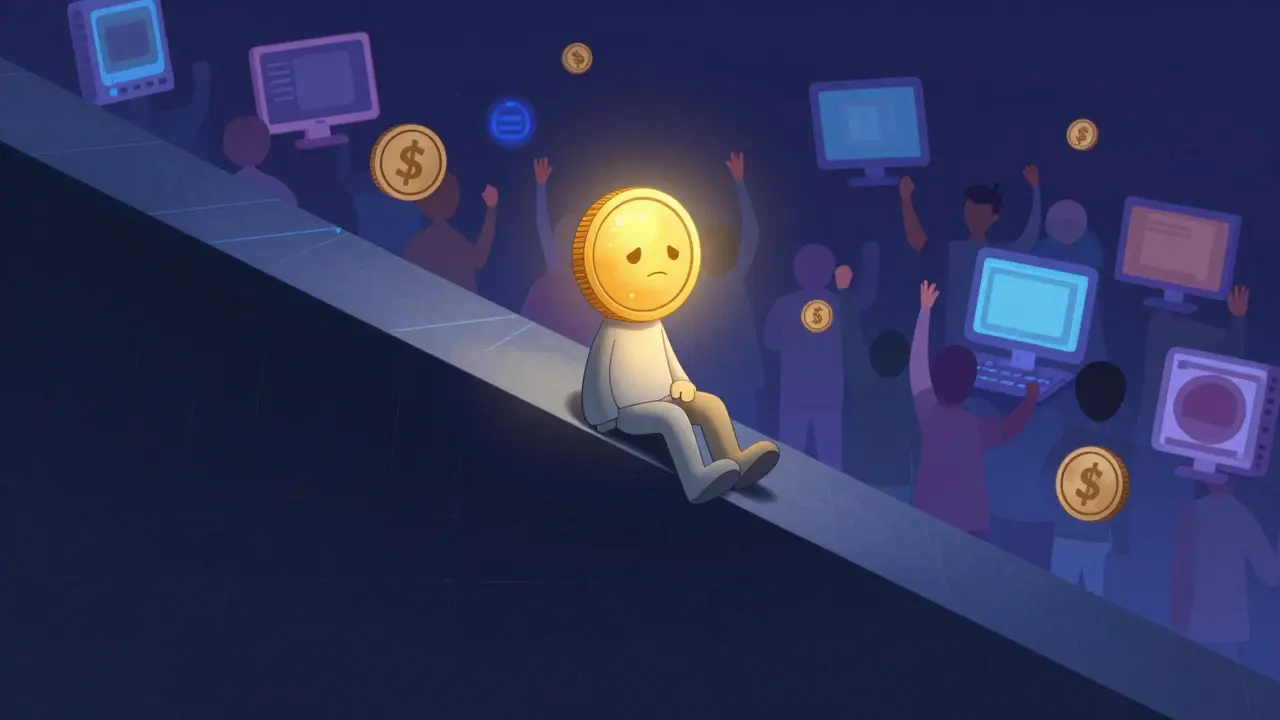
Here is where the story takes a sharp turn. If you held onto your GENS tokens expecting them to grow like Bitcoin or Ethereum, you faced a harsh reality. By September 2025, the market price of GENS had plummeted to approximately $0.00001301. That is a decline of about 99.98% from the initial reference price.
Why did this happen? Several factors converged. First, the broader crypto market experienced cycles of boom and bust. Projects launched during the 2021-2022 bull run often struggled to retain value when interest shifted. Second, the DeFi sector became increasingly crowded. Newer protocols offered higher yields or simpler user experiences, drawing liquidity away from older platforms like Genshiro. Finally, the complexity of the Kusama ecosystem, while technically robust, presented a barrier to entry for mainstream users who preferred the familiarity of Ethereum or Solana.
This depreciation highlights a critical lesson for airdrop hunters: receiving tokens is only half the battle. Liquidity, market sentiment, and ongoing utility determine long-term value. Many early recipients sold immediately upon listing, contributing to downward pressure. Those who held hoped for recovery, but the lack of massive adoption meant the price continued to slide.
Technical Architecture: What Was Under the Hood?
Despite the price drop, Genshiro's technology wasn't empty marketing. The platform relied on eight core components designed to create a comprehensive DeFi environment. Understanding these helps explain the project's original promise.
- Cross-Chain Interoperability: This allowed assets to move seamlessly between different blockchains. In theory, this reduced the risk of being stuck on a single network.
- Integrated DeFi Modules: Users could access lending, borrowing, and yield farming directly within the Genshiro interface. No need to switch tabs or use bridges manually.
- Smart Contract Platform: Developers could build custom financial instruments on top of Genshiro, expanding its functionality beyond basic trading.
- Layer-2 Scaling Solutions: To handle high transaction volumes efficiently, the platform incorporated scaling tech to keep fees low and speeds high.
- DAO Governance: A Decentralized Autonomous Organization structure allowed token holders to vote on future developments, aiming for community-driven decision-making.
- Liquidity Pools: Integrated pools facilitated efficient trading across various assets, ensuring users could swap tokens without slippage issues common in smaller markets.
- Oracle Systems: Reliable price feeds from external data sources ensured that lending and borrowing rates reflected real-world market conditions.
- Security Audits: Regular network audits and cryptographic security measures were implemented to protect user funds from exploits.
This architecture positioned Genshiro as a serious contender in the multi-chain DeFi space. However, technical superiority doesn't always translate to market success. User adoption requires more than just good code; it needs network effects, marketing, and timing.
The Roadmap: Ambitions Through 2030
Even with the price challenges, the Genshiro team maintained a published roadmap extending to 2030. This suggests an ongoing commitment to the vision, rather than an abandoned project. Let's look at what they planned.
- 2025 Expansion: Focus on enhancing cross-chain interoperability and launching new DeFi products. The goal was to deepen integration with other networks and offer more diverse financial tools.
- 2026 Risk Management: Plans emphasized implementing advanced risk management features. As DeFi matures, protecting users from volatility and smart contract risks becomes paramount.
- 2027 Staking Innovations: Introduction of innovative staking and yield farming opportunities. The aim was to attract increased user participation and capital investment by offering competitive returns.
- 2030 Ecosystem Goal: Position Genshiro as a leading DeFi ecosystem offering a comprehensive suite of financial services. This long-term target relies on successful execution of previous phases and broader market recovery.
These milestones indicate that development hasn't stopped. However, the gap between roadmap promises and market reality remains wide. For potential participants, the question is whether these features will drive enough demand to reverse the price trend.

Lessons for Future Airdrop Hunters
If you are eyeing future airdrops, Genshiro offers valuable insights. First, not all airdrops are created equal. Some require active engagement, like voting with locked tokens, while others are passive rewards. Active participation often signals a healthier community, but it also ties up your capital temporarily.
Second, do your homework on the underlying technology. Was Genshiro just hype, or did it solve real problems? It solved real problems, but the market didn't pay for the solution at scale. Look for projects with clear use cases and sustainable tokenomics. Avoid those relying solely on speculative growth.
Third, consider the exit strategy. Many airdrop recipients sell immediately, causing price dumps. If you believe in the long-term vision, hold. If you want quick profit, take it when you can. There is no right answer, but having a plan prevents emotional decisions.
Finally, diversify. Don't put all your eggs in one basket, especially in volatile sectors like DeFi. Spread your participation across multiple projects to mitigate risk. The Genshiro story reminds us that even well-funded, technically sound projects can face severe downturns.
Is There Still Hope for GENS?
For those holding GENS tokens today, the situation is tough. The current price of $0.00001301 makes it difficult to see immediate gains. However, the low price could represent a bottom for believers in the Kusama ecosystem. If the 2025-2030 roadmap delivers significant improvements in user experience and cross-chain functionality, there might be renewed interest.
Additionally, the broader crypto market is cyclical. Bull runs tend to lift all boats, including neglected gems. Whether GENS qualifies as a gem depends on your perspective. From a technical standpoint, it remains a sophisticated DeFi hub. From a market standpoint, it struggles for relevance.
Future airdrop opportunities may arise if the project executes its plans successfully. Keep an eye on official channels for announcements. Community updates often precede major developments. Engaging with the DAO and participating in governance could position you for any future distributions.
When did the Genshiro airdrop happen?
The most significant Genshiro airdrop occurred in January 2022, primarily through MEXC and Gate.io exchanges. The MEXC voting period was specifically on January 22, 2022.
How much was the GENS token worth during the airdrop?
During the MEXC airdrop in January 2022, the reference price for GENS was approximately $0.063 per token.
What is the current price of GENS in 2026?
As of late 2025 and into 2026, the GENS token has experienced a significant decline, trading around $0.00001301, representing a near-total loss of value from its peak.
Did I need to pay to participate in the Genshiro airdrop?
For the MEXC airdrop, you needed to hold and lock MX tokens to vote, which tied up your capital temporarily. The Gate.io offering was described as a "Free Offering," but typically required account verification and prior activity on the platform.
What blockchain is Genshiro built on?
Genshiro is built on the Kusama network, which serves as a canary network for Polkadot, allowing for faster iteration and testing of DeFi applications.
Is Genshiro still active in 2026?
Yes, the project maintains a roadmap extending to 2030, with ongoing development focused on cross-chain interoperability and DeFi enhancements, despite the token's low market price.
Qolbina Islami
July 29, 2026 AT 17:40THIS IS ABSOLUTELY DISGUSTING!!! Who in their right mind trusted these charlatans?! The entire concept of 'free money' is a lie designed to bleed the working class dry! I lost my shirt on this garbage and now they have the audacity to talk about 'roadmaps'? Pathetic!!
Billy Cunningham
July 31, 2026 AT 16:47Yeah it sucks :( I just want my money back 😞
Ed Wallace
August 2, 2026 AT 15:28One might ponder if the true value lay not in the token itself, but in the fleeting hope it provided. We are all merely passengers on a cosmic train, hurtling towards an inevitable destination where our digital assets hold no more weight than dust. Yet, there is beauty in the attempt, isn't there? A colorful tapestry of human greed and optimism woven together by code.
Joshua Hofford
August 3, 2026 AT 07:25Hey everyone! Look on the bright side! At least we learned something, right? Every failure is just a stepping stone to success. Genshiro might be down, but the spirit of DeFi lives on! Let's keep supporting each other through these tough times. 🌟
Eric Zehr
August 3, 2026 AT 09:05You must consider the broader context of market cycles. While the decline is steep, it is not unprecedented. Many projects face similar trajectories. It is important to remain disciplined and not let emotions dictate your financial decisions. The technology remains sound, even if the market sentiment has shifted drastically.
Namrata Mapgaonkar
August 4, 2026 AT 12:52i remeber when i got mine.. it was such a nice surprise :) but yeah now its nothing.. sad times :/ maybe next time ill be luckier lol
Rita Dutta
August 5, 2026 AT 05:12Actually, you fools dont understand the quantum mechanics of blockchain decentralization. The price drop is merely a correction in the etheric plane of finance. Most people are too simple to grasp the higher dimensional value of Kusama based assets. Its not about money, its about consciousness expansion through tokenomics!
Paul Smith
August 6, 2026 AT 11:35Hey folks! 👋 Just wanted to say that while the price is low, the community is still here! 🤝 Don't give up hope! There's always a chance for a comeback. Keep smiling and stay positive! 😊✨
Rodmun Tarnowski
August 6, 2026 AT 17:47Indeed!! The situation is dire!! However!! One must remember!! That history is filled with recoveries!! Stay strong!! Do not despair!! The future is unwritten!!
Matthew Smith
August 7, 2026 AT 15:55it is what it is. moral failure of the industry. no accountability. just vibes and charts.
Prudence Flemming
August 8, 2026 AT 12:38the liquidity trap is real. smart contracts are just code. code doesnt care about your feelings. hODL or sell. thats the dichotomy.
Carl Michaud
August 9, 2026 AT 09:36Wake up sheeple! This was orchestrated by the central banking elite to test the waters for CBDCs. They want you to lose faith in decentralized systems so you'll accept their digital leash. The price crash is artificial manipulation by high-frequency trading algorithms controlled by shadowy figures in Zurich. Trust no one!
Matt Kay
August 10, 2026 AT 09:54waste of time. trash project.
Dave Kjendal
August 11, 2026 AT 02:10you guys are all missing the point. its about the journey not the destination. also the tech is kinda cool i guess. but yeah probably dead.
Kat Bennett
August 11, 2026 AT 13:12I mean, looking at the long-term horizon, which could span several decades given the cyclical nature of crypto markets, one might argue that the current valuation represents a significant discount relative to the potential utility of cross-chain interoperability solutions, assuming that the development team continues to execute on their roadmap without further delays or technical setbacks, which is certainly a big assumption to make in this volatile environment.
Candice Cornett
August 12, 2026 AT 09:40everyone says buy the dip but its just a cliff. stop being naive. the experts know better and they sold. you should too.
Lance Jantz
August 12, 2026 AT 13:00Oh, darling, do come closer! Let me whisper the secrets of the blockchain gods into your ear! The GENS token is not dead; it is merely sleeping in the womb of the market, waiting to be reborn as a phoenix of pure profit! You plebeians cannot see the grand design because your minds are clouded by mediocrity! Embrace the chaos!
Don Fizy
August 13, 2026 AT 11:07Don't worry buddy! :) You did everything right. Sometimes the market just goes crazy. Take a deep breath. Maybe check out some other projects too. Keep your chin up! (Y)
Phil Babb
August 15, 2026 AT 11:06LISTEN UP!!! You need to take control of your portfolio!!! Stop crying about past losses!!! Focus on the present!!! Research new opportunities!!! Be aggressive!!! Be bold!!! Success favors the brave!!!