Imagine walking into a job interview and proving your degree is real in three seconds. No phone calls to the registrar. No waiting for mailed transcripts. Just a quick scan of a QR code linked to an NFT that holds your verified academic record. This isn't science fiction; it's how modern blockchain systems are reshaping digital identity. But here's the catch: most people think the actual diploma lives inside the token. It doesn't. Understanding where the data sits-and why that matters-is the key to grasping how these systems work.
The Core Misconception: Data vs. Proof
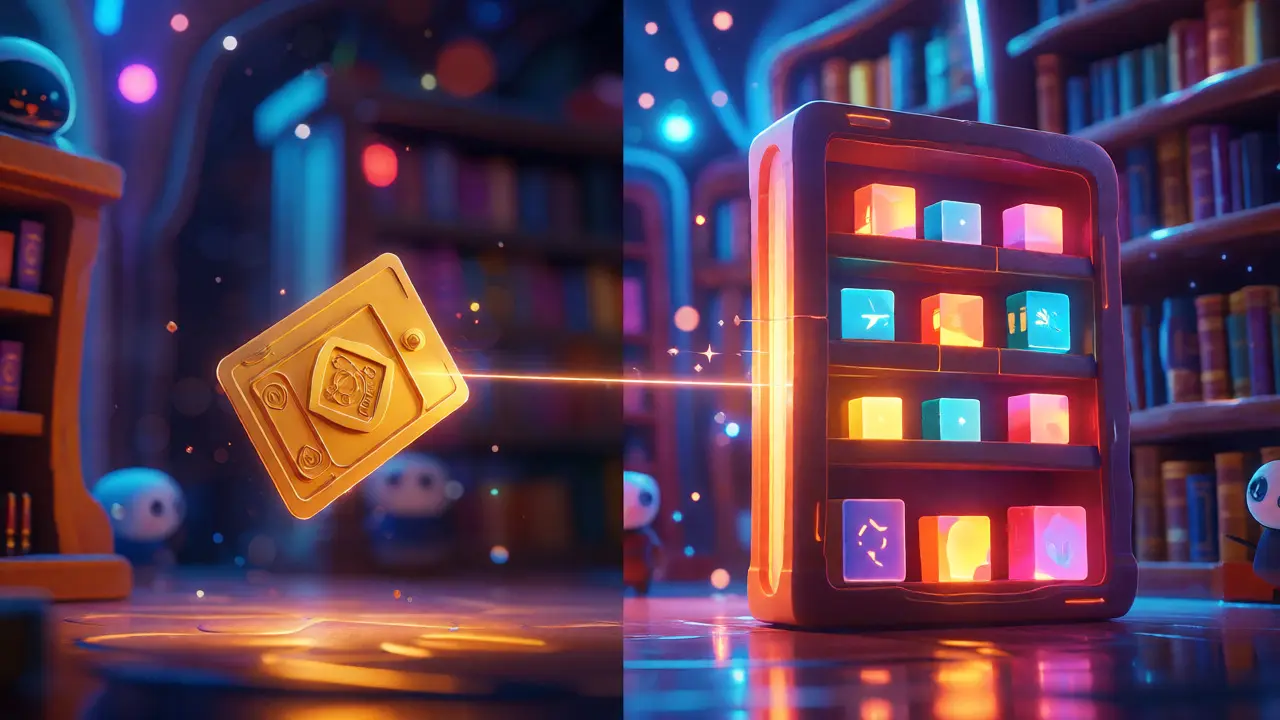
When you hear "NFT credential," your brain probably pictures a JPEG or a PDF file locked inside a smart contract. That’s a common mistake. Storing large files like high-resolution diplomas directly on the Ethereum blockchain is prohibitively expensive and inefficient. Instead, the system uses a clever split architecture. The NFT itself acts as a tamper-proof pointer, not the container. Think of it like a library card catalog. The card (the NFT) tells you exactly where the book (the credential data) is located and proves that the entry hasn’t been altered. The book itself sits elsewhere, usually in decentralized storage networks like IPFS or Arweave.
This distinction is crucial for security and cost. If every university stored every student’s transcript directly on-chain, network congestion would skyrocket. By keeping the heavy data off-chain and anchoring only the cryptographic hash on-chain, we get the best of both worlds: low costs and high security. The hash serves as a digital fingerprint. If someone tries to alter the document in storage, the fingerprint changes, and the verification fails instantly.
Technical Anatomy: How Verification Actually Works
To understand the mechanics, we need to look at the underlying standards. Most credential NFTs rely on the ERC-721 standard, which defines non-fungible tokens. Each token has a unique ID and metadata URI. When an institution issues a credential, they don't just send you a token; they sign a specific data structure called a Verifiable Credential (VC). This VC contains claims about you-like "John Doe graduated with honors"-and is signed using the institution’s private key.
Here is the step-by-step flow of a typical issuance:
- Creation: The issuer creates a JSON object containing the user’s public key (or DID) and the credential details.
- Hashing: This JSON object is hashed using SHA-256 to create a unique identifier.
- Storage: The full JSON file is uploaded to decentralized storage (IPFS/Arweave), generating a content address (CID).
- Minting: The issuer mints an NFT on Ethereum. The metadata points to this CID.
- Signing: The issuer signs the credential data with their private key, embedding the signature within the VC structure.
Verification happens when a third party (like an employer) checks the NFT. They read the token ID, fetch the metadata from the blockchain, retrieve the file from IPFS, and then use the issuer’s public key to verify the signature. If the signature matches and the hash aligns, the credential is valid. No central database needs to be online for this check to occur.
The Role of Decentralized Identifiers (DIDs)
You might wonder, "How does the system know who I am?" This is where Decentralized Identifiers (DIDs) come in. Unlike traditional logins tied to email addresses, DIDs are cryptographically generated strings controlled by the user. In Ethereum-based systems, these often take the form of `did:ethr`, which is derived directly from your wallet address.
A DID Document links your identifier to public keys and service endpoints. When you receive an NFT credential, it is typically bound to your DID. This means the credential is mathematically tied to your wallet. You can prove ownership by signing a challenge with your private key. This approach supports self-sovereign identity principles, giving users control over their data without relying on a central authority to manage profiles.
Privacy and Selective Disclosure
One major concern with blockchain transparency is privacy. If everyone can see my degree, do they also see my grades or personal info? Enter Zero-Knowledge Proofs (ZKPs). These cryptographic methods allow you to prove a statement is true without revealing the underlying data. For example, you could prove you are over 18 or have a GPA above 3.0 without revealing your exact age or grade point average.
While ZKPs are powerful, they aren't always implemented in basic NFT credential setups yet. Often, the privacy comes from selective disclosure. Since the credential data is encrypted or structured so that only specific fields are shared during verification, you maintain control. However, it’s vital to note that if the off-chain storage is public, anyone with the link can view the raw data unless it’s encrypted. Best practices now involve encrypting sensitive fields before uploading to IPFS, ensuring only those with the decryption key (usually the holder) can read the full details.
Comparing Storage Models: On-Chain vs. Off-Chain
Choosing where to store credential data involves trade-offs between cost, speed, and resilience. Here is a breakdown of the primary approaches used in 2026.
| Feature | On-Chain Metadata | Off-Chain (IPFS/Arweave) | Hybrid Approach |
|---|---|---|---|
| Cost | High (Gas fees scale with size) | Low (Minimal gas for hash) | Moderate |
| Data Permanence | Very High (Immutable ledger) | High (Depends on pinning services) | High |
| Scalability | Poor (Block size limits) | Excellent | Good |
| Verification Speed | Fast (Direct read) | Slower (Requires external fetch) | Variable |
| Use Case | Small text proofs, IDs | Diplomas, Certificates, Badges | Critical records needing backup |
The hybrid approach is gaining traction among institutions. It stores critical hashes on-chain but keeps the bulk data in redundant off-chain nodes. This ensures that even if one storage provider goes down, the data remains accessible via alternative gateways.
Challenges and Pitfalls to Avoid
Despite the promise, NFT credentials aren't flawless. The biggest hurdle isn't technical; it's human. Key management remains a significant risk. If you lose your private key, you lose access to your credentials. There is no "forgot password" button in DeFi. Recent studies indicate that nearly 78% of credential loss incidents stem from user error rather than blockchain bugs. Institutions must provide robust recovery mechanisms, such as social recovery wallets or custodial options for less tech-savvy users.
Interoperability is another pain point. An NFT issued on Ethereum might not be easily verifiable on Solana or Polygon without cross-chain bridges. Standards like EBSI (European Blockchain Services Infrastructure) are working to fix this, but fragmentation persists. Additionally, legal recognition varies by region. While the EU is moving toward recognizing digital identities under eIDAS 2.0, other jurisdictions lag behind, creating friction for global mobility.
Real-World Impact and Adoption Trends
So, who is actually using this? Academic institutions lead the charge. Over 40 top universities globally have piloted NFT diploma programs. The benefit is clear: employers can verify degrees instantly, reducing hiring time and fraud. Corporate sectors are catching up, with Fortune 500 companies experimenting with NFT-based professional certifications for skills training and compliance tracking.
User feedback highlights a mix of excitement and frustration. Students love the portability-credentials stay with them regardless of where they move. However, HR departments often struggle with the verification tools. Many legacy HR systems cannot natively parse blockchain data, requiring manual checks or specialized middleware. As wallet interfaces improve and account abstraction features roll out in upcoming Ethereum upgrades, these usability barriers are expected to drop significantly.
Future Outlook: What’s Next for Credential NFTs?
The next few years will focus on seamless integration. We are seeing a shift towards multi-chain compatibility, allowing credentials to be recognized across different networks without complex bridging. Security enhancements, particularly in zero-knowledge proof efficiency, will enable more granular privacy controls. Furthermore, regulatory frameworks are maturing, providing clearer guidelines for issuers and holders alike.
If you are considering issuing or holding NFT credentials, start small. Test the workflow with a single certificate. Ensure your storage solution is pinned reliably. And most importantly, educate your end-users on key management. The technology works, but its success depends entirely on the human layer interacting with it.
Where is the actual diploma file stored in an NFT credential?
The actual diploma file is typically stored off-chain in decentralized storage networks like IPFS or Arweave. The NFT on the blockchain contains a metadata pointer (a URL or content identifier) that references this location, along with a cryptographic hash to ensure integrity.
Can I edit my credential after it is minted as an NFT?
Generally, no. Once minted, the NFT and its associated metadata are immutable. If information needs to be corrected, the issuer usually revokes the old credential and mints a new one. Some advanced smart contracts allow for updating metadata pointers, but the core verified data should remain static to preserve trust.
What happens if the off-chain storage server goes down?
If the specific gateway you use goes down, the data might temporarily become inaccessible via that link. However, because decentralized storage networks replicate data across multiple nodes, other gateways or peers can usually serve the same content. Pinning services help ensure long-term availability by maintaining active copies of the data.
Do NFT credentials support privacy?
Yes, through techniques like Zero-Knowledge Proofs (ZKPs) and selective disclosure. Users can prove specific attributes (e.g., "I have a degree") without revealing all underlying data (e.g., grades or birthdate). Encryption of off-chain data further protects sensitive information from public viewing.
Is it safe to share my NFT credential publicly?
Sharing the NFT itself is safe because it only reveals public data like the issuer and the fact that you hold it. Sensitive personal details should be encrypted or kept in private fields. Always check what metadata is exposed on-chain versus what is hidden in encrypted off-chain payloads.