Imagine owning a piece of a skyscraper in New York for $50. Or holding a fraction of a gold bar stored in Zurich. Or investing in a wind farm in Texas without needing millions. This isn’t science fiction. It’s happening right now - thanks to real world asset tokenization.
Tokenization turns physical things - buildings, art, oil pipelines, even patents - into digital tokens on a blockchain. These tokens represent ownership rights. And unlike the old way of buying assets, you don’t need to own the whole thing. You can own 0.001% of it. That’s the game-changer.
What Exactly Is Real World Asset Tokenization?
Real World Asset (RWA) tokenization means taking something tangible - like a building, a shipment of coffee beans, or a bond - and creating a digital version of it on a blockchain. Each token stands for a share of that asset. If you hold the token, you legally own a portion of the underlying asset. This isn’t just a digital representation. It’s backed by real legal rights.
Think of it like this: Traditionally, if you wanted to invest in commercial real estate, you’d need to buy an entire property or partner with a fund that locks up your money for years. With tokenization, you can buy a token representing 1/10,000th of that same building. The blockchain records who owns what. Smart contracts handle rent distribution, sales, and even voting rights - automatically.
There are two main types of tokens used:
- Fungible tokens (ERC-20): These are interchangeable, like Bitcoin. Used for assets like gold, bonds, or shares in a property.
- Non-fungible tokens (NFTs - ERC-721): These are unique. Used for one-of-a-kind assets like a painting or a rare collectible.
The key? Ownership is transparent, verifiable, and transferable 24/7. No paper deeds. No middlemen. Just code and consensus.
Why This Matters: The Big Advantages
Traditional asset markets are slow, expensive, and closed off. RWA tokenization flips that.
1. Fractional Ownership Opens the Door
Before tokenization, only the ultra-wealthy could afford luxury assets. A $5 million art piece? Only billionaires could buy it. Now, you can buy $10 worth of a token representing 0.0002% of that same painting. Retail investors - people with $500 to spare - can finally participate in markets that were once exclusive.
2. Liquidity That Doesn’t Exist Before
Real estate, private equity, infrastructure - these assets are called “illiquid” because they’re hard to sell quickly. You can’t just list a bridge on eBay. Tokenization changes that. A tokenized asset can be traded on secondary markets like a stock. Settlements that used to take 30 days now happen in under 15 minutes. Chainlink’s 2023 data shows tokenized real estate trades settle 95% faster than traditional deals.
3. Global Access, No Borders
Traditionally, if you live in Indonesia and want to invest in U.S. commercial real estate, you’d face legal barriers, currency issues, and paperwork. Tokenization removes most of that. With a digital wallet and verified identity, you can buy into assets anywhere in the world. The market is no longer local - it’s global.
4. Lower Costs
Traditional transactions charge 5-10% in fees - lawyers, brokers, banks, clearinghouses. Tokenized transactions? Often under 0.5%. That’s because smart contracts automate what used to require armies of clerks. Venly.io’s 2024 analysis confirms that tokenized asset transfers cut costs by up to 90% compared to legacy systems.
What Can Be Tokenized? (And What Can’t)
Not everything works. Some assets are perfect. Others? Not so much.
Top Tokenized Assets (2024 Data):
- Real Estate (35% of market): Residential, commercial, industrial. Platforms like RealT and Brickken lead here.
- Commodities (22%): Gold, oil, wheat. Tokenized gold from PAMP Suisse and others is already trading on-chain.
- Financial Instruments (18%): Bonds, private equity, venture funds. BlackRock launched its tokenized fund in March 2024 - managing $500 million.
- Art & Collectibles (10%): NFTs of physical artworks, signed memorabilia.
- Infrastructure (7%): Cell towers, solar farms, toll roads. These generate steady cash flow - perfect for tokenization.
What doesn’t work well? Assets that are hard to verify or manage physically. Livestock? Perishable crops? Things that decay or move unpredictably? Those are still too messy. Tokenization needs clear, stable, and verifiable ownership - which is why the best candidates are fixed, high-value, income-generating assets.

How It Works: The 5-Step Process
Tokenizing an asset isn’t just slapping a blockchain on it. It’s a multi-step legal and technical process.
- Asset Selection: Choose what to tokenize. Is it a building? A bond? A patent? Each has different legal implications.
- Token Design: Decide if it’s fungible (like shares) or non-fungible (like a unique piece of art). Set supply, rights, and rules.
- Blockchain Choice: Ethereum is common, but Polygon, Solana, and private enterprise chains are gaining ground for speed and cost.
- Off-Chain Verification: This is critical. Who says the asset even exists? Oracle networks like Chainlink Proof of Reserve connect the blockchain to real-world proof - like bank statements, warehouse receipts, or title deeds.
- Issuance & Compliance: Mint the tokens. Register the legal structure (usually a Special Purpose Vehicle). Ensure KYC/AML checks. This step alone can take 45-90 days.
Failure at any step means failure overall. A token backed by nothing? That’s just a scam. A token with unclear legal rights? That’s a lawsuit waiting to happen.
Who’s Leading the Charge?
It’s not just crypto startups anymore. Big finance is in.
- BlackRock: Launched its tokenized fund in March 2024. Now manages $500 million in tokenized assets.
- BNY Mellon: Holds $12.7 billion in tokenized assets under custody as of June 2024.
- Goldman Sachs: Rolled out its own tokenization platform in Q1 2024.
- NYSE: Partnered with Chainlink in July 2024 to explore tokenized equities.
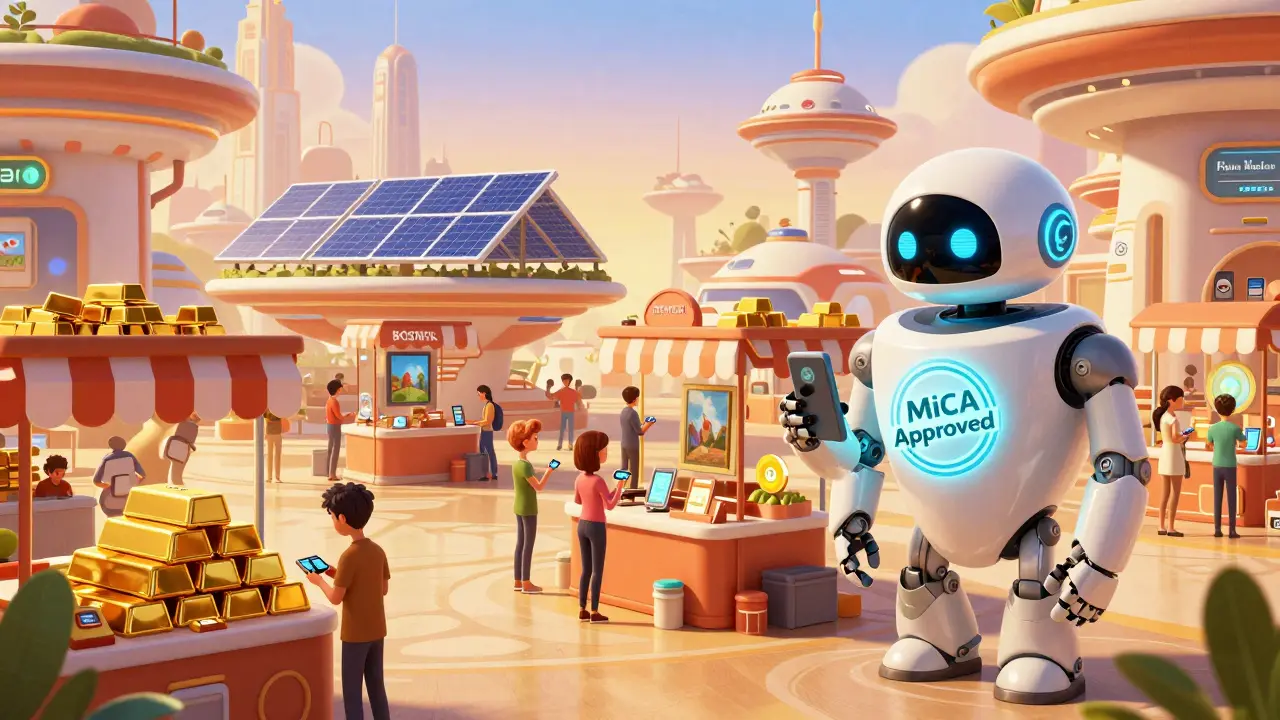
- EU: MiCA regulations (effective January 2025) are the first comprehensive legal framework for tokenized assets across 27 countries.
These aren’t experiments. They’re institutional bets. If the world’s largest asset managers are moving in, it’s not a fad - it’s infrastructure being rebuilt.
The Big Hurdles: Regulation, Custody, and Trust
It’s not all smooth sailing.
Regulation is a patchwork. Only 28 of 195 countries have clear rules. In the U.S., 19 states have passed laws - but no federal standard. SEC Chair Gary Gensler said in May 2024: “Tokenized assets must comply with all existing securities laws.” That means issuers can’t just ignore the SEC. They need lawyers, compliance teams, and audits. That adds cost and slows adoption.
Custody is still a nightmare. Who holds the physical asset? If you tokenize a warehouse full of gold, who stores it? Who audits it? Who’s liable if it gets stolen? Most projects use third-party custodians - but they’re not always trustworthy. PwC found that 40% of failed tokenization projects collapsed because custody arrangements broke down.
Technology isn’t perfect. 8.7% of token transfers fail due to wallet incompatibility. Users get locked out. Contracts have bugs. Oracles go offline. And if the underlying asset’s value drops, the token doesn’t magically fix it. The blockchain only records ownership - it doesn’t create value.
And then there’s trust. People have been burned by scams. If you don’t know who issued the token or what backs it, you’re gambling. That’s why verification via Chainlink or similar oracles isn’t optional - it’s the foundation.
The Road Ahead: What’s Next?
The future isn’t just about more tokens. It’s about integration.
- ISO Standardization: By Q2 2026, ISO/TC 68 will release global standards for RWA tokenization - think of it as the “HTTP of asset ownership.”
- Project Hamilton (Fed): The Federal Reserve’s Phase 3, launching Q4 2025, will test how tokenized assets settle on a U.S. central bank digital currency (CBDC) - a game-changer for compliance.
- Global Tokenization Alliance: The World Economic Forum is pushing for cross-border regulatory alignment by 2027. If they succeed, tokenized assets could flow like data - frictionless across borders.
- Smart Contract Templates: ISDA released standardized templates in August 2024. Now, lawyers don’t have to start from scratch. This will slash legal costs and speed up launches.
McKinsey predicts tokenization will become the standard model for illiquid assets within 15 years. Gartner says 30% of institutional assets will be tokenized by 2030. Even Deloitte, known for caution, agrees - if regulation improves, the market could hit $30 trillion.
But if regulators stay fragmented? The market might cap out at $8-12 trillion. The difference? Clarity.
Real User Experiences
People are already using this.
On Reddit, user “CryptoInvestor42” invested $200 in a tokenized apartment in Atlanta. They get 6.2% annual yield - paid weekly in crypto. “It’s better than my savings account,” they said.
But “TokenNewbie” spent 14 days on KYC just to buy $500 in tokenized gold. “I had to send my passport, a selfie, and a utility bill. Then wait. Again. It felt like applying for a loan in 1998.”
Professional asset managers report 40-60% lower administrative costs after tokenizing private equity. But 52% still say regulatory uncertainty is their biggest fear.
The lesson? The tech works. The user experience? Still clunky. The legal side? Still messy. But the momentum? Unstoppable.
Final Thought: This Isn’t Just About Tech
Tokenization isn’t just a blockchain trick. It’s a reset of how ownership works. It’s turning assets into something that can be bought, sold, and divided like code.
The future of finance isn’t about bigger banks or faster computers. It’s about making ownership open, global, and fair. Whether you’re a farmer in Kenya selling tokenized coffee beans, a student in Brazil buying a slice of a solar farm, or a pension fund in Germany holding tokenized infrastructure - you’re part of it.
The old system is crumbling. The new one is being built - one token at a time.
Alex Williams
February 16, 2026 AT 03:56Tokenization is the real deal - fractional ownership of real estate, gold, even infrastructure? Game over for traditional finance. I’ve got 0.3% of a solar farm in Texas generating passive income in USDC every week. No broker. No paperwork. Just smart contracts doing their thing. The 90% cost reduction isn’t hype - it’s math. And yeah, custody is still a mess, but Chainlink’s Proof of Reserve is closing the gap fast. This isn’t crypto weirdness - it’s the future of capital allocation.
Sarah Shergold
February 17, 2026 AT 20:52lol imagine paying $50 for ‘ownership’ of a building that’s probably falling apart. 🤡
Lisa Parker
February 17, 2026 AT 22:22why is everyone so excited? i just want to cry. my aunt bought a tokenized painting and now she’s obsessed. she talks about ‘liquidity events’ at thanksgiving. i miss the old days when art was just… art. not a crypto lottery ticket. 😭
Nova Meristiana
February 18, 2026 AT 00:57you think this is revolutionary? lol. it’s just Wall Street with a blockchain mask. 🤖 the SEC is already drafting rules to strangle this. they hate decentralization. they want control. mark my words - this’ll be regulated into oblivion by 2026. 💀
Aileen Rothstein
February 18, 2026 AT 23:26the fact that we’re even having this conversation is wild. 10 years ago, this would’ve been dismissed as fantasy. now? BlackRock’s managing half a billion in tokenized assets. BNY Mellon’s custodying over $12B. This isn’t speculative - it’s institutional adoption. The infrastructure is being built. The legal frameworks? Still messy, sure - but look at how fast MiCA moved. We’re not waiting for permission anymore. We’re building the new system while the old one crumbles. And yeah, the UX is clunky - but that’s phase one. Phase two? Seamless. Just wait.
JJ White
February 19, 2026 AT 16:54you’re all naive. this is a pyramid scheme wrapped in legal jargon. who’s auditing the ‘real’ assets? who’s liable when the warehouse full of gold ‘disappears’? PwC says 40% of failures come from custody collapse - and you think we’re gonna trust some ‘oracle’ from Chainlink? please. the blockchain doesn’t care if your asset is real. it only cares if the code runs. and code? code can be hacked. manipulated. erased. this isn’t innovation - it’s financial theater. and the audience? dumbasses with MetaMask.
Nicole Stewart
February 20, 2026 AT 12:32tokenization is just securitization with blockchain buzzwords. the same risks. the same opacity. the same fees. just repackaged. and now we have 10x more scams. congrats.
Alan Enfield
February 21, 2026 AT 12:21agree with Alex - the cost savings are insane. but custody? yeah, it’s still the Achilles heel. I’ve been working with a few SMEs trying to tokenize machinery. The legal side? Nightmare. But the tech? Solid. The real bottleneck isn’t blockchain - it’s lawyers and banks still using fax machines. If we can get ISO standards rolling by 2026, this becomes mainstream overnight.
Jennifer Riddalls
February 22, 2026 AT 21:00just wanted to say - if you’re a beginner, don’t get overwhelmed. start small. $10 in tokenized gold. see how the interface feels. read the whitepaper. ask questions. the tech isn’t magic - it’s just code. and code can be learned. you don’t need to be a genius. just curious. and patient. this is a marathon, not a sprint. 🌱
yogesh negi
February 24, 2026 AT 18:17bro, i live in india, and i just tokenized my uncle’s small wheat storage facility last month. it’s not a skyscraper, but it’s real. 200 farmers now own tiny shares. we use polygon because gas fees in eth are insane here. we had to do 3 rounds of KYC, but now we get weekly payouts in USDT. it’s not perfect - but it’s better than the local moneylender who charged 40% interest. this isn’t just for rich guys in NY. it’s for people like us. thank you for writing this. it gave me hope.
Tarun Krishnakumar
February 25, 2026 AT 05:15you think this is about ownership? think again. this is a surveillance tool disguised as finance. every token transaction is recorded. every wallet is tracked. every ‘fractional share’ is a data point for the state. the Fed’s Project Hamilton? That’s not about efficiency - it’s about control. the moment a CBDC integrates with tokenized assets, your ‘ownership’ becomes revocable. they’ll freeze your ‘share’ if you protest. if you’re ‘non-compliant.’ if you’re inconvenient. blockchain doesn’t make you free - it makes you traceable. and traceable means controllable. this isn’t liberation. it’s digital feudalism. and you’re all cheering for your new chains.
jennifer jean
February 26, 2026 AT 16:20omg yes!! 🥹💖 i just bought $25 in tokenized wind turbines and now i feel like i’m part of the future!! 🌬️⚡ thank you for this post!!
Rajib Hossaim
February 28, 2026 AT 06:17While the concept of tokenization is promising, the current regulatory ambiguity remains a critical impediment. The absence of a unified global framework may result in market fragmentation and legal uncertainty. Consequently, institutional adoption may remain constrained until harmonized standards are established.
Beth Erickson
March 2, 2026 AT 01:50lol america thinks it’s leading the future. europe has MiCA. china’s got its own CBDC. we’re just playing catch-up with crypto hype. this whole thing was built on american greed and bad regulation. tokenization? more like tokenization of delusion.