If you're running a cryptocurrency exchange in the U.S., you're not just a tech company-you're a financial institution. That’s the reality under FinCEN’s rules, and it’s not optional. FinCEN, the Financial Crimes Enforcement Network, doesn’t ask for permission. It demands registration. And if you skip it? You’re breaking federal law.
It sounds simple, but the truth is messier. You don’t get a shiny license. You don’t get a certificate to hang on the wall. You get a mountain of paperwork, ongoing monitoring, state licenses, and constant audits. And it’s not just about Bitcoin and Ethereum anymore. Any business that moves crypto to fiat, holds user funds, or processes payments through digital assets falls under this rule.
Who Exactly Needs to Register?
FinCEN doesn’t care if you call yourself a "wallet provider," "decentralized exchange," or "crypto app." What matters is what you do. If your platform lets users trade crypto for dollars, euros, or other digital assets-and you hold or transfer those funds-you’re a Money Services Business (MSB). That triggers mandatory registration.
This includes:
- Centralized exchanges like Coinbase or Binance U.S. (yes, even if you’re based outside the U.S. but serve American users)
- Custodial wallet services that store users’ private keys
- Crypto payment processors that convert crypto to fiat at checkout
- Platforms that facilitate peer-to-peer trades with automated clearing
Even if you claim you "don’t touch the money"-if users deposit crypto, and you later send them dollars in return-you’re transmitting value. That’s money transmission under U.S. law. No exceptions.
The Registration Process: It’s Not a One-Time Form
FinCEN doesn’t issue licenses. It requires registration through the FinCEN BSA E-Filing System. You submit Form 112 (Registration of Money Services Business), pay a small fee, and provide your business details, ownership structure, and AML policies. But here’s the catch: registration is just the starting line.
After you register, you’re locked into a cycle of compliance:
- KYC Procedures: You must verify every customer’s identity-name, address, ID number, date of birth. No exceptions. Even if someone deposits $10 in Bitcoin, you still need to know who they are.
- Record Keeping: Keep transaction records for at least five years. That includes IP addresses, device IDs, wallet addresses, timestamps, and transfer details.
- Suspicious Activity Reports (SARs): If something looks off-a sudden $500,000 transfer from an unknown wallet, repeated small deposits to avoid thresholds-you file a SAR with FinCEN within 30 days. Miss it? You’re in violation.
- AML Program: You need a written, approved Anti-Money Laundering plan. It must include training, audits, and internal controls. And yes, you have to update it every time FinCEN changes its guidance.
There’s no grace period. No "we’re still growing" excuse. If you’re processing transactions, you’re already in scope.

The State Layer: Where It Gets Complicated
FinCEN is federal. But every state has its own rules. You can’t just register with FinCEN and call it done. In 48 states, you need a Money Transmitter License (MTL) to legally operate. That means applying separately in each state where you have customers-yes, even if they’re just one person in Wyoming.
Some states make it worse:
- New York: Requires a BitLicense-a separate, expensive, and highly scrutinized permit. Only 20 companies have it.
- California: Has strict consumer protection rules and requires bonding.
- Texas: Requires annual audits and proof of financial solvency.
Many exchanges avoid this mess by partnering with licensed entities-like a bank or a licensed money transmitter-that handles compliance on their behalf. It’s called a "pass-through" model. You pay a fee, but you skip the 12-month application process in 50 states.
What Happens If You Don’t Register?
You think you can fly under the radar? Think again.
FinCEN doesn’t wait. In 2023, they shut down a crypto exchange that claimed it was "just a software tool." They fined the owners $10 million and pressed criminal charges. Another operator in Florida was sentenced to 37 months in federal prison for operating an unregistered MSB.
Penalties aren’t just financial. They’re personal. Owners, operators, even compliance officers can be held personally liable. FinCEN doesn’t go after corporations. It goes after people.
And the IRS? They’ll audit your taxes. The SEC? They’ll check if you’re selling unregistered securities. The CFTC? They’ll look at market manipulation. One unregistered exchange can trigger investigations from three federal agencies at once.
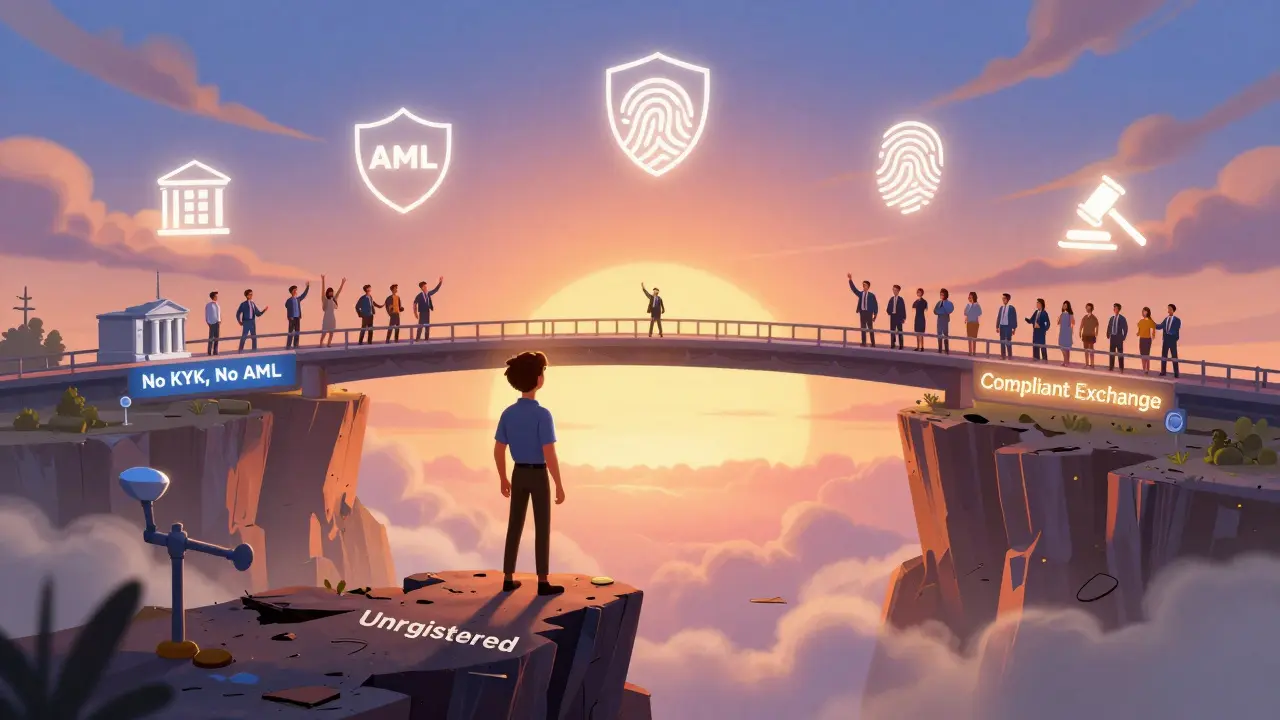
Why This Matters in 2026
As of 2024, nearly 1 in 4 U.S. adults owns crypto. That’s 70 million people. And every one of them who trades on a non-compliant platform is a risk-not just to the business, but to the entire financial system.
FinCEN’s 2023 guidance on mixing services showed they’re watching even the most obscure corners of crypto. Tools that obscure transaction trails? Now they’re flagged as high-risk. Wallets that hold crypto in unhosted addresses? Those are under scrutiny too.
The message is clear: the U.S. government isn’t trying to stop crypto. It’s trying to control it. And control means registration, transparency, and accountability.
For legitimate businesses, this is a competitive edge. Exchanges that comply build trust. Banks will work with them. Payment processors will integrate with them. Investors will fund them.
For everyone else? It’s a ticking clock.
What’s Next? The Future of Crypto Regulation
There are rumors of a federal "BitLicense"-a single national standard to replace the patchwork of state licenses. But don’t hold your breath. Congress has been stuck on this for years.
Right now, the only safe path is to do the work. Build the KYC system. Hire the compliance officer. File the SARs. Pay the state fees. Train your team. Update your AML plan every six months.
There’s no shortcut. No loophole. No "we’re too small to matter." If you’re moving crypto value in the U.S., you’re already in the system. The question isn’t whether you should register-it’s whether you’re ready to handle what comes after.
Brian Lemke
February 25, 2026 AT 15:57Let me tell you something real: this isn’t about regulation-it’s about survival. If you’re running a crypto exchange and you think you can dodge FinCEN, you’re not a disruptor, you’re a liability. The ones who win in 2026 aren’t the ones who fought the system-they’re the ones who built it into their DNA. KYC, SARs, AML plans? That’s not red tape, that’s trust infrastructure. Banks won’t touch you without it. Investors won’t fund you without it. Customers won’t stay with you without it. This is the new baseline. No more pretending you’re just a tech startup. You’re a financial institution. Own it.
And if you’re scared? Good. Fear means you’re still alive. The ones who got shut down in 2023? They weren’t scared. They were delusional.
kati simpson
February 26, 2026 AT 10:09Michelle Mitchell
February 26, 2026 AT 22:12christopher luke
February 28, 2026 AT 19:06Mary Scott
February 28, 2026 AT 20:24Shannon Holliday
March 2, 2026 AT 03:24Jeremy buttoncollector
March 3, 2026 AT 19:42Ryan Burk
March 5, 2026 AT 01:42Don B.
March 6, 2026 AT 21:30Fiona Monroe
March 7, 2026 AT 07:18Molley Spencer
March 8, 2026 AT 06:46Lucy Simmonds
March 10, 2026 AT 02:14Dana Sikand
March 11, 2026 AT 07:08Cameron Pearce Macfarlane
March 12, 2026 AT 04:06Elizabeth Smith
March 13, 2026 AT 14:19Daisy Boliaan
March 15, 2026 AT 11:23Nicki Casey
March 17, 2026 AT 04:07