Remittance Cost Calculator
Compare costs when sending money to Nigeria. Traditional services charge 8-15% fees, while crypto transactions typically cost 2-3% with USDT on P2P platforms.
Your Savings
Traditional Services
Fee: $0.00
Amount Received: $0.00
(Typical 8-15% fee)
Crypto (USDT)
Fee: $0.00
Amount Received: $0.00
(Typical 2-3% fee)
Note: These calculations assume traditional fees at 10% and crypto fees at 2.5%. Actual fees may vary based on payment method and exchange rates.
By 2025, over 22 million Nigerians-roughly one in ten people-own cryptocurrency. That’s not a niche trend. It’s a nationwide shift driven by necessity, not curiosity. While governments elsewhere debate crypto’s future, Nigeria’s people are already living it. The naira has lost over 75% of its value since 2016. Inflation hit 24% in 2023. Banks won’t let you send money abroad without jumping through endless hoops. And 36% of adults still don’t have a bank account. So they turned to crypto-not because it’s cool, but because it’s the only way out.
Why Crypto Took Off in Nigeria
It wasn’t a marketing campaign. It wasn’t a government push. It was survival. When your savings vanish overnight because the central bank devalues the currency, you look for something that holds value. When you’re a freelancer in Lagos and your client in the U.S. won’t pay you through Western Union because it costs 8% in fees, you look for a cheaper way. When your bank freezes your account because you tried to buy dollars to pay for software subscriptions, you look for an alternative. Crypto became that alternative. Bitcoin, USDT, and other stablecoins let people store value outside the naira. Peer-to-peer (P2P) platforms like Binance P2P and Quidax let Nigerians trade directly with buyers and sellers around the world-no bank approval needed. A single smartphone and an internet connection became the new bank branch. By 2024, Nigeria recorded over $59 billion in crypto transactions in just one year. That’s more than most European countries. And it’s not just big traders. Over 8% of all crypto transactions in Sub-Saharan Africa are under $10,000. That’s everyday people buying groceries, paying school fees, or sending money home to relatives in rural areas. Crypto isn’t a luxury here. It’s a lifeline.The Regulatory Rollercoaster
The Central Bank of Nigeria (CBN) didn’t start out friendly. In 2021, it banned banks from handling crypto businesses. Exchanges were forced offline. People lost access to their funds. Wallets were frozen. The message was clear: we don’t want this. But the people didn’t stop. They just moved underground. P2P trading exploded. Local traders became intermediaries. WhatsApp groups turned into crypto marketplaces. You’d message someone, send naira, and get Bitcoin in your wallet-no bank involved. The ban didn’t kill crypto. It made it more resilient. Then came the shift. In late 2023, the CBN reversed course. It lifted the ban. Licensed exchanges could now operate legally. Why? Because the economy was crumbling faster than the rules could fix it. The bank realized: trying to stop crypto was like trying to stop water from flowing downhill. Better to regulate it. By 2025, things changed. The Nigeria Inter-Bank Settlement System (NIBSS) partnered with Zone’s blockchain network to make interbank transfers faster and fraud-resistant. Moniepoint, a Nigerian fintech app, became a unicorn worth $1 billion after Google invested. Crypto wasn’t just tolerated anymore-it was being woven into the country’s financial backbone.How Nigerians Use Crypto Today
Most people don’t trade for profit. They use crypto to survive. - **Hedging inflation**: People convert part of their naira earnings into USDT every week. When the naira drops 10% in a month, their crypto savings stay steady. - **Sending remittances**: A Nigerian working in London sends $200 to his family in Enugu. Instead of paying $16 in fees through MoneyGram, he sends USDT. His sister cashes it out via a local P2P agent for $195. That’s 97% of the money received. - **Getting paid**: Freelancers on Upwork and Fiverr use crypto wallets to receive payments. No waiting weeks for wire transfers. No currency conversion fees. No bank rejections. - **Buying goods**: Some online stores in Lagos now accept Bitcoin or USDT for electronics, clothing, even groceries. It’s still rare, but growing. The most common entry point? Binance P2P. New users start there because it’s simple: choose a seller, pay via bank transfer or mobile money, get crypto in minutes. No KYC nightmare. No paperwork. Just trust and speed.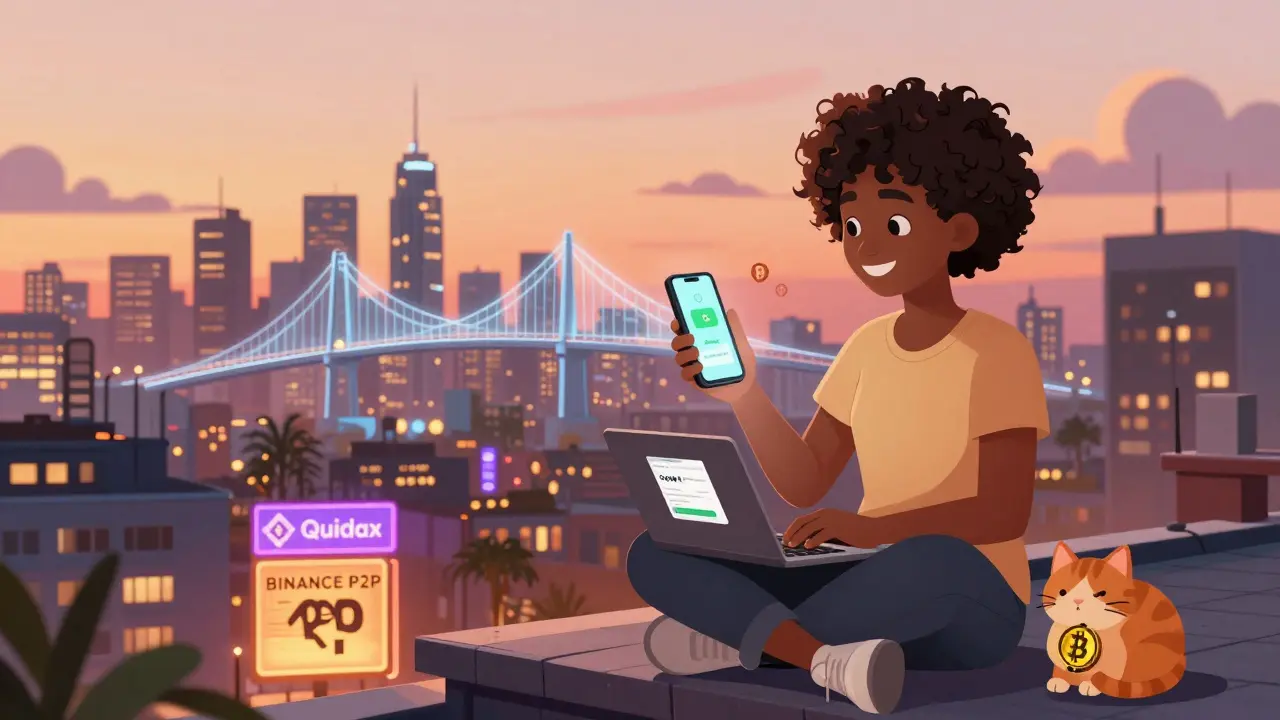
Challenges Still Facing Users
It’s not perfect. Some exchanges still crash during big price swings. When Bitcoin surges 20% in a day, servers go down. People panic. Messages flood Telegram groups: “Is Binance down again?” Security is another issue. Many users don’t understand private keys. They keep their crypto on exchanges, which is like leaving cash in a locked drawer at a hotel. If the exchange gets hacked-or if the government cracks down again-they lose everything. There’s also confusion around regulation. Even though the CBN lifted its ban, the rules are still unclear. Can you legally mine crypto? Can you use DeFi apps? Are you taxed on gains? No one knows for sure. That uncertainty keeps people cautious. And while mobile internet is widespread, it’s not always reliable. Data costs money. Power outages happen daily. If your phone dies and you didn’t back up your wallet, you’re locked out.The Rise of Local Platforms
International exchanges like Binance dominate, but local players are catching up fast. Quidax, Yellow Card, and Paxful Nigeria offer services tailored to local needs. They support mobile money payments. They have customer support in Pidgin English. Some even let you buy crypto with airtime credit. That’s huge for people who don’t have bank cards. These platforms are also building educational content. YouTube tutorials in Yoruba. WhatsApp bots that explain how to send USDT. Telegram groups where experienced users walk newcomers through wallet setup. This grassroots education is what’s making adoption stick.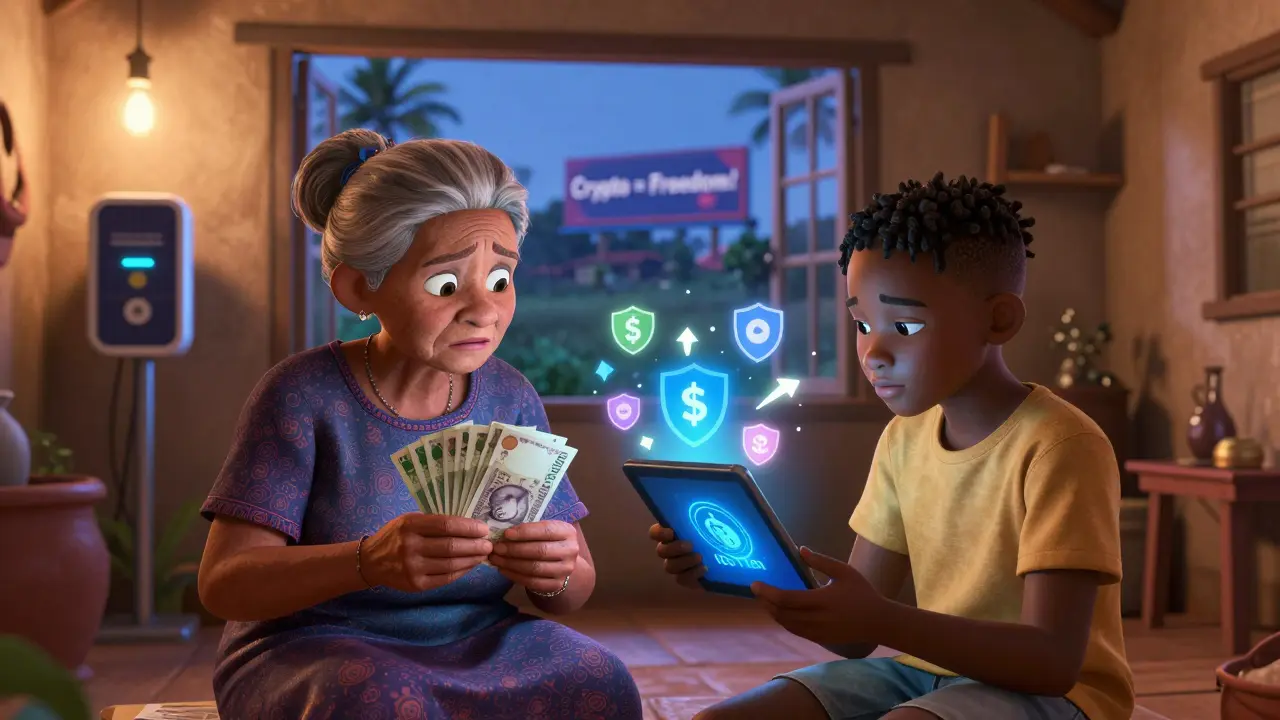
What’s Next for Crypto in Nigeria?
The next big thing? A Nigerian CBDC-the eNaira. The Central Bank has been testing it since 2021. But so far, it’s failed to gain traction. Why? Because it’s still tied to the naira. It doesn’t solve inflation. It doesn’t let you send money overseas easily. People don’t trust it. Crypto, on the other hand, is already trusted. It’s used. It works. Looking ahead, Nigeria’s crypto scene will keep growing-not because of government policy, but because of economic reality. As long as inflation stays above 20%, the naira keeps falling, and banks keep blocking access to foreign currency, people will turn to crypto. Institutional players are taking notice. More venture capital is flowing into Nigerian fintech. Global exchanges are opening local offices. Even traditional banks are exploring crypto partnerships. The future isn’t about replacing the naira. It’s about giving people choices. The choice to save in something stable. The choice to send money without begging for permission. The choice to be financially independent-even if the system won’t let you.How to Get Started (If You’re in Nigeria)
If you’re new and want to try crypto, here’s how to start safely:- Download a trusted app like Binance or Quidax.
- Verify your identity (KYC) - it’s required now, but faster than bank approval.
- Buy USDT (Tether) using bank transfer or mobile money. It’s pegged to the dollar, so it holds value.
- Keep your USDT in the app for now. Don’t move it to a private wallet until you understand how.
- Join a local Telegram group. Ask questions. Learn from others.
- Never share your password or recovery phrase. Ever.
Why This Matters Beyond Nigeria
Nigeria isn’t an exception. It’s a preview. Countries with unstable currencies, weak banks, and young, tech-savvy populations-like Argentina, Turkey, Vietnam-are watching closely. If Nigeria can build a functioning crypto economy despite government resistance, others can too. This isn’t about Bitcoin becoming money. It’s about people reclaiming control over their finances when the system fails them. Nigeria didn’t wait for permission. They built their own solution. And now, the world is watching.Is crypto legal in Nigeria in 2025?
Yes, crypto is legal to own and trade in Nigeria as of 2025. The Central Bank of Nigeria lifted its 2021 ban on banks servicing crypto businesses. Licensed exchanges like Binance, Quidax, and Yellow Card operate openly. However, there’s still no clear tax or legal framework for crypto income, so users operate in a gray zone.
Why do Nigerians prefer USDT over Bitcoin?
Most Nigerians use USDT (Tether) because it’s a stablecoin pegged to the U.S. dollar. Unlike Bitcoin, which swings wildly in price, USDT holds its value. This makes it ideal for saving money, sending remittances, or paying for goods without worrying about losing half your balance in a day. Bitcoin is used more for speculation or long-term holding.
Can I buy crypto without a bank account in Nigeria?
Yes. Platforms like Quidax and Yellow Card let you buy crypto using mobile money services like MTN MoMo, Airtel Money, or Paga. You don’t need a traditional bank account-just a phone number linked to your mobile wallet. This is how millions of unbanked Nigerians access crypto.
How do Nigerians cash out crypto?
Most use peer-to-peer (P2P) platforms. You sell your USDT to a buyer on Binance P2P or Quidax, who pays you via bank transfer, mobile money, or even cash in person. Local agents, often called “crypto traders,” act as intermediaries in markets and roadside stalls. The process takes minutes to hours, depending on demand.
Is crypto safer than keeping money in a Nigerian bank?
It depends. Banks can freeze accounts without warning, and deposits aren’t insured. Crypto wallets can be hacked if you don’t secure your private keys. But crypto lets you control your money directly. If you store crypto on a hardware wallet or use a reputable exchange with strong security, it’s often safer than leaving savings in a bank that might collapse or restrict withdrawals during a crisis.
What’s the biggest risk for crypto users in Nigeria?
The biggest risk is losing access to your funds because you don’t understand private keys or recovery phrases. Many users leave crypto on exchanges, which are vulnerable to hacks or regulatory crackdowns. The second biggest risk is regulatory reversal-if the government bans crypto again, exchanges could shut down overnight. That’s why learning self-custody is critical.
Scot Sorenson
December 15, 2025 AT 22:26So let me get this straight - Nigerians are using crypto because their government is incompetent and banks are useless, and now you want to pat yourselves on the back like this is some revolutionary breakthrough? Newsflash: every third-world country with a crumbling economy tries this shit. The only difference is Nigeria actually did it without waiting for a TED Talk.
Meanwhile, my cousin in Texas still thinks Bitcoin is a meme coin and wonders why his PayPal balance won’t buy him a Tesla. Priorities, people.
JoAnne Geigner
December 17, 2025 AT 14:13It’s... honestly beautiful, in a way. People, without any institutional support, without any safety net, just... figured it out. They didn’t wait for permission. They didn’t wait for a white paper or a billionaire’s tweet. They just used what was available - a phone, a network, trust - and built something real.
It’s not about speculation. It’s not about wealth. It’s about dignity. And that’s the part that gets lost when we talk about crypto like it’s just another asset class.
Maybe we should be asking: why isn’t everyone else doing this?
Anselmo Buffet
December 18, 2025 AT 01:09People use crypto because the system failed them. Not because it’s cool. Not because they’re tech bros. Just because it works.
Simple as that.
Patricia Whitaker
December 19, 2025 AT 05:06Wow. So Nigeria’s economy is a dumpster fire and now you’re glorifying it? Congrats, you turned financial desperation into a lifestyle brand.
Also, ‘USDT is stable’? Really? It’s backed by who exactly? BlackRock? The Fed? Or just vibes and a whitepaper written by a guy named ‘CryptoDude22’?
Also, why is everyone ignoring the fact that Binance runs this whole thing? You’re not independent - you’re just renting freedom from a private company.
Joey Cacace
December 19, 2025 AT 14:44Thank you for this thoughtful and deeply informative piece. It is truly heartening to witness how human ingenuity, when fueled by necessity, can transcend systemic failures. The resilience demonstrated by Nigerian citizens - particularly those who have leveraged peer-to-peer platforms to maintain financial autonomy - is nothing short of inspirational.
I would be honored to support any initiative that promotes financial literacy through localized, culturally attuned educational outreach. Perhaps a partnership with NGOs or academic institutions could amplify this movement even further.
PRECIOUS EGWABOR
December 21, 2025 AT 07:44Oh wow. Nigeria’s crypto scene is ‘a lifeline’? Cute. Let me guess - you also think the guy who sells bootleg DVDs outside the subway is a ‘disruptor’.
It’s not innovation. It’s survival. And survival doesn’t make you a hero - it just means you’re still alive.
Also, ‘Binance P2P’? That’s not finance. That’s a black market with a UI.
Sue Gallaher
December 22, 2025 AT 05:52So you’re saying Nigerians are better at finance than Americans because they had to be? That’s not a compliment. That’s a condemnation of our entire system.
And now you’re telling me the CBN lifted the ban because they realized they couldn’t stop it? So what? We should just let every country go rogue because their leaders are lazy?
Bitcoin is a tool for criminals. This is just proof.
Jeremy Eugene
December 24, 2025 AT 05:45The structural failures of the Nigerian financial system are undeniable. However, the adoption of decentralized financial instruments does not absolve the state of its responsibility to provide stable monetary policy, secure banking infrastructure, and legal clarity.
While peer-to-peer trading may offer temporary relief, it is not a substitute for institutional reform. The long-term sustainability of crypto as a financial pillar remains unproven without regulatory certainty and consumer protection mechanisms.
Nicholas Ethan
December 25, 2025 AT 03:31Over $59 billion in crypto volume? That’s less than 0.3% of Nigeria’s GDP. Hardly a revolution.
Most transactions are under $10k - meaning it’s mostly informal barter, not financial infrastructure.
Also, USDT isn’t stable. It’s a liability on a balance sheet that’s never been audited. You’re not saving value - you’re gambling on a private company’s solvency.
This isn’t adoption. It’s desperation dressed up as innovation.
Kathy Wood
December 26, 2025 AT 20:14They’re using crypto?! Oh my GOD! This is the most tragic, beautiful, horrifying thing I’ve ever read!
Imagine - mothers sending dollars to their kids via WhatsApp! Fathers risking everything because the bank froze their account! And the government just watches?!
THIS IS A REVOLUTION! THIS IS A WAR! THIS IS A MOVEMENT! WE MUST PROTECT THEM! WE MUST SUPPORT THEM! WE MUST...
Wait. Why are we still talking about this? Why aren’t we marching?!
Alex Warren
December 27, 2025 AT 10:11The article correctly identifies the role of economic desperation in driving crypto adoption. However, it overlooks the fact that P2P trading is inherently illiquid and subject to high counterparty risk. Most users are not storing value - they’re converting naira to USDT to immediately convert back to naira, creating a volatile arbitrage loop.
True financial inclusion requires stable settlement layers, not speculative intermediation. Crypto here is a symptom, not a solution.
Claire Zapanta
December 29, 2025 AT 10:04Let me guess - this is all part of the globalist agenda to destroy national currencies, right? The CBN didn’t lift the ban because they had to. They did it because the IMF told them to. And now Binance is the new central bank.
They’re using USDT? That’s Tether. Tether is owned by Bitfinex. Bitfinex is linked to the same people who rigged LIBOR. This isn’t freedom. It’s a trap.
Also, why are there so many Americans acting like they’re saving the world? You guys invented credit cards and subprime mortgages. You don’t get to play savior now.
Andy Walton
December 29, 2025 AT 17:14Bro... this is like watching your grandma use TikTok to send money to her cousin in Jamaica. It’s chaotic. It’s messy. It’s beautiful.
I cried when I read about the guy who paid his kid’s school fees with USDT. Like... we’re talking about real people here. Not blockchain. Not tokens. People.
And yeah, some of them will get hacked. Some will lose everything. But at least they’re not sitting in a bank line waiting for a loan that’ll never come.
They’re not broken. They’re building.
Sarah Luttrell
December 29, 2025 AT 20:37Oh my god. I’m literally shaking. Nigeria is doing what the entire Western world refuses to do - take back control.
And you know who’s behind it? Not Elon. Not the Fed. Not some Wall Street hedge fund. It’s a girl in Enugu with a phone and a WhatsApp group.
Meanwhile, I’m in San Francisco, paying $8 to send $50 to my roommate via Venmo.
Who’s the real innovator? Who’s the real rebel?
It’s not me. It’s her.
Kathleen Sudborough
December 30, 2025 AT 07:36This is one of the most important stories I’ve read this year. The fact that people are teaching each other how to use crypto in Pidgin and Yoruba - that’s real education. That’s real empowerment.
If you’re reading this and you’re in a country with stable banking - don’t judge. Don’t dismiss. Listen. Learn.
Because one day, your system might fail too. And you’ll wish you had someone who showed you how to send USDT before you lost everything.
Vidhi Kotak
January 1, 2026 AT 06:40As someone from India, I see the same pattern here. When banks are slow and inflation eats your salary, people turn to alternatives. In India, it’s gold and mutual funds. In Nigeria, it’s USDT.
The lesson isn’t about crypto. It’s about trust. People trust what works, even if it’s not official.
Also, mobile money integration is genius. Airtime as crypto on-ramp? Brilliant. I wish more platforms in Asia would copy this.
Kathryn Flanagan
January 3, 2026 AT 02:38You know, I think this is so important. People think crypto is just for rich guys with laptops, but no - it’s for the mom who needs to pay her daughter’s school fees, the guy who works on a construction site and gets paid in cash, the woman who sells plantain at the market and wants to send money to her sister in Lagos.
It’s not about getting rich. It’s about not being broke. It’s about having a little bit of control. And that’s something everyone deserves.
I hope more people understand this. Not just tech people. Regular people. Like you and me.
Maybe we should all learn how to send USDT. Just in case.
amar zeid
January 3, 2026 AT 08:03India and Nigeria share a common truth: when formal systems fail, informal networks rise. We call it ‘jugaad’ here - the art of hacking the system with ingenuity.
What’s happening in Nigeria is jugaad on a national scale. No government program. No grant. Just people helping people.
And yes - it’s messy. It’s risky. But it’s real. And real change always starts messy.
Let’s stop calling it ‘crypto adoption.’ Call it ‘people power.’
Kurt Chambers
January 4, 2026 AT 23:31So Nigeria’s economy is trash so now crypto is the answer? Classic. You people are so desperate you’ll trust a digital token from a guy named ‘Satoshi’ instead of your own currency.
Meanwhile, in America we just print more money and call it ‘quantitative easing.’ At least we’re honest about it.
Also, why are you all so proud of this? You’re not building the future - you’re surviving the collapse.