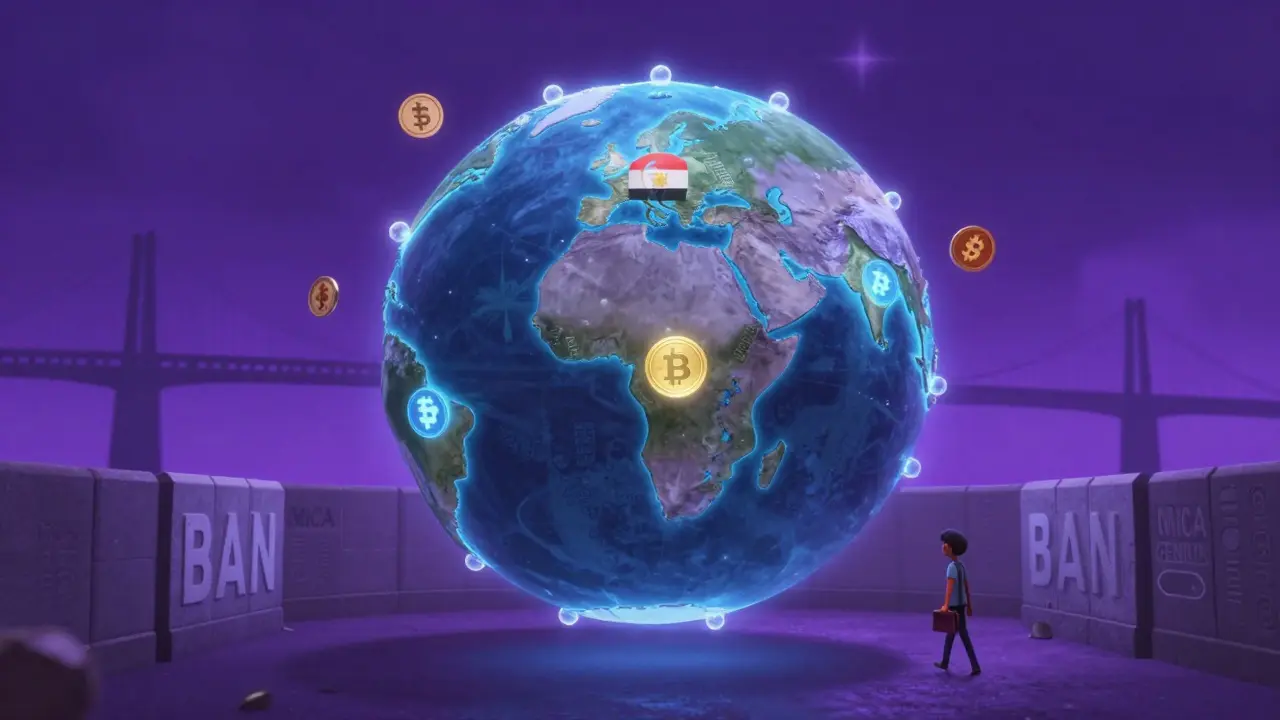
If you live in a country that bans cryptocurrency, using Bitcoin, Ethereum, or any other digital asset could land you in serious legal trouble. But how serious? And does it even work? The answer isn’t as simple as you might think. While some governments treat crypto use like a felony, others barely enforce their bans - and adoption keeps rising anyway.
Where Is Crypto Illegal - And What Happens If You Get Caught?
As of 2026, only about 10 countries have outright bans on cryptocurrency. That means 65 others allow it in some form. But even in those 10, the rules vary wildly. In Algeria is a country that prohibits the purchase, sale, use, and holding of virtual currencies under Article 117 of its 2017 official journal. The law says violations are punishable "in accordance with the laws and regulations in force," but it doesn’t say how much jail time or fine you’ll get. That vagueness makes enforcement unpredictable.
Morocco is similar. The central bank declared in 2017 that using Bitcoin is an "infringement of exchange regulations," but again, no specific penalties are listed. The same goes for Egypt. Banks and financial institutions are forbidden from dealing in crypto, yet individuals still trade through peer-to-peer apps. No one’s been prosecuted for personal use - at least not publicly.
Then there’s China. It’s the strictest case. Since 2021, China has banned all crypto trading, mining, and exchange operations. But here’s the twist: the ban targets companies and infrastructure, not everyday users. If you’re holding Bitcoin in your wallet? The government doesn’t come knocking. They shut down mining farms, freeze exchange accounts, and arrest operators - not ordinary people.
Why Do Countries Ban Crypto in the First Place?
Most bans aren’t about stopping technology. They’re about controlling money. Governments fear three things: money laundering, terrorist financing, and citizens moving wealth out of the country. The TRM Labs 2025 Crypto Crime Report shows how crypto is used to move funds for sanctioned groups like Hamas, Hezbollah, and Russian entities. In 2024, the U.S. Treasury’s Office of Foreign Assets Control (OFAC) designated 86 cryptocurrency addresses linked to these networks.
But here’s the irony: bans rarely stop the behavior. The Atlantic Council’s 2025 report found that even in countries with full crypto bans, adoption rates stayed high. In China alone, peer-to-peer crypto transactions hit $28.7 billion in 2024. In Algeria and Morocco, users still buy crypto on LocalBitcoins and Paxful. They just do it quietly.
How Do People Bypass Crypto Bans?
People aren’t waiting for permission. They’re using tools that bypass government control. Peer-to-peer (P2P) platforms like LocalBitcoins and Paxful let users trade directly - no bank account needed. In Egypt, users report using WhatsApp to arrange cash trades. In Morocco, people meet in cafés to swap cash for Bitcoin. No KYC, no trace.
Decentralized exchanges like Uniswap and PancakeSwap let users swap tokens without registering. You don’t need a passport. You just need a phone and a wallet. A 2025 CoinDesk survey of users in banned countries found only 12% had ever faced legal consequences. Most never even got a warning.
And let’s not forget stablecoins. USDT (Tether) and USDC are the real workhorses of underground crypto markets. They’re pegged to the U.S. dollar, so they’re stable. And they’re easy to move across borders. Over 80% of stablecoin flows in 2024 happened outside the U.S. - mostly in countries with strict bans.

Why Are Some Countries Changing Their Approach?
Governments are realizing bans don’t work. Instead, they’re shifting to targeted enforcement. The U.S. Department of Justice made this clear in April 2025 with its memo titled "Ending Regulation by Prosecution." It said they’ll stop using criminal charges to settle regulatory debates - like whether crypto is a security or commodity. Now, they focus only on real crimes: fraud, money laundering, sanctions evasion, and stealing client funds.
The European Union’s MiCA framework, which took effect in 2024, is another example. It doesn’t ban crypto. It regulates it. Exchanges must be licensed. Wallet providers must verify users. But if you own Bitcoin? You’re not breaking the law. South Korea took a similar path with its Virtual Asset Users Protection Act passed in 2023. It forces exchanges to keep records and protect users - not jail them.
Even Canada, which lists platforms like KuCoin and Poloniex as prohibited, doesn’t arrest users. It blocks those platforms from operating in Canada. The focus is on companies, not individuals.
What’s the Real Risk? And Who Gets Punished?
If you’re just holding crypto in your wallet, you’re probably fine - even in banned countries. The real targets are:
- Exchange operators running illegal platforms
- Miners running large-scale operations
- Businesses accepting crypto for payments
- People laundering money for sanctioned entities
Take Mustafa Ayash, founder of GazaNow. He wasn’t punished for using Bitcoin. He was sanctioned - and later arrested - for raising funds for Hamas after the October 7 attacks. That’s not a crypto ban violation. That’s a terrorism financing case. The punishment isn’t about owning crypto. It’s about funding violence.
Most people using crypto in banned countries aren’t doing anything illegal under international law. They’re just trying to save money, send remittances, or protect their savings from inflation. In countries like Nigeria, Argentina, and Turkey - where crypto isn’t banned - people use it for the same reasons. The difference? In those places, they’re not risking jail.
Is There Any Pattern to Who Bans Crypto?
Yes. Countries with outright bans are usually those with weak financial systems, strict capital controls, or authoritarian governments. Most are not G20 members. In fact, 12 of the 20 G20 countries - including the U.S., Japan, Germany, and Canada - have clear legal frameworks for crypto. The U.S. is the only advanced economy where crypto adoption ranks in the top 10 globally, despite regulatory uncertainty.
China’s ban stands out because it’s a major economy. But even there, enforcement is selective. The government doesn’t want crypto to replace the yuan. So they crush mining operations and shut down exchanges. But they’re not tracking every wallet. Why? Because they’re building their own digital currency - the digital yuan.
That’s the bigger picture. Over 90% of countries studied by the Atlantic Council are working on their own central bank digital currencies (CBDCs). The real goal isn’t to kill crypto. It’s to control money. If you can’t stop people from using Bitcoin, maybe you can get them to use your version instead.
What’s Next? Will Bans Disappear?
It’s not about whether crypto is legal. It’s about whether governments can control it. The data shows they can’t. Even in places with harsh penalties, adoption keeps growing. The U.S. just passed the GENIUS Act in July 2025, which regulates stablecoins as payment instruments - not as securities. That’s a sign of maturity: stop criminalizing, start regulating.
The future isn’t more bans. It’s smarter rules. Countries will keep cracking down on criminals - but they’ll stop punishing ordinary people for using tech they can’t control. The ones who get arrested won’t be the users. They’ll be the ones trying to stop them.
Can you go to jail for owning Bitcoin in a banned country?
In most cases, no. Countries like Algeria, Morocco, and Egypt ban crypto transactions, but enforcement targets businesses, not individuals. There are no public records of someone being jailed just for holding Bitcoin. The real risk comes from operating exchanges, mining farms, or using crypto for money laundering. Everyday users rarely face legal consequences.
Which countries have the harshest crypto penalties?
China has the strictest enforcement, but it focuses on companies - not users. Mining operations are shut down, exchanges are banned, and operators face prison. However, there are no known cases of individuals being jailed for personal crypto ownership. Other countries like Algeria and Egypt have vague laws with no clear penalties, making enforcement inconsistent. Russia and Iran have cracked down on exchanges but still allow private use.
Do crypto bans actually reduce usage?
No. The Atlantic Council’s 2025 data shows no correlation between bans and lower adoption. In China, peer-to-peer crypto volume hit $28.7 billion in 2024. In Algeria and Morocco, users still trade via P2P apps. When exchanges are blocked, people switch to decentralized platforms or cash trades. Bans create inconvenience - not compliance.
Is using crypto for remittances illegal?
It depends. In countries with strict bans, sending crypto to family abroad could technically violate capital control laws. But enforcement is rare. People in Nigeria, Egypt, and Venezuela regularly use crypto to send money home because traditional banks are slow or unreliable. Authorities rarely pursue these cases unless large sums are involved or linked to sanctions evasion.
Why are governments shifting from bans to regulation?
Because bans don’t work. Governments realized they can’t stop people from using crypto - but they can regulate the companies that enable it. The EU’s MiCA law, South Korea’s user protection act, and the U.S. GENIUS Act all focus on licensing exchanges, requiring KYC, and preventing fraud - not jailing users. This approach is more effective and less politically risky.
McKenna Becker
February 21, 2026 AT 18:29Samantha Stultz
February 22, 2026 AT 04:38George Suggs
February 22, 2026 AT 17:26Dianna Bethea
February 24, 2026 AT 16:04Michael Rozputniy
February 24, 2026 AT 20:20Cathy Sunshine
February 25, 2026 AT 23:26Dee Resin
February 27, 2026 AT 15:38Tanvi Atal
March 1, 2026 AT 03:50Colin Lethem
March 2, 2026 AT 00:32Kaitlyn Clark
March 3, 2026 AT 20:46Derek Sasser
March 5, 2026 AT 14:07Nadia Shalaby
March 6, 2026 AT 23:56John Fuller
March 7, 2026 AT 00:42Daisy Boliaan
March 8, 2026 AT 17:58Jessica Carvajal montiel
March 9, 2026 AT 11:21bella gonzales
March 9, 2026 AT 22:56Alyssa Herndon
March 11, 2026 AT 11:54