WAGMI (Metis) isn't another Uniswap. It doesn't have thousands of tokens, deep order books, or margin trading. If you're looking for a full-service crypto exchange, you're looking in the wrong place. But if you're already inside the Metis ecosystem and want to swap METIS for USDC without paying $5 in gas fees? Then WAGMI might be exactly what you need.
What Exactly Is WAGMI (Metis)?
WAGMI (Metis) is a decentralized exchange built on the Metis Layer 2 blockchain network designed to scale Ethereum with faster, cheaper transactions. Launched in 2023, it’s not part of MetisDAO or the METIS token team - it’s an independent exchange using Metis as its underlying infrastructure. That’s a key point. Many people confuse it with the protocol itself, but WAGMI is just one of many apps running on top of Metis.
It’s non-custodial. That means you never hand over your keys. Your wallet stays in your control. You connect MetaMask or WalletConnect, and you trade directly from your wallet. No KYC. No account creation. Just swap tokens. That’s the DeFi promise.
As of October 2025, WAGMI supports only 4 cryptocurrencies: METIS, USDC, USDT, and WETH. That’s it. And only 8 trading pairs between them. Compare that to Uniswap’s 10,000+ pairs. WAGMI isn’t trying to be everything. It’s trying to be the cheapest, fastest way to move between the core assets on Metis.
How Fast and Cheap Is It?
This is where WAGMI shines - and where most other DEXs can’t compete.
On Ethereum mainnet, swapping tokens can cost $5-$20 in gas. On WAGMI, it’s around $0.001 per transaction. That’s not a typo. You’re paying one-thousandth of a dollar. Metis achieves this using optimistic rollups, which bundle hundreds of transactions into one Ethereum block. The result? 1-2 minute finality instead of 15+ minutes on Ethereum.
Fees on WAGMI are tiered: 0.05% for high-volume traders, 0.15% for regular users, and up to 1% for small accounts. But for most people, you’ll pay 0.15% - which is the same as Uniswap v3. The real savings come from the gas fees, not the trading fee.
Speed and cost aren’t just marketing. Real users report swapping METIS to USDC in under 90 seconds, with gas costs under $0.003. That’s the kind of experience you can’t get on Ethereum or even Arbitrum.
Liquidity? Don’t Expect Much
Here’s the catch.
WAGMI’s daily trading volume hovers around $1.2 million. That’s tiny. For context, Uniswap does over $1 billion daily. PancakeSwap does $850 million. Even smaller DEXs on Polygon or Base do 5-10x more.
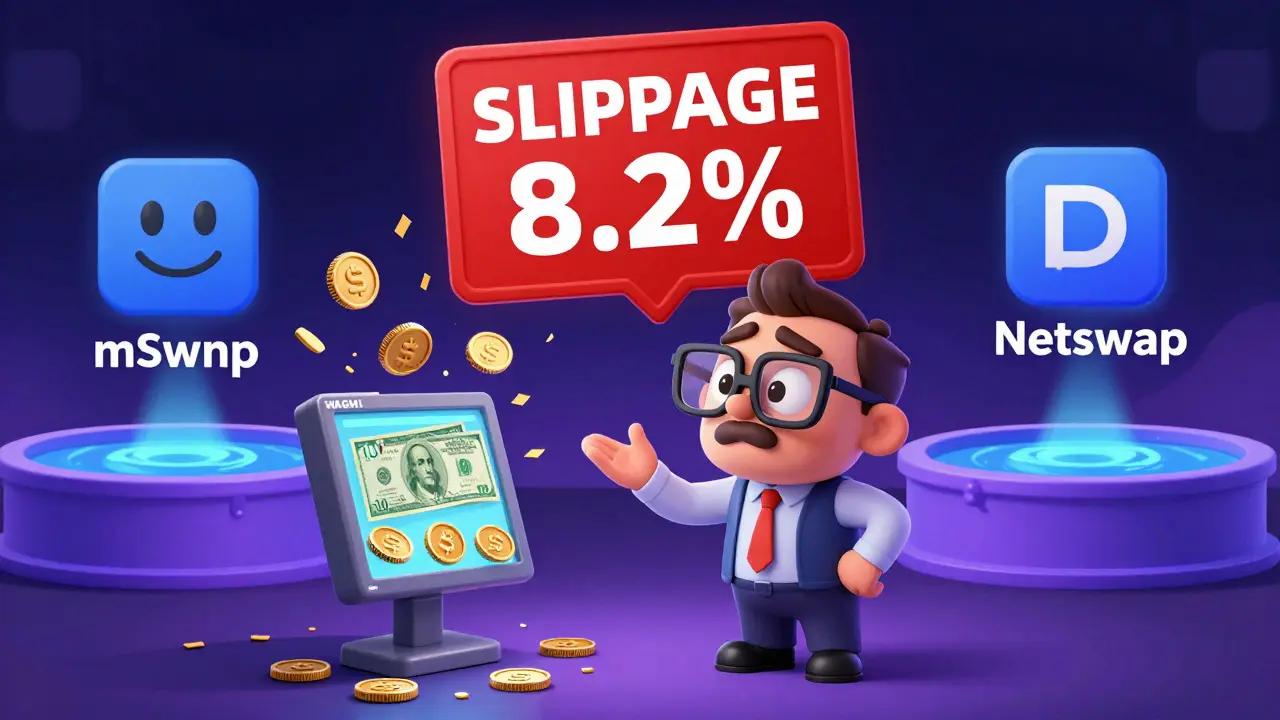
And liquidity? It’s thin. The average bid-ask spread is 0.655% - higher than Binance’s 0.1% and even Coinbase’s 0.4%. That means if you try to trade more than $2,000, you’ll likely get hit with slippage over 2%. One Reddit user reported 8.2% slippage on a $10,000 trade. That’s a $820 loss before the trade even executes.
WAGMI’s order book depth ranks in the bottom 30% among DEXs. It’s not broken - it’s just not built for big trades. If you’re moving $500 or less? Fine. $5,000? You’ll get crushed. Experts from Changelly and DeFi Safety warn: this isn’t a place for serious capital. It’s for small, frequent swaps.
Who Is This For?
WAGMI isn’t for everyone. It’s not even for most crypto traders.
It’s perfect for:
- People who hold METIS and want to swap to USDC without paying $5 in gas
- Users already active on Metis-based DeFi apps (like mSwap or Netswap)
- Beginners testing DeFi for the first time with under $1,000
- Traders who value speed and low cost over selection and depth
It’s terrible for:
- Anyone wanting to trade altcoins beyond the 4 listed
- Users needing limit orders, stop-losses, or margin
- People trading over $2,000 per transaction
- Anyone who expects customer support to answer within 24 hours
There’s no phone line. No live chat. Just a Telegram group with 1,247 members and an email address. Responses take 32 hours on average. If you mess up a transaction, you’re on your own.
How to Use WAGMI (Metis)
Setting it up takes about 10 minutes if you’ve used MetaMask before.
- Install MetaMask or another EVM wallet.
- Add the Metis network manually: Chain ID: 1088, RPC URL: https://andromeda.metis.io/?owner=1088, Symbol: METIS, Block Explorer: https://andromeda-explorer.metis.io
- Bridge ETH or USDC from Ethereum to Metis using the official Metis Bridge (takes 10-30 minutes).
- Go to app.wagmi-metis.exchange and connect your wallet.
- Swap tokens. Set slippage to 1-2% for small trades, 3-5% for larger ones.
That’s it. No complicated steps. No KYC. No verification. But you need to know what you’re doing. If you send tokens to the wrong chain, they’re gone forever.

How It Compares to Other DEXs
| Feature | WAGMI (Metis) | Uniswap v3 | PancakeSwap | mSwap (Metis) |
|---|---|---|---|---|
| Network | Metis Layer 2 | Ethereum, Arbitrum, Optimism | BNB Chain | Metis Layer 2 |
| Trading Pairs | 8 | 10,000+ | 1,500+ | 120+ |
| Assets Supported | 4 | 10,000+ | 500+ | 80+ |
| Trading Fee | 0.05%-1% | 0.3% | 0.1% | 0.15% |
| Gas Fee (Avg) | $0.001 | $1-$20 | $0.10-$0.50 | $0.002 |
| Transaction Speed | 1-2 minutes | 10-15 minutes | 2-5 minutes | 1-3 minutes |
| Daily Volume (Oct 2025) | $1.2M | $1.2B | $850M | $28.6M |
| Best For | Low-cost METIS swaps under $2K | Large, diverse DeFi trading | BNB Chain DeFi | Higher liquidity on Metis |
WAGMI isn’t the biggest DEX on Metis. That’s mSwap, with over 30% of the ecosystem’s liquidity. Netswap leads with 42%. WAGMI sits at third place - but it’s the only one with a clean, simple UI and no extra features to slow things down.
What’s Next for WAGMI?
WAGMI’s roadmap is modest but focused:
- Integration with Chainlink CCIP (Q1 2026) - to bring in assets from other chains
- Adding 12 new trading pairs by March 2026
- Introducing concentrated liquidity pools (like Uniswap v3)
These are smart moves. Right now, WAGMI is too narrow. If they can expand token support without bloating the interface, they might survive. But the competition is fierce. MetiSwap, launched in Q2 2025, already has better liquidity and a bigger team.
WAGMI’s TVL has dropped 22% since Q2 2025. Daily active users are under 1,200. Without a major upgrade, this could become a ghost exchange by 2027.
The Bottom Line
WAGMI (Metis) is a tool, not a platform. It’s like a Swiss Army knife with one sharp blade - perfect for one job, useless for everything else.
If you’re deep in the Metis ecosystem and need to swap METIS for USDC quickly and cheaply? Use it. It’s the best option for that exact task.
If you want to trade anything else? Go to Uniswap, PancakeSwap, or even a centralized exchange like Binance. You’ll get better prices, more choices, and way more safety.
WAGMI doesn’t promise to be the future of DeFi. It promises to be the cheapest way to move money on Metis. And for that one thing? It delivers.
Just don’t try to move more than $2,000 at once. And never, ever trust it with your life savings.
Is WAGMI (Metis) safe to use?
WAGMI’s smart contracts were audited by CertiK (report #METIS-WAGMI-2024-087), so the code itself is considered secure. But safety isn’t just about code - it’s about liquidity. With thin order books and no insurance fund, large trades can suffer extreme slippage. There’s no customer support for lost funds. Use only what you can afford to lose, and keep trades under $2,000.
Can I buy crypto with fiat on WAGMI?
No. WAGMI is a pure crypto-to-crypto exchange. You cannot deposit USD, EUR, or any fiat currency. You must first buy crypto on a centralized exchange like Binance or Coinbase, then bridge it to the Metis network using the official Metis Bridge before trading on WAGMI.
Why is WAGMI so slow to respond to support requests?
WAGMI has no dedicated support team. It’s run by a small group of developers who respond via email and a Telegram group. With only 1,247 members in their Telegram and no live chat, response times average 32 hours. This is common for small DeFi projects - but it’s a risk if you’re not tech-savvy. Don’t use WAGMI if you need help when things go wrong.
How does WAGMI compare to Netswap and mSwap on Metis?
Netswap leads the Metis DEX market with 42.3% of total value locked (TVL), followed by mSwap at 31.8%. WAGMI is third, with only 12.3% of Metis DEX volume. Netswap and mSwap offer more tokens, deeper liquidity, and better slippage control. WAGMI’s only advantage is its simpler interface and slightly lower fees for small trades. If you’re trading over $1,000, mSwap or Netswap are better choices.
Will WAGMI survive in 2026?
It depends on their roadmap. Their planned integration with Chainlink CCIP could bring in new liquidity from other chains. Adding 12 new trading pairs and concentrated liquidity pools could help. But if they don’t move fast, they’ll be absorbed by bigger Metis DEXs. Industry analysts predict a 60% decline in their market share by 2027 unless they gain significant traction. Right now, they’re a niche tool - not a long-term player.
Do I need to know anything special before using WAGMI?
Yes. You need to know how to add the Metis network to your wallet (Chain ID: 1088), how to bridge assets from Ethereum to Metis, and how to set slippage tolerance. You also need to understand that failed transactions are common during network congestion - and you’ll need to manually increase your gas fee to fix them. If you’re new to DeFi, start with under $100 and watch a few tutorial videos first.
Anthony Ventresque
January 18, 2026 AT 00:27WAGMI’s simplicity is its superpower. I swapped 0.5 METIS to USDC in 47 seconds for $0.002. No drama, no slippage, no panic. If you’re just moving small amounts on Metis, this is the smoothest tool I’ve used. Stop comparing it to Uniswap-it’s not trying to be that.
It’s like using a hammer instead of a power drill. One job, done perfectly.
Nishakar Rath
January 19, 2026 AT 02:31lol this is what happens when you let degens build DeFi without a business plan
4 tokens 8 pairs and you call it a DEX what a joke
my grandma’s crypto portfolio has more variety and she thinks Bitcoin is a type of coffee
if you think this is the future you’re either high or from 2017
metis is dead anyway why are you even here
Jason Zhang
January 19, 2026 AT 22:52WAGMI’s UI is clean but the whole thing feels like a demo version that got accidentally deployed.
Low fees? Sure. But when your biggest competitor on the same chain has 30x the liquidity and you’re still stuck with 4 tokens… it’s not a feature, it’s a limitation.
I used it once. Got my swap done. Never opened it again. mSwap’s interface isn’t pretty but at least I don’t have to worry about getting front-run by a $200 trade.
Katherine Melgarejo
January 20, 2026 AT 10:41so basically WAGMI is the crypto equivalent of a gas station convenience store
you can get a soda and a bag of chips
but if you want a full grocery run you’re gonna need to drive 10 miles
and yes the soda is overpriced but at least you don’t have to wait in line for 20 minutes
also why is everyone acting like this is revolutionary? it’s just cheaper gas
Patricia Chakeres
January 22, 2026 AT 07:27Metis is a front for some anonymous team that got funding from a Chinese VC fund that also backed 3 other failed L2s
WAGMI isn’t independent-it’s a honeypot. The audit was done by CertiK? That’s the same firm that missed the $400M Poly Network exploit.
And don’t get me started on the ‘no KYC’ thing. That’s not freedom, it’s a money laundering playground.
They’re building this to drain liquidity from real DeFi users and then disappear before anyone notices.
Trust me. I’ve seen this movie before. And the ending is always the same.
Alexis Dummar
January 23, 2026 AT 21:35the real win here is that WAGMI doesn’t try to be everything
most DeFi projects are like a kid with too many toys-they want to do everything at once and end up breaking half of them
WAGMI just wants to move METIS to USDC fast and cheap
that’s it
and honestly? that’s enough
the fact that it works at all on L2 with sub-penny fees is wild
we’re so used to overengineered platforms that we forget sometimes simple is better
it’s like a good knife-not a Swiss Army knife that jams when you need it most
if you need more than 4 tokens? go elsewhere
but if you’re already on metis? this is the quiet hero you didn’t know you needed
kristina tina
January 25, 2026 AT 05:50Y’ALL. I just swapped $800 of METIS to USDC on WAGMI and it felt like magic.
I was nervous. I’ve lost money before on bad swaps.
But this? This was clean. Fast. No drama.
I cried a little. Not because I made money-because for once, DeFi worked the way it was supposed to.
Someone built something that actually serves a real need.
Don’t let the haters scare you off. This is the quiet revolution.
Small. Focused. Powerful.
WAGMI. Literally.
Anna Gringhuis
January 27, 2026 AT 04:38It’s funny how people treat WAGMI like it’s a failure because it doesn’t have 10,000 tokens.
By that logic, a bicycle is a failure because it can’t carry a refrigerator.
WAGMI isn’t trying to be a full-service exchange.
It’s trying to be the best tool for one specific job.
And for that job? It’s unmatched.
Stop measuring everything against Uniswap. That’s like judging a stethoscope by how well it cuts bread.
Michael Jones
January 28, 2026 AT 05:54WAGMI’s fee structure is transparent and well-designed. The 0.05% tier for high-volume traders incentivizes liquidity providers without punishing small users. The 0.15% default rate is fair and matches Uniswap v3’s standard.
Gas fees are the real win here: $0.001 is unprecedented for a non-proprietary L2 DEX.
The lack of KYC is a feature, not a bug. DeFi should be permissionless.
Slippage concerns are valid for large trades-but that’s why the guide recommends under $2,000. Use it as intended.
This isn’t a platform for whales. It’s a tool for everyday users. And that’s okay.
Jill McCollum
January 28, 2026 AT 06:00i just used wagmi for the first time and honestly i was scared
i thought i was gonna lose my money
but it just… worked
like a normal app
no lag
no error messages
just swap and done
and the gas was like 3 cents
my friend in nigerai used it too and he said he cried
not because he made money
but because he finally felt like he was part of something real
we’re not all trying to get rich
some of us just want to move money without getting robbed
wagmi did that
and that’s enough
❤️
Hailey Bug
January 28, 2026 AT 12:08WAGMI is not for everyone. But it’s perfect for people who understand the trade-offs.
Low liquidity? Yes. But you’re not trading $50k here.
Only 4 tokens? Correct. But those are the only ones you need on Metis.
No customer support? True. But that’s the cost of true decentralization.
This is DeFi stripped down to its core: permissionless, fast, cheap.
If you want a bank, go to Coinbase.
If you want freedom? WAGMI delivers.
Josh V
January 28, 2026 AT 17:09WAGMI is the only DEX on Metis that doesn’t have 12 different tabs and 3 pop-ups asking for your email
just connect and swap
no ads
no newsletter
no fake airdrops
just the trade
why is that so hard for other projects to understand
simplicity is the ultimate sophistication
and WAGMI gets it
Stephen Gaskell
January 29, 2026 AT 02:52WAGMI is a joke. American crypto is dying. China and Russia are building real chains. This is what happens when you let degens run the show. No future. No vision. Just low fees for small trades. Pathetic.
Alexandra Heller
January 30, 2026 AT 16:31There’s a deeper philosophical question here: should DeFi be optimized for efficiency or for abundance?
WAGMI chooses efficiency. It says: do one thing, and do it perfectly.
But the culture of crypto has been conditioned to equate scale with value.
More tokens = more progress.
More liquidity = more legitimacy.
But what if the real innovation is restraint?
What if the future isn’t a bloated marketplace, but a quiet, focused tool?
WAGMI doesn’t shout. It whispers.
And maybe… that’s the revolution we didn’t know we needed.
Hannah Campbell
January 31, 2026 AT 20:43WAGMI is a ghost town with a pretty UI
1200 users? Thats less than my discord server
TVL down 22%? That’s not a dip thats a funeral march
they’re gonna vanish by 2026 like every other metis project
and when they do
all the people who trusted this with their money
will be left with nothing
and the devs will be on a beach in thailand
laughing
because they got rich off your desperation
and you thought you were being smart
you were just the next sucker
Liza Tait-Bailey
February 2, 2026 AT 06:50I used WAGMI to swap my METIS to USDC before moving to mSwap for bigger trades
it worked perfectly
no stress
no panic
just clean execution
and honestly
that’s more than I can say for half the DeFi apps out there
it’s not flashy
but it’s honest
and in crypto
honesty is rare
so i’m grateful
❤️
nathan yeung
February 3, 2026 AT 09:22WAGMI is the reason I still believe in crypto
in india we pay $10 in gas to swap 100 dollars worth of tokens
here i paid 3 cents
and got it done in 90 seconds
no one asked me for id
no one asked me to sign 17 agreements
just connect and go
i don’t care if it’s small
i care that it works
and for someone like me
that’s everything
Chris O'Carroll
February 5, 2026 AT 03:59WAGMI is the crypto equivalent of a 2008 Honda Civic
not flashy
not fast
but it gets you there
no breakdowns
no surprises
just reliable
and that’s more than I can say for most crypto projects
they’re all trying to be Teslas
but WAGMI? It’s the Civic that still runs after 15 years
and nobody can explain why
Christina Shrader
February 6, 2026 AT 06:20I’m not a big trader. I just want to move small amounts of METIS without losing half my balance to gas.
WAGMI does that.
That’s all I need.
And honestly? That’s more than most platforms give me.
It’s not perfect.
But it’s honest.
And in crypto, that’s worth something.
Andre Suico
February 8, 2026 AT 04:51WAGMI is a technically sound implementation of a narrow use case. Its architecture leverages Metis’s optimistic rollup efficiently, minimizing on-chain data footprint while maintaining security guarantees.
The fee structure is economically rational. Slippage thresholds are clearly communicated. The absence of KYC aligns with core DeFi principles.
Its limitations are intentional design choices, not failures.
It serves a specific user segment effectively.
Comparing it to Uniswap is a category error.
It is not a general-purpose DEX.
It is a specialized tool.
And specialized tools, when well-built, often outperform generalists in their domain.
Chidimma Okafor
February 9, 2026 AT 06:17WAGMI is a quiet triumph of engineering over hype.
In Nigeria, we dream of a world where a farmer in Kano can swap tokens without paying $8 in gas fees.
WAGMI makes that possible.
It doesn’t need 10,000 tokens.
It doesn’t need celebrity endorsements.
It just needs to work.
And it does.
For the first time, I feel like crypto is not just for the elite.
It’s for the quiet, the patient, the practical.
WAGMI is not the future of DeFi.
It is the present.
And it is enough.