Imagine you’re an independent inventor in Bristol. You’ve just patented a new type of solar panel efficiency algorithm. In the traditional world, proving you owned that idea first involves piles of paperwork, waiting months for government stamps, and hoping no one else filed it slightly earlier. Now, imagine doing that in seconds, with a timestamp so secure not even a government agency can alter it, and selling a license to a company in Tokyo without ever speaking to a lawyer. That’s the promise of Blockchain IP Marketplaces. These platforms aren’t just buzzwords; they are actively changing how we define, protect, and trade ideas.
The Broken State of Traditional IP Management
Before we look at the fix, let’s be honest about the problem. The current system for managing Intellectual Property (IP) is slow, fragmented, and expensive. If you want to license your music sample or patent your software code, you often deal with opaque intermediaries. Verification takes weeks. Disputes over who created what take years. And don’t get me started on cross-border transactions-trying to enforce a UK copyright in China can feel like shouting into a void.
Creators lose out here. Small inventors and artists often lack the legal budget to fight infringement cases. Meanwhile, large corporations spend millions on compliance teams just to track who owns what. It’s a bottleneck for innovation. When you have to wait six months to prove you own an idea, you’re not innovating; you’re waiting.
How Blockchain Fixes Ownership Proof
A blockchain IP marketplace is a decentralized platform that uses distributed ledger technology to register, verify, and trade intellectual property assets. At its core, it solves the "trust" issue. Instead of relying on a central authority like a patent office to hold the only record of truth, every transaction is recorded across thousands of computers (nodes). Once your IP is registered on the chain, it gets a unique digital fingerprint and an incorruptible timestamp.
This creates an immutable record. No one can go back and change the date you uploaded your design. This is huge for legal disputes. If someone claims they invented your feature first, you can pull up the blockchain record and show exactly when yours was logged. It turns a he-said-she-said argument into a verifiable fact.
Smart Contracts: The Automated Middleman
If blockchain provides the record, Smart Contracts provide the action. Think of these as self-executing contracts where the terms are written directly into lines of code. In a traditional setting, if you license your photo to a magazine, you send an invoice, wait for payment, and hope they don’t forget to pay next month.
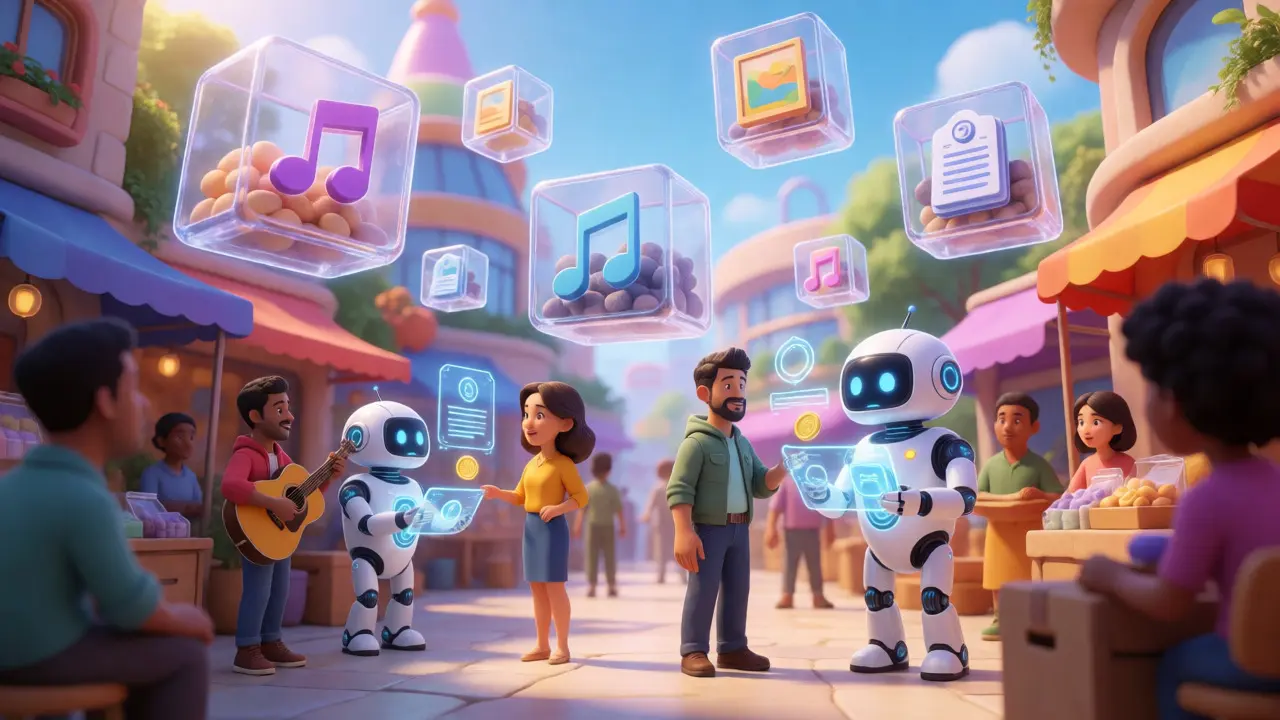
In a blockchain marketplace, the smart contract handles this automatically. When the magazine uses the photo, the smart contract detects the usage (or receives a signal) and instantly releases the royalty payment to your wallet. No invoices. No chasing payments. No late fees. This automation extends to complex scenarios too, like split royalties between a songwriter, a producer, and a label. The code splits the money precisely according to the agreed percentages every time the song is streamed or sold.
Key Players Shaping the Landscape
You might wonder, "Is this actually happening, or is it still theoretical?" It’s very real. Several platforms are leading the charge, each targeting different niches within the IP world.
| Platform | Primary Focus | Key Feature | Target Audience |
|---|---|---|---|
| IPwe | Patents & Trademarks | AI-driven patent valuation and trading | Corporations, R&D firms |
| DEIP Ledger | General IP Registration | Open-source protocol for IP data | Developers, Creators |
| GoChain | Enterprise Solutions | High-speed transactions for business use | Enterprises, Supply Chain |
| IPChain | Russian/EU Market | Integration with national IP registries | Regional businesses |
Notice the diversity? IPwe focuses heavily on high-value corporate patents, using AI to help companies buy and sell unused patents. DEIP Ledger is more open, allowing anyone to build applications on top of their protocol. This variety means there’s likely a solution whether you’re a solo artist protecting a logo or a tech giant managing a portfolio of 10,000 patents.
Types of Marketplaces: Open vs. Closed
Not all blockchains are built the same way, and neither are their marketplaces. Generally, you’ll encounter two main types:
- Open Marketplaces: These are permissionless. Anyone can list their IP, and anyone can buy or license it. They offer maximum liquidity and global reach but require users to do their own due diligence regarding quality and legality.
- Closed (Permissioned) Marketplaces: These restrict access to verified entities. Often used by consortia of banks or specific industries, they prioritize compliance and security over speed. You know everyone on the network has been vetted, which reduces fraud risk.
There’s also a distinction between primary and secondary markets. Primary markets are where new IP is registered and sold for the first time. Secondary markets allow previously traded rights to be resold. Imagine buying a share of a music catalog today and selling it three years later because its value increased-that’s the secondary market in action.
Real-World Benefits for Creators and Businesses
Why should you care? Let’s break down the tangible benefits.
For Creators: You gain direct access to buyers. You cut out the middlemen who take large cuts of your earnings. You get paid faster thanks to automated smart contracts. And crucially, you have undeniable proof of creation, which empowers you to fight infringement without breaking the bank.
For Businesses: Due diligence becomes easier. If you’re acquiring a startup, checking their IP portfolio on the blockchain gives you a clear, auditable trail of ownership history. There’s less risk of hidden liens or disputed ownership. Additionally, tokenizing IP allows companies to fractionalize ownership. A pharmaceutical company could sell shares of a drug patent to investors, raising capital without giving up full control.

The Challenges: It’s Not All Smooth Sailing
Let’s keep it real. Blockchain isn’t a magic wand. There are hurdles.
First, there’s the learning curve. Managing digital wallets, understanding gas fees, and interacting with smart contracts can be intimidating for non-tech-savvy creators. While user interfaces are improving, it’s still harder than uploading a file to Dropbox.
Second, legal recognition varies wildly. While a blockchain timestamp is technically strong evidence, not every court in every country accepts it equally yet. You might have perfect proof on the chain, but if the local judge doesn’t understand the tech, you could still face challenges. Regulatory frameworks are catching up, but they lag behind the technology.
Third, interoperability. If your patent is on Ethereum and the buyer’s system runs on Hyperledger, moving that asset seamlessly can be tricky. Cross-chain bridges exist, but they add complexity and potential points of failure.
Getting Started: A Practical Guide
Ready to try it out? Here’s a simplified path for participating in a blockchain IP marketplace.
- Choose Your Platform: Match the platform to your asset type. Use IPwe for patents, DEIP for general creative works, or specialized NFT platforms for digital art.
- Set Up a Digital Wallet: You’ll need a crypto wallet (like MetaMask) to store your tokens and sign transactions. Secure your seed phrase carefully.
- Register Your Asset: Upload your work or patent details. The platform will generate a hash (digital fingerprint) and record it on the blockchain. This usually costs a small transaction fee.
- Define Licensing Terms: Create a smart contract template. Specify price, duration, and royalty splits. Make sure the logic matches your intent.
- List and Promote: Put your asset on the marketplace. Share the link. Because it’s public, SEO and community engagement matter just as much as in traditional sales.
The Future: Interoperability and Regulation
As we move deeper into 2026, the trend is toward integration. We’re seeing more efforts to connect blockchain records with traditional government databases. Imagine filing a patent with the UK Intellectual Property Office and having it automatically mirrored on a private blockchain for instant verification. That hybrid model is likely the near-term future.
Also, watch for NFT evolution. Initially seen as hype for JPEGs, NFTs are maturing into serious tools for representing unique IP rights. We’ll see more utility-based NFTs that grant access to exclusive content, voting rights in DAOs (Decentralized Autonomous Organizations), or revenue shares from physical products.
Are blockchain IP registrations legally binding?
It depends on the jurisdiction. In many places, blockchain records serve as strong supporting evidence of creation and ownership rather than replacing official registration entirely. However, some regions are beginning to recognize them as primary proof. Always consult a local IP attorney for critical assets.
Do I need cryptocurrency to use these marketplaces?
Generally, yes. Most transactions, including registration fees and licensing payments, occur via cryptocurrencies or stablecoins. Some platforms are introducing fiat on-ramps, allowing you to pay with credit cards, which then convert internally to crypto for the settlement layer.
What happens if I make a mistake in my smart contract?
Because smart contracts are immutable once deployed, errors can be costly. Many platforms now offer "upgradeable" contracts or testing environments where you can simulate transactions before committing. Always test your contract logic thoroughly before listing high-value assets.
Can big corporations really trust decentralized systems?
Yes, increasingly so. Companies prefer permissioned blockchains where they know exactly who the other participants are. This combines the transparency and efficiency of blockchain with the privacy and control requirements of enterprise law.
How does this help against counterfeiting?
Each genuine product or licensed asset has a unique token on the blockchain. Consumers can scan a QR code to verify the item’s provenance and authenticity instantly. Counterfeiters cannot replicate the cryptographic proof of origin, making fakes easy to spot.