Imagine walking into a bank branch in 2026. You don't hand over your passport or show a physical ID card. Instead, you tap your phone against a reader, and the system verifies your age, citizenship, and creditworthiness instantly. No data leaves your phone except the specific proof the bank asked for. This is the promise of Blockchain Identity Standards, a technical framework that shifts control of digital identity from corporations back to individuals. These standards are no longer just theoretical; they are the backbone of new digital wallets, government e-residency programs, and enterprise supply chain verifications.
The core problem these standards solve is simple but critical: centralization. Traditional identity systems rely on a single database-your university's records, your government's registry, or a tech giant's cloud. If that server gets hacked, your identity is compromised. Blockchain identity standards use distributed ledgers to create tamper-proof records that you own, not rent. By 2024, 92% of new decentralized identity frameworks were built upon the foundational specifications released by the World Wide Web Consortium (W3C), signaling a clear industry consensus on how this technology should work.
The Core Building Blocks: DIDs and Verifiable Credentials
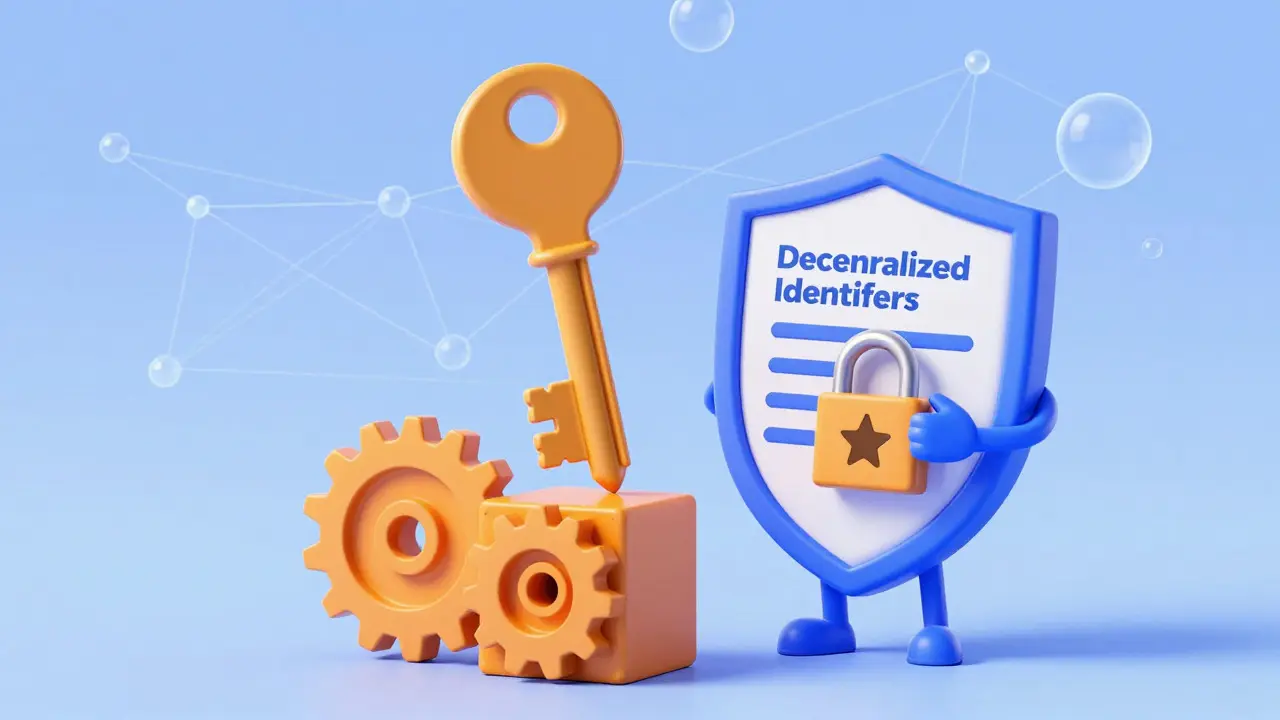
To understand how this works, you need to know two specific terms: Decentralized Identifiers (DIDs) and Verifiable Credentials (VCs). Think of a DID as your unique, permanent digital address. It follows a strict format defined by the W3C DID Specification 1.0, published in July 2022. The format looks like did:method:identifier. For example, did:ion:abc123 might be your identifier on Microsoft’s ION network, while did:key:xyz789 uses a simpler public key method. As of late 2024, there are 37 registered DID methods, each serving different needs from enterprise privacy to consumer simplicity.
Verifiable Credentials are the digital documents attached to those DIDs. A VC isn't just a PDF scan; it’s a cryptographically signed JSON object. When an issuer (like a university) signs your degree with a VC, they attach a cryptographic proof. Later, when you prove your degree to an employer, you can use selective disclosure. This means you can prove "I have a Master's Degree" without revealing your GPA, graduation year, or even the name of the university if you prefer. This capability relies on zero-knowledge proofs, a mathematical technique that allows one party to verify a statement without revealing the underlying data.
| Component | Function | Standard/Spec | Key Attribute |
|---|---|---|---|
| DID | Unique identifier | W3C DID Spec 1.0 | Permanent, user-controlled URI |
| VC | Cryptographic document | W3C VC Data Model 1.0 | Selective disclosure via ZKPs |
| Resolver | Finds DID docs | Universal Resolver | Cross-chain interoperability |
Major Frameworks and Networks
Standards are only useful if software implements them. Several major networks have emerged, each with distinct trade-offs between speed, privacy, and decentralization.
- Sovrin Network: Launched in 2018, Sovrin is a permissioned blockchain designed specifically for identity. It processes high volumes of transactions efficiently. In 2023, it handled 12.7 million identity registrations. It’s popular for government and large enterprise projects because its governance structure is transparent and stable.
- Hyperledger Indy: Developed under the Linux Foundation, Hyperledger Indy is the engine behind many enterprise solutions. It supports over 1,000 transactions per second (TPS) with finality in under two seconds. This makes it suitable for real-world applications like supply chain tracking where speed matters.
- Microsoft ION: Built on Ethereum, ION offers a more decentralized approach. While Ethereum’s base layer handles about 15 TPS, ION leverages Layer 2 scaling solutions to improve performance. It’s favored by developers who want to stay within the Ethereum ecosystem.
- Ethereum Name Service (ENS): Often confused with identity, ENS is primarily a naming service, but it’s increasingly used for basic identity anchoring. However, it processed fewer registrations (473,000 in 2023) compared to dedicated identity chains like Sovrin, highlighting the difference between general-purpose blockchains and specialized identity infrastructure.
The choice of network depends on your needs. If you’re a bank needing regulatory compliance and speed, a permissioned network like Sovrin or Hyperledger-based solutions might be best. If you’re a developer building a consumer app and value maximum decentralization, Ethereum-based solutions like ION or ENS might be more appropriate.
Interoperability and the Universal Resolver
A major criticism of early blockchain identity was fragmentation. Your ID on one network couldn’t be verified on another. This created silos, defeating the purpose of open standards. The solution is the Universal Resolver, developed by the Decentralized Identity Foundation. This framework acts as a translator. It allows a verifier on any platform to resolve a DID, regardless of which method or network it belongs to.
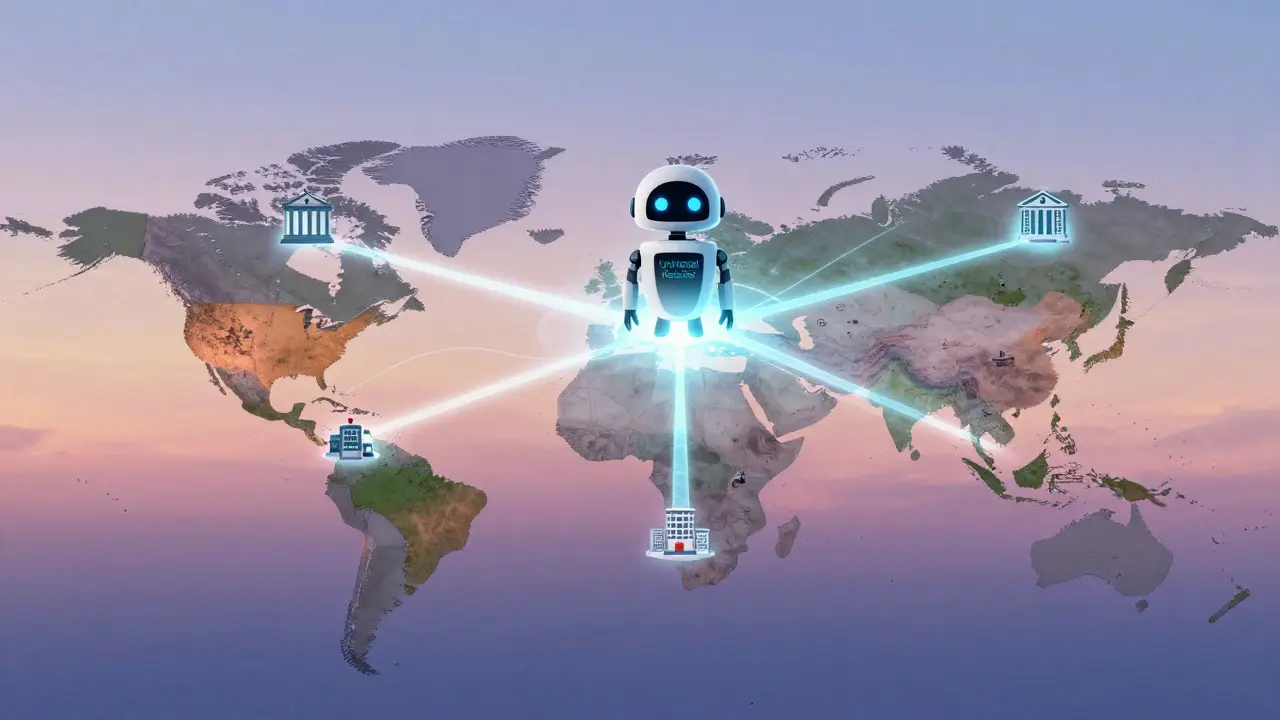
In 2024, the European Blockchain Sandbox pilot demonstrated this power by connecting German, French, and Dutch government identity systems. Previously, cross-border verification required bilateral agreements and custom code. Now, a single resolver call can handle it. This is crucial for the EU’s eIDAS 2.0 regulation, which takes effect in June 2026. eIDAS 2.0 mandates that member states recognize blockchain-based qualified electronic identities, making interoperability not just a technical nice-to-have, but a legal requirement.
Real-World Adoption and Challenges
Are these standards actually being used? Yes, but with caveats. The banking and financial services sector leads adoption, holding 24% market share in 2025. Banks use blockchain identity to reduce Know Your Customer (KYC) times. One case study showed a reduction in onboarding time from 72 hours to 20 hours using R3 Corda’s identity solution. However, implementation costs are high. The average enterprise project costs $287,000, and most companies need external consultants.
Healthcare lags behind at 12% market share, largely due to HIPAA compliance complexities. But success stories exist. The Philippines’ Department of Social Welfare and Development used a Hyperledger Indy-based system for its cash assistance program, reducing identity fraud by 94%. Conversely, Australia’s myGovID pilot was discontinued in 2023 after 68% of users over 55 struggled with the wallet interface. This highlights a critical gap: technical robustness doesn’t guarantee user adoption. Usability remains the biggest hurdle for mainstream consumer adoption.
Security is another concern. A 2023 review by the MIT Digital Currency Initiative found that 22% of implementations had improper key management practices. If you lose your private key, you lose your identity. Unlike a forgotten password, there is no "reset" button. This has led to the development of social recovery mechanisms and biometric-bound credentials, though 63% of negative reviews for identity wallets still cite irreversible account loss as the primary issue.
Future Outlook and Regulatory Alignment
The future of blockchain identity standards looks bright but complex. The global market is projected to grow from $1.57 billion in 2025 to $118.96 billion by 2032. Two trends will shape this growth:
- Regulatory Mandates: With eIDAS 2.0 in the EU and NIST developing US standards, regulators are moving from observation to enforcement. This will drive standardization and reduce fragmentation.
- AI Integration: 83% of platforms plan to integrate AI for fraud detection by 2026. AI can analyze behavioral patterns in identity verification, adding another layer of security beyond cryptography.
However, experts warn that governance remains the weak link. Dr. Kim Hamilton Duffy, co-chair of the W3C Credentials Community Group, notes that while technical interoperability is solved, governance frameworks are not. Without clear rules on who controls the standards and how disputes are resolved, we risk creating new forms of centralization through dominant wallet providers. The goal is true self-sovereignty, where users have economic and technical control over their identity. Achieving that requires not just better code, but better policies.
OLIVER CHRISTIAN
August 20, 2026 AT 20:50Great overview of the landscape. One thing to keep in mind is that while the tech is solid, the UX is still the biggest hurdle. We've seen this with myGovID in Australia. If you can't make it work for a 55-year-old grandmother without a tutorial, it's not ready for prime time.
Calliope Clio
August 21, 2026 AT 09:19Meh 🙄 another buzzword salad piece pretending to be deep. The '92% consensus' stat is suspiciously round and likely pulled from thin air by some VC firm trying to justify their next round. Who actually reads these specs? Just us degens and bored sysadmins I bet. It's all just fancy JSON in a trench coat. 💅
Tasha Davis
August 22, 2026 AT 11:53Ooh this looks really cool! I love how you don't have to show your whole ID, just what they need. That feels so much safer than handing over a passport every time. I hope this works out for everyone because privacy is super important!
Jillian Groskreutz
August 23, 2026 AT 14:23You're missing the point entirely; it's not about 'feeling safe,' it's about cryptographic proof-of-possession. If you think tapping a phone is inherently secure, you haven't read the W3C spec on key management. It's a disaster waiting to happen if you lose your seed phrase. Don't get your hopes up, darling.
Mohamed Shoaeb
August 25, 2026 AT 03:44from an Indian perspective we are seeing a lot of this in the Aadhaar system but that is centralized. The DID approach is interesting because it allows for portability across borders which is huge for the diaspora. However the infrastructure cost mentioned here is high for smaller enterprises. We need more open source implementations to bring the price down.
SHIV SHANKAR KANTA
August 26, 2026 AT 01:09the soul of identity is being digitized and sold to the highest bidder. they say self-sovereign but who controls the resolver? it is always the same old powers in new clothes. we are trading one master for another just with better encryption. wake up people. the matrix is updating its code.
Alexander Scheel
August 26, 2026 AT 05:11One must observe that the narrative of 'self-sovereignty' is largely a marketing construct designed to obscure the reality of corporate data harvesting. While the cryptography is sound, the social contract remains broken. Until users understand the trade-offs between convenience and privacy, this will remain a niche tool for the technologically literate elite.
Quang Thai Tran
August 27, 2026 AT 03:15It is highly probable that this entire standardization effort is a front for a global surveillance state. The EU eIDAS mandate is merely the first step towards a digital leash. Watch closely as the 'interoperability' features allow foreign governments to track citizens seamlessly. The wolves are coming, and they are wearing suits.
Dianne Ritter
August 27, 2026 AT 19:53Let's be real for a second. The $287k implementation cost is a joke for small businesses. This tech is only viable for banks and governments right now. Unless we see a massive drop in dev costs or a free tier from a major provider, this is going to stay in the enterprise silo. Great write-up though, very detailed.
Kelsey Anne
August 28, 2026 AT 02:15Key management is the weak link. Lose the key, lose the life. Simple as that.
Teri W
August 28, 2026 AT 18:13I feel like we are walking into a trap!! Everyone is so excited about the 'future' but nobody talks about what happens when the server goes down or the app gets hacked. My cousin tried a crypto wallet and lost his savings. Imagine losing your ID?! It's terrifying honestly. Why do we trust computers with our souls?
Marco Maldonado
August 29, 2026 AT 21:08US needs to stop letting the EU dictate our standards. eIDAS is great for them but we have NIST. We should build our own sovereign stack. Why do we need to interoperate with German bureaucracy? Let's keep it American. Strong, independent, and fast. No need for that European red tape slowing us down.
Darren Moon
August 30, 2026 AT 04:04While the technical architecture is robust, one must consider the sociological implications of such a shift. The term 'self-sovereign' is somewhat oxymoronic given the dependency on third-party resolvers. Furthermore, the jargon-heavy nature of the discourse alienates the very public it seeks to empower. A more accessible lexicon would be beneficial for mainstream adoption, wouldn't you agree?
Daniel Brown
August 30, 2026 AT 08:36You guys are overthinking it. Just use the phone. If you can't handle a QR code you are too dumb for the internet anyway. Stop complaining about the interface and start using the tech. Progress doesn't wait for the slow ones.
Sonia Gomez Gomez
August 31, 2026 AT 14:51Did you know that your biometric data is already being harvested by your smart fridge? 🤔 This is just the next logical step. Stop fighting the inevitable and embrace the transparency! Your privacy was never yours to begin with, honey. 😘
Nia Franklin
September 1, 2026 AT 00:11Oh wow, the cross-border aspect is just... magical?? 🌍✨ I mean, imagine traveling without paperwork!! It’s like a dream come true for frequent flyers. Though, I did stumble on a typo in the intro (it said 'rent' instead of 'rented' maybe?) but otherwise, pretty neat stuff! Can’t wait to see this in action at the airport!! ✈️💖
Mike Baca
September 1, 2026 AT 21:48Here is the thing man. We talk about decentralization but we are just moving the database from the bank to the cloud. Is that really freedom? Or is it just a different kind of cage? I think we are philosophically stuck. The tech is cool but the human condition hasn't changed. We still want to be known. We still want validation. Does a DID change that? I doubt it. But hey, nice article. Made me think hard.
Jennifer Ulmer
September 2, 2026 AT 17:16I think the balance between security and ease of use is tricky. If it's too easy, people get lazy and lose keys. If it's too hard, people give up. Maybe we need better recovery options built into the standard itself rather than relying on social recovery hacks. It's a good problem to solve though.
Dianne Ritter
September 3, 2026 AT 13:25Agreed. Social recovery is a band-aid. We need hardware-backed recovery or perhaps a hybrid model where a trusted contact can help restore access after a cooldown period. Otherwise, we are just creating digital orphans.