When governments talk about CBDCs, they’re not just talking about a new way to pay for coffee. They’re talking about a complete overhaul of how money moves, who controls it, and what they can see when you spend it. Unlike Bitcoin or Ethereum, CBDCs aren’t decentralized. They’re issued, tracked, and managed by the same institutions that print cash-your country’s central bank. And that changes everything.
Real-Time Oversight of Every Transaction
Imagine if every time you bought groceries, paid rent, or donated to a charity, the government saw it instantly. That’s not science fiction-it’s how CBDCs work. Every digital coin carries a unique identifier tied to your identity. This isn’t just about tracking fraud. It’s about knowing exactly where money flows in real time. A mother in rural India uses her CBDC wallet to buy rice. A teenager in Berlin tips a street musician. A small business owner in Mexico sends money to a supplier. All of it is recorded, timestamped, and stored in a single government ledger.
This level of visibility gives central banks tools they’ve never had before. They can see spending patterns across regions, detect sudden drops in consumption, and even predict economic downturns before they hit. In 2024, the Bank of England tested a prototype CBDC that flagged unusual spending spikes in energy bills during a heatwave-allowing emergency aid to be distributed within hours, not weeks.
Slashing the Cost of Running Money
Printing, transporting, securing, and storing physical cash costs governments billions every year. The U.S. Federal Reserve spends over $700 million annually just to manage paper currency. CBDCs eliminate that. No more armored trucks. No more vaults. No more counterfeit bills. A digital dollar, euro, or yen costs almost nothing to issue once the system is built.
Even more striking is the impact on international payments. Right now, sending money across borders can take days and cost up to 6.25% in fees. With CBDCs, those transactions happen in seconds, directly between central banks. No SWIFT network. No intermediary banks. No hidden charges. Countries like Nigeria and Jamaica have already seen remittance costs drop by over 40% in pilot programs.
Smarter, Faster Economic Policy
Traditional monetary policy moves slowly. Interest rate changes take months to ripple through the economy. CBDCs change that. With direct access to citizens’ digital wallets, central banks can adjust spending behavior instantly.
Imagine a recession hits. Instead of waiting for banks to approve stimulus checks, the government sends digital funds directly into every citizen’s CBDC wallet. And here’s the twist: those funds can be programmed. They expire in 30 days unless spent on local businesses. Or they can only be used at grocery stores, not online retailers. This isn’t theoretical-it’s been tested in China’s digital yuan program, where stimulus funds were restricted to small vendors to boost local economies.
Negative interest rates become possible too. If the economy is overheating, the central bank can automatically reduce the value of money in your wallet over time-encouraging spending instead of hoarding. No need to convince banks. No need for complex financial instruments. Just a software update.

Cracking Down on Crime and Tax Evasion
Cash is anonymous. That’s why it’s used in drug deals, human trafficking, and tax fraud. CBDCs end that. Every transaction leaves a permanent, unchangeable digital trail. If someone tries to launder money through a series of shell companies, the system flags it. If a business hides income by underreporting sales, the government sees every payment received.
Law enforcement agencies no longer need warrants to trace money. They can pull up a full financial history with a single query. In 2025, Spain’s National Police used CBDC transaction logs to dismantle a €200 million tax evasion ring that had gone undetected for five years. The evidence was all there-time-stamped, location-tagged, and linked to real identities.
Even sanctions become sharper. If a country is under international sanctions, CBDCs can block transactions to specific businesses or regions automatically. No loopholes. No offshore accounts. Just code enforcing policy.
Financial Inclusion Without Banks
Over 1.4 billion people worldwide don’t have bank accounts. They live in cash economies-relying on informal lenders, cash transfers, or barter. CBDCs change that. You don’t need a bank branch to use a digital wallet. A smartphone and a government-issued ID are enough.
In Kenya, a pilot CBDC project helped over 300,000 unbanked women receive direct payments for solar energy subsidies. No middleman. No delays. No paperwork. In Brazil, rural farmers began receiving crop subsidies directly into their phones, cutting administrative costs by 70% and reducing corruption.
This isn’t charity. It’s efficiency. Governments stop wasting money on intermediaries. Citizens stop losing money to fees. And everyone gets faster, more reliable access to public services.
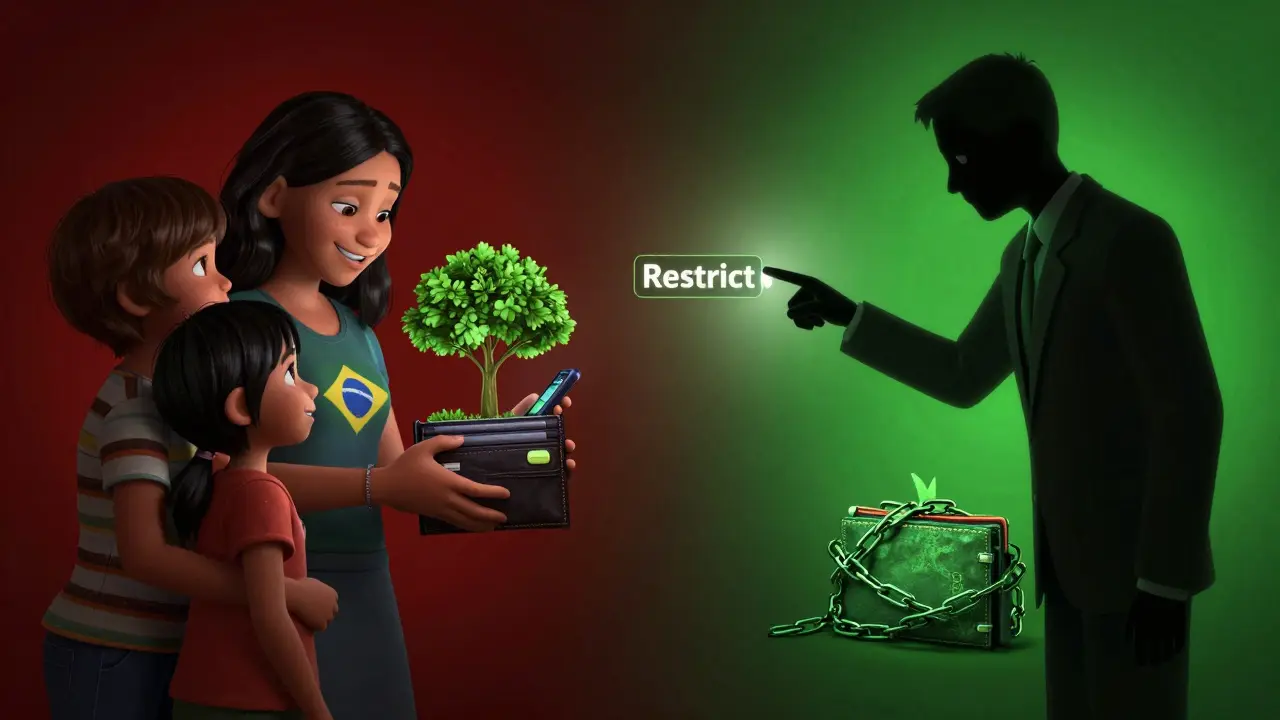
The Dark Side: Surveillance and Control
But here’s the catch: the same tools that help fight crime can also be used to control people.
China’s digital yuan doesn’t just track spending-it restricts it. Users who make donations to certain NGOs, visit banned websites, or fail to meet social credit thresholds find their CBDC wallets frozen. Spending limits are applied automatically. Travel is blocked. Even access to public transport can be denied.
In the U.S., lawmakers like Senator Ted Cruz and Representative Tom Emmer have introduced bills to ban CBDCs, warning that they could become “digital handcuffs.” Florida’s governor has ordered state agencies to prepare for legal challenges if a federal CBDC is rolled out.
Privacy advocates point out that CBDCs don’t just record transactions-they create permanent, centralized profiles of your life. What you eat. Who you donate to. Where you shop. What time you buy medicine. All of it becomes data the government can use to reward compliance or punish dissent.
Who Really Benefits?
It’s easy to say CBDCs are good for the economy. But who wins? Governments do. They gain total control over money. Corporations that build the infrastructure do too. Tech firms like IBM, Microsoft, and Palantir are already bidding for CBDC contracts.
But citizens? They get convenience. They get faster payments. They get fewer fees. But they also lose financial privacy-the kind that’s been a cornerstone of free societies for centuries. Cash didn’t just protect your money. It protected your freedom to spend without being watched.
As of 2026, over 130 countries are exploring CBDCs. A dozen have launched them. The technology is here. The question isn’t whether governments will use it. It’s whether they’ll use it to serve the public-or to control it.
Are CBDCs the same as Bitcoin?
No. Bitcoin is decentralized-no government or bank controls it. CBDCs are the opposite. They’re issued and managed by central banks, just like physical cash, but in digital form. While Bitcoin’s value swings wildly, CBDCs are pegged 1:1 to your country’s fiat currency, so they’re stable.
Can governments freeze my CBDC wallet?
Yes. Unlike cash, CBDCs are programmable. Governments can set rules that block transactions based on location, time, spending category, or even social behavior. In China, users have had their wallets frozen for donating to unauthorized groups or failing to meet social credit standards. This isn’t theoretical-it’s already happening.
Do I need a bank account to use a CBDC?
No. One of the main goals of CBDCs is to reach people without bank accounts. All you need is a government-issued ID and a smartphone with a digital wallet app. No credit check. No minimum balance. Just access to your money.
Can CBDCs help fight inflation?
Not directly. CBDCs don’t change how much money is printed. But they give central banks far better tools to manage it. They can target stimulus payments to specific sectors, slow spending in overheated markets, or even apply negative interest rates directly to wallets. This makes monetary policy more precise-but not magic.
Is my CBDC data safe from hackers?
It’s encrypted and designed to be secure. But because all transactions are stored in a central government ledger, a single breach could expose every citizen’s spending history. That’s a bigger risk than scattered bank systems. Privacy isn’t just about encryption-it’s about who holds the data.
Nancy Jewer
March 7, 2026 AT 10:57CBDCs are a double-edged sword, honestly. On one hand, the efficiency gains are insane-imagine cutting out 40% of remittance fees for migrant workers in Mexico or Kenya. On the other, the surveillance architecture is terrifyingly elegant. We’re trading anonymity for convenience without fully understanding the institutional capture that follows. The central bank doesn’t just track spending-it *shapes* it. And once that power is codified, it never goes away.
Look at China’s digital yuan: it’s not just about fraud detection. It’s behavioral engineering. Spend on state-approved vendors? Good. Donate to an NGO the government doesn’t like? Wallet frozen. This isn’t fiscal policy-it’s social control dressed in fintech jargon. And we’re acting like this is just a technical upgrade.
The real danger isn’t the tech. It’s the normalization. We’ve already accepted facial recognition in public transit, algorithmic policing, and data harvesting by corporations. CBDCs are just the next layer. The question isn’t whether governments *can* control spending-it’s whether we’ll still have the political will to say no when they do.
And don’t get me started on the corporate players. IBM, Palantir, Microsoft-they’re not building infrastructure. They’re building permanent access points into the financial nervous system of nations. This isn’t public service. It’s a privatized surveillance monopoly with a public face.
Financial inclusion is a noble goal, sure. But if inclusion means total transparency to the state, are we including people… or assimilating them?
Steven Lefebvre
March 9, 2026 AT 07:14Interesting breakdown. I think we’re missing the forest for the trees here. CBDCs aren’t inherently good or evil-they’re tools. Like a hammer. You can build a house or break a skull.
The real issue is governance. Who’s writing the rules? Are there independent audits? Can citizens challenge transaction freezes? Is there a legal recourse? Right now, most CBDC pilots are opaque black boxes. That’s the problem-not the tech itself.
Canada’s experimenting with a phased rollout. We’re insisting on privacy-preserving design: zero-knowledge proofs, offline capability, pseudonymous tiers. It’s possible. But we need public pressure. Not fear.
Jonathan Chretien
March 9, 2026 AT 22:38Bro. 🤔
Cash was freedom. CBDCs are… well, let’s be real-it’s like giving the government a live feed of your Netflix history, but for your groceries. "Oh, you bought organic kale and a copy of "The Sovereign Individual"? Hmm. Suspicious. Wallet frozen for 72 hours."
And don’t even get me started on negative interest rates. Imagine waking up and your savings just… shrunk. Because the state said so. "We’re encouraging spending!" Yeah, like a petri dish of economic bacteria. 🤡
Also, who’s gonna code these rules? Some guy in a basement in D.C. with a CS degree and a Starbucks habit? No thanks. I’ll stick with my gold coins. And my paranoia. 😎
Bill Pommier
March 10, 2026 AT 17:17The normalization of financial surveillance is a catastrophic erosion of civil liberties. The argument that CBDCs will "fight crime" is a classic pretext. Criminals will always find ways to operate outside the system-darknet markets, barter, crypto. But law-abiding citizens? They are being systematically disarmed of financial privacy. This is not efficiency. It is authoritarianism by algorithm.
The Bank of England’s "heatwave response" is not innovation-it is social engineering. The state now has the capacity to ration access to necessities based on behavioral compliance. This is not governance. It is control. And the fact that this is being celebrated as progress reveals a profound moral decay in our public discourse.
There is no technical solution to this problem. Only political resistance. And we are losing.
Olivia Parsons
March 12, 2026 AT 01:28CBDCs are a game-changer for people without bank accounts. In rural India, women used to walk 10 miles to cash a government check. Now? They get money in seconds on their phone. No middlemen. No corruption. No delays.
Yes, surveillance is scary. But let’s not throw the baby out with the bathwater. We can design CBDCs with privacy layers-like offline mode, tiered identity, and strict oversight. It’s not all-or-nothing.
The real enemy isn’t the tech. It’s bad policy. And we can fix that.
Megan Lutz
March 12, 2026 AT 23:46Let’s cut through the noise. The state has always controlled money. Paper currency was never freedom-it was just harder to track. CBDCs don’t create surveillance; they expose it. The real question is whether we want to pretend we’re still free or start building systems that actually protect liberty within a digital framework.
Privacy isn’t about hiding. It’s about consent. If the government can freeze your wallet because you donated to a banned group, that’s not governance-it’s tyranny. And if we accept that as inevitable, we’ve already lost.
But here’s the thing: we can design CBDCs that are transparent, auditable, and reversible. No backdoors. No black boxes. Public ledger, private identity. It’s technically feasible. The only thing standing in the way is political cowardice.
China’s model isn’t inevitable. It’s a choice. And we’re making that choice right now-by doing nothing.
Don’t fear the technology. Fear the lack of imagination.
Rachel Rowland
March 14, 2026 AT 21:20I’ve seen this play out in small towns. People who never had bank accounts now get subsidies straight to their phones. No more lost checks. No more corrupt middlemen. It’s life-changing.
Yes, the surveillance stuff is scary. But we’ve got to remember who benefits most from cash: criminals, tax evaders, traffickers. CBDCs don’t take freedom-they take away the tools of exploitation.
We need guardrails. Not bans. Real oversight. Independent review boards. Public input. This isn’t about stopping progress. It’s about making it fair.
Bonnie Jenkins-Hodges
March 15, 2026 AT 06:15AMERICA NEEDS TO STAND UP. This is communist tech. They’re gonna freeze your wallet if you buy the wrong book or say the wrong thing. I saw it in China. I won’t let it happen here. #StopCBDC #FreedomFirst
🔥🇺🇸
Jamie Hoyle
March 16, 2026 AT 10:52Oh wow, another tech utopian dream. Let me guess-you think the government is gonna use this to help grandma pay for insulin? Nah. They’re gonna use it to track who’s protesting. Who’s buying fuel. Who’s donating to the wrong cause. And then they’ll say, "Oh, we’re just trying to optimize."
Also, negative interest rates? That’s not policy. That’s theft. You’re telling me my money loses value just because I’m not spending it fast enough? What’s next? A tax on sleeping?
This isn’t innovation. It’s control. And we’re all just clicking "accept" like sheep.
Jeffrey Dean
March 16, 2026 AT 17:02CBDCs are the logical endpoint of centralized power. They’re not about efficiency. They’re about dependency. Once you’re in the system, you can’t opt out. You can’t hide. You can’t dissent.
It’s not whether governments *can* control you. It’s whether they *will*. And history says yes.
Every revolution starts with a single restriction. This is the first.
Jane Darrah
March 18, 2026 AT 10:59Okay, so let’s just sit with this for a second. Imagine you’re a single mom in Ohio. You get your stimulus check. But wait-it’s only good for groceries. Not gas. Not medicine. Not your kid’s school supplies. Because the algorithm says you "need" to spend on essentials. But what if you needed to fix your car so you could get to work? Too bad. The system knows better than you.
And then there’s the fact that your entire spending history is stored in a single database. One hack. One rogue bureaucrat. One political shift. And your life is an open book to whoever’s in charge next year.
Also, why are we okay with this? Why aren’t we screaming? Because we’ve been conditioned to think convenience is freedom. And now we’re trading our autonomy for faster payments. It’s not progress. It’s surrender.
And don’t even get me started on how they’ll use this data to sell us stuff. "You bought tofu three times this month. You’re clearly vegan. Here’s a coupon for a meditation app. And a warning: your social score dropped 2 points."
We’re not just building a currency. We’re building a panopticon. And we’re paying for it with our dignity.
Denise Folituu
March 19, 2026 AT 16:48CBDCs are the ultimate weapon against the poor. You think they’re helping unbanked people? No. They’re putting them on a leash. Every transaction monitored. Every purchase judged. Every moment of spending under review.
And who’s gonna suffer first? The undocumented. The disabled. The elderly. The ones who can’t fight back.
This isn’t inclusion. It’s surveillance disguised as charity.
And the worst part? Everyone’s too busy being excited about "faster payments" to notice they’re giving up their last shred of privacy.
jack carr
March 20, 2026 AT 19:31Man, I’m just chill with it. If it helps people get paid faster and cuts out fraud, cool. I don’t care if they know I bought coffee at 7am. I’m not doing anything shady. 🤷♂️
Eva Gupta
March 21, 2026 AT 23:00As someone from India, I’ve seen how cash delays hurt families. CBDCs changed everything. My aunt got her pension directly to her phone last month. No middleman. No waiting. No bribes.
Yes, privacy matters. But so does dignity. Being able to feed your kids without begging for help? That’s freedom too.
We need safeguards-not shutdowns.
Ken Kemp
March 23, 2026 AT 04:30CBDCs are great but the rollout is messy. In Canada, we’ve got users who can’t access the app because their phone’s too old. Or they don’t have ID. Or the network’s down. We’re leaving people behind in the name of "progress".
Also, why are we using blockchain? It’s not needed. A simple, secure, centralized ledger with audit trails would work better. But nope-everyone’s chasing crypto buzzwords.
Fix the access issues first. Then we can talk about control.
Julie Potter
March 24, 2026 AT 16:39CBDCs are the future. And people are acting like it’s the end of the world. Get over it. We use apps to track our sleep, our steps, our dating history. Why is money the one thing we get to keep secret?
It’s not surveillance-it’s transparency. And transparency is good.
Also, if you’re not doing anything wrong, why are you scared? 😏
nalini jeyapalan
March 24, 2026 AT 19:01CBDCs are necessary. The current system is broken. Cash is a tool for crime. Digital money is cleaner. Faster. More equitable.
Privacy? We can build it in. But we can’t let fear paralyze progress.
Christina Young
March 25, 2026 AT 08:48CBDCs enable targeted monetary policy. That’s not control. That’s precision. The old system was a sledgehammer. This is a scalpel.
China’s model is authoritarian. But the tech isn’t. Design matters.
Stop conflating implementation with architecture.
Leah Dallaire
March 25, 2026 AT 15:42CBDCs are a prelude to the New World Order. They’re not about money. They’re about population control. Once they own your wallet, they own your life. No more cash means no more anonymity. No more anonymity means no more resistance.
This is Step One. Next: mandatory health tracking. Then: voting restrictions. Then: biometric ID for everything.
They’re coming for your freedom. And you’re cheering them on.
prasanna tripathy
March 26, 2026 AT 08:38As a small business owner in rural India, CBDCs saved my life. I used to lose 15% to middlemen just to get paid. Now? Direct deposit. Instant. No delays. No corruption.
Yes, I know the government sees my transactions. But I’m not stealing. I’m not hiding. I’m just trying to feed my family.
Privacy is nice. But survival is better.
Nick Greening
March 27, 2026 AT 13:52CBDCs are just crypto with a government stamp. The only difference is you can’t mine them. And you can’t escape them.
They’re not fixing the system. They’re locking it down.
Also, negative interest rates? That’s not policy. That’s psychological warfare.
Issack Vaid
March 27, 2026 AT 23:43The notion that CBDCs are inherently authoritarian is a false binary. The U.S. Federal Reserve already controls the money supply. CBDCs simply make that control more efficient, not more invasive.
The real threat is not the technology-it is the failure to establish robust legal safeguards. We can have both efficiency and liberty. But only if we demand it.
Shawn Warren
March 28, 2026 AT 10:38CBDCs represent a quantum leap in monetary policy precision. The ability to deploy targeted stimulus with programmable conditions is unprecedented. This is not surveillance. It is economic stewardship.
Furthermore, the elimination of cash-based fraud and tax evasion will generate trillions in public revenue. These funds can be reinvested into education, infrastructure, and healthcare.
The cost of inaction far outweighs the perceived risks of implementation.
Jackson Dambz
March 29, 2026 AT 08:52They say CBDCs are about efficiency. But let’s be honest: this is about power. The state doesn’t want to make payments faster. It wants to make dissent impossible.
Every transaction tracked. Every purchase monitored. Every wallet frozen on command.
This isn’t progress. It’s a quiet coup.
Nancy Jewer
March 31, 2026 AT 07:18That’s exactly why we need independent oversight. If the central bank can freeze wallets without judicial review, we’re already in trouble. The system needs a firewall between policy and enforcement.
Also, negative interest rates should be opt-in, not automatic. People need agency.
Megan Lutz
March 31, 2026 AT 15:52Exactly. The architecture must be designed with reversibility. A freeze shouldn’t be permanent. There should be an appeal process. A human review. Transparency.
Otherwise, we’re not building a currency. We’re building a prison.
Jonathan Chretien
March 31, 2026 AT 20:07Appeal process? 😂
Good luck appealing to a government that just froze your wallet for buying a book. "Sorry, sir. Your social score dropped. Your appeal has been queued behind 12 million others. Estimated wait time: 6-8 weeks."
Also, "opt-in" negative rates? That’s like saying "opt-in" to being robbed.
This isn’t a system. It’s a trap with a user manual.