When you hear about blockchain scaling solutions like ZK-Rollups, you’re really hearing about two competing technologies fighting for dominance: zk-SNARKs and zk-STARKs. Both promise the same thing - proof that a transaction is valid without revealing any of the data behind it. But they’re built on completely different foundations. Choosing between them isn’t just a technical decision. It affects cost, security, scalability, and even long-term survival in a world where quantum computers might one day break today’s encryption.
What zk-SNARKs Actually Do (And Why They’re Everywhere)
zk-SNARKs - Zero-Knowledge Succinct Non-Interactive Argument of Knowledge - became the first practical zero-knowledge proof system used on a live blockchain. Zcash launched in 2016 with zk-SNARKs as its core privacy engine, proving you could send money without showing the sender, receiver, or amount. Since then, they’ve become the backbone of most ZK-Rollups on Ethereum, including projects like Loopring and zkSync v1.
How do they work? They rely on elliptic curve cryptography. Think of it like a locked box. You can prove you have the key without showing the key. The math behind it is complex, but the result is simple: tiny proofs - often under 200 bytes - that can be verified in milliseconds on Ethereum. That’s why zk-SNARKs dominate: they’re cheap to verify. A single zk-SNARK proof on Ethereum costs between 300,000 and 500,000 gas. For comparison, a regular Ethereum transaction uses about 21,000 gas. That efficiency is why Polygon, zkSync, and others chose zk-SNARKs early on.
But here’s the catch: zk-SNARKs need a trusted setup. Before the system can work, a group of people must generate cryptographic parameters and then destroy them. If even one person keeps a copy of those parameters, they could forge transactions forever. Zcash’s original setup involved six participants across five countries over five days. Newer systems like the Powers of Tau ceremony use multi-party computation to reduce risk, but the trust requirement remains. No matter how well you do it, there’s always a theoretical backdoor. And that scares regulators, auditors, and purists.
How zk-STARKs Are Different - No Trust, Just Math
zk-STARKs - Zero-Knowledge Scalable Transparent Arguments of Knowledge - came along in 2018 as a direct response to zk-SNARKs’ weaknesses. The name says it all: transparent. No trusted setup. No secret parameters. No backdoors. Just publicly verifiable math.
Instead of elliptic curves, zk-STARKs use collision-resistant hash functions - the same kind that power Bitcoin’s SHA-256. This makes them quantum-resistant. If a quantum computer ever arrives, zk-SNARKs could collapse. zk-STARKs? They’ll keep working. That’s why companies like StarkWare, which runs the Starknet network, bet everything on STARKs. Their StarkEx system has processed over 1 billion transactions since 2020, all with zero trusted setup.
The trade-off? Size. A zk-STARK proof is massive compared to a zk-SNARK. We’re talking 45KB to 200KB - that’s 100 to 1,000 times larger. On Ethereum, verifying one of these proofs costs between 1 and 2 million gas. That’s expensive. But here’s the twist: zk-STARKs scale better. As the computation gets bigger, zk-SNARKs get slower and more expensive. zk-STARKs? Their verification time grows logarithmically. For complex operations - like matching thousands of NFT trades or running a full-order book - zk-STARKs become more efficient than zk-SNARKs. That’s why Immutable X and other high-throughput gaming platforms use them.
Performance Comparison: Proof Size, Speed, and Cost
Let’s cut through the noise. Here’s what actually matters when you’re building or using a blockchain application:
| Feature | zk-SNARKs | zk-STARKs |
|---|---|---|
| Proof Size | 188 bytes - 1.5 KB | 45 KB - 200 KB |
| Verification Time | 1 - 10 milliseconds | 10 - 200 milliseconds |
| Verification Cost (Ethereum) | 300,000 - 500,000 gas | 1,000,000 - 2,000,000 gas |
| Trusted Setup | Required | Not required |
| Quantum Resistance | No | Yes |
| Scalability for Large Computations | Worse (O(N)) | Better (O(log² N)) |
For simple transfers or small batched transactions, zk-SNARKs win. For complex logic - think DeFi derivatives, multi-signature wallets, or real-time gaming - zk-STARKs pull ahead. And if you’re building something meant to last 20 years? The quantum resistance of STARKs isn’t a nice-to-have. It’s a requirement.
Developer Experience: Learning Curve and Tooling
Choosing between zk-SNARKs and zk-STARKs isn’t just about math. It’s about who can build on it.
zk-SNARKs have the edge in tooling. Frameworks like Circom and SnarkJS have been around since 2018. There are tutorials, GitHub repos with thousands of stars, and even university courses. Developers with Solidity experience can get up to speed in 4-6 weeks. The community is huge: over 12,000 active members across Discord and Telegram. Documentation is deep - Zcash alone has over 400 pages of technical guides.
zk-STARKs? Not so much. StarkWare’s Cairo language is powerful but unfamiliar. It’s not like Solidity. It’s more like assembly with a functional twist. Learning it takes 8-12 weeks. Community support is smaller - around 7,500 members. Documentation is improving, but it’s still half the size of zk-SNARK resources. Developers who’ve tried both report that zk-SNARKs feel more like “programming,” while zk-STARKs feel like “solving a puzzle.”
And then there’s the tooling gap. SnarkJS lets you generate proofs on your laptop. Cairo requires serious hardware - high-memory servers, often cloud-based. If you’re a solo dev or a small team, zk-SNARKs are easier to start with. But if you’re scaling to enterprise volume, zk-STARKs’ infrastructure becomes worth the upfront cost.
Who’s Using What - And Why
Market share tells a clear story. As of 2023, zk-SNARKs power about 72% of live ZK-Rollups. Zcash, Tornado Cash, zkSync v1, and Loopring all rely on them. Why? Because they’re proven, cheap, and well-supported. Enterprises love them too - 68% of financial institutions using ZK tech prefer zk-SNARKs. Why? Compliance. Auditors understand elliptic curve cryptography. It’s familiar. It’s been studied for decades.
zk-STARKs are growing fast. They hold 28% of the market, but their growth rate is over 3 times faster than zk-SNARKs. Why? Gaming. NFT marketplaces. High-frequency trading. Platforms like Immutable X, Starknet, and Scroll use them because they need throughput. A single zk-STARK proof can verify 10,000 trades at once. zk-SNARKs? You’d need 10,000 separate proofs. That’s not scalable.
Regulators are watching. The SEC’s 2022 framework flagged zk-SNARKs’ trusted setup as a potential risk. PwC’s 2023 compliance guide says zk-STARKs’ transparency makes them audit-friendly. If you’re building a regulated product - think asset tokenization or compliance-heavy DeFi - zk-STARKs might be the safer bet.
The Future: Convergence, Not Competition
Here’s the thing: the battle isn’t over. And it might not even be a battle anymore.
zk-SNARKs aren’t standing still. Halo 2, launched in 2021, removes the trusted setup using recursive proofs. It’s not as small as Groth16, but it’s getting closer. Meanwhile, zk-STARKs are shrinking. StarkWare’s DEEP-ALG algorithm, announced in June 2023, cuts proof sizes by 40% without sacrificing security.
Projects are starting to blend both. Polygon Miden, announced in early 2023, uses a hybrid approach. Some operations use zk-SNARKs for speed. Others use zk-STARKs for scalability. It’s not about picking one. It’s about picking the right tool for the job.
Long-term, quantum computing will force the shift. IBM’s roadmap suggests a machine capable of breaking ECC could arrive by 2030. When that happens, zk-SNARKs will need to be replaced. zk-STARKs won’t. That’s why Vitalik Buterin called them “the future for long-term security.”
Which Should You Use?
Let’s cut to the chase. Here’s how to decide:
- Use zk-SNARKs if: You need low gas costs, have a small team, are building simple transactions, and can accept a trusted setup. Ideal for payment rollups, privacy coins, or early-stage DeFi apps.
- Use zk-STARKs if: You need scalability for complex logic, want quantum resistance, can’t tolerate trust assumptions, and have the engineering resources to learn Cairo. Ideal for gaming, NFTs, enterprise compliance, or long-term infrastructure.
There’s no winner. Just trade-offs. zk-SNARKs are the reliable workhorse. zk-STARKs are the future-proof powerhouse. Pick based on what you’re building - not what’s trending.
Can zk-SNARKs be made trustless?
Yes, but with trade-offs. Systems like Halo 2 use recursive proofs to eliminate the trusted setup, but they increase proof size and verification cost. They’re not as lightweight as traditional zk-SNARKs, but they remove the backdoor risk. This makes them a middle ground - more secure than Groth16, but not as scalable as zk-STARKs.
Are zk-STARKs slower than zk-SNARKs?
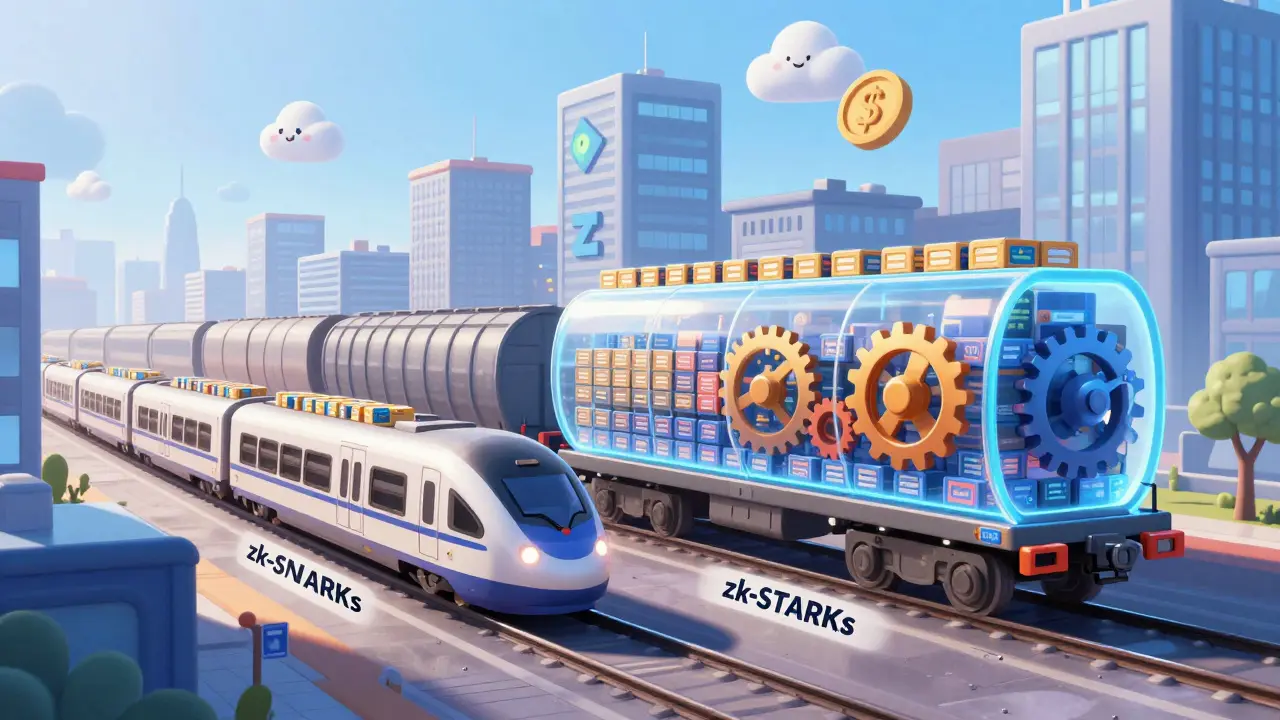
In terms of verification speed on Ethereum, yes - they take longer. But that’s only part of the story. zk-STARKs scale better as computation grows. For small tasks, zk-SNARKs win. For large, complex operations, zk-STARKs become faster and cheaper overall. Think of it like a sedan vs. a freight train: one is faster for short trips, the other is better for moving massive loads.
Why aren’t more projects using zk-STARKs if they’re more secure?
Cost and maturity. zk-STARKs cost 2-4x more to verify on Ethereum. That’s a big deal when you’re processing millions of transactions. Also, the tooling and community are younger. Most teams don’t have the expertise to build with Cairo yet. But that’s changing fast - adoption is growing 3.2x faster than zk-SNARKs.
Is quantum computing a real threat to zk-SNARKs?
Yes. zk-SNARKs rely on elliptic curve cryptography, which quantum computers can break using Shor’s algorithm. While we don’t have quantum computers capable of this today, experts estimate one could emerge by 2030. zk-STARKs, built on hash functions, are immune to this threat. If you’re building infrastructure meant to last beyond 2030, this isn’t theoretical - it’s strategic.
Can I switch from zk-SNARKs to zk-STARKs later?
Technically, yes - but it’s not simple. The underlying cryptography, programming languages, and proof structures are completely different. You can’t just swap them out. Projects like Polygon Miden are building hybrid systems from the start. If you’re planning to migrate, design for flexibility early - modular proof systems, clear API boundaries, and abstraction layers will make the transition possible.
If you’re evaluating ZK solutions today, don’t just follow the hype. Look at your use case. Cost? Speed? Longevity? Regulatory needs? The answer isn’t zk-SNARKs or zk-STARKs. It’s which one fits your problem.
Holly Perkins
February 13, 2026 AT 22:35Will Lum
February 15, 2026 AT 10:06Sanchita Nahar
February 16, 2026 AT 13:25Ben Pintilie
February 17, 2026 AT 00:25Sakshi Arora
February 17, 2026 AT 20:34Claire Sannen
February 17, 2026 AT 22:00Beth Trittschuh
February 19, 2026 AT 16:00Tammy Chew
February 20, 2026 AT 15:00Kaz Selbie
February 22, 2026 AT 01:48bala murali
February 22, 2026 AT 10:12Lindsey Elliott
February 23, 2026 AT 01:41Santosh kumar
February 23, 2026 AT 14:10SAKTHIVEL A
February 24, 2026 AT 00:24