You want to prove you are over 18 without showing your birth certificate. You want to log into a service without typing your password into a server that might leak it. This tension between proving something is true and keeping the underlying data private has been one of the biggest headaches in digital security. Until recently, there was really no good way to verify facts without exposing the facts themselves. That changed with the rise of Zero-Knowledge Proofs, often called ZKPs. These are cryptographic methods that enable one party, called a prover, to prove to another party, called a verifier, that a statement is true without revealing any underlying information or data. In today's hyper-connected world, this technology represents a fundamental shift in how we handle trust.
Think about your daily interactions online. When you buy something, you give away your card details. When you post comments, you reveal your account credentials. Traditional systems demand you hand over the 'key' to prove you own the 'lock'. Zero-Knowledge Proofs break this pattern. Instead of handing over the password, you mathematically prove you know the password without ever sending the password across the wire. This mechanism prevents leaks, tampering, and impersonation, making them ideal for use in secure identification where data exposure must be avoided entirely.
The History Behind the Technology
It feels like new magic, but the science behind this privacy tool has deep roots. The concept was first formally introduced in a 1985 MIT paper titled "The Knowledge Complexity of Interactive Proof Systems". Authored by Shafi Goldwasser, Silvio Micali, and Charles Rackoff, the work defined the theoretical groundwork we still stand on. Their foundational definition states that a Zero-Knowledge Proof is "a method by which one party (the prover) can prove to another party (the verifier) that something is true, without revealing any information apart from the fact that this specific statement is true".
Back then, it was pure theory. Today, it powers real-world systems. Companies utilize ZKPs for data protection purposes, where they need to validate data without wanting the liability of accessing sensitive details. The technology has evolved from abstract mathematics into practical applications in secure communications, electronic voting, access control, and gaming. As we move through 2026, these tools are becoming standard features in software architecture rather than niche experiments.
Understanding the Mechanism: The Cave Analogy
To grasp how this actually functions without getting bogged down in heavy math, consider the classic analogy. Imagine a circular cave with two entrances, A and B. There is a magic door connecting the paths inside the cave that can only open with a secret word. A person, let's call them Peggy (the prover), claims to know this secret word but refuses to tell anyone. She enters from one side and exits from the side the other person, Victor (the verifier), requests.
If Peggy truly knows the word, she can always obey the request regardless of where she starts. If she doesn't know the word, she would have to guess which path Victor chooses. If she happens to enter from the left and Victor asks her to exit from the right, she fails. By repeating this process many times with random choices, it becomes statistically highly improbable that she is guessing every time. Therefore, Victor is convinced she knows the word, even though he never sees the word itself. This illustrates how ZKPs work perfectly in theory. The prover solves challenges that could only be correctly solved if they knew the secret they claim to know.

The Three Pillars of Security
Every valid Zero-Knowledge Proof must satisfy three fundamental and mandatory criteria for security. You cannot have a reliable system without all three of these pillars standing firm together. They act as the guardrails ensuring the system isn't easily tricked.
- Completeness: If the prover provides a valid proof based on true information, then the verifier will accept it as valid. Put simply, if the statement is true, an honest verifier will be convinced by an honest prover. This ensures legitimate users aren't locked out by false negatives.
- Soundness: This ensures that if a false statement is provided, then it will be rejected by the verifier. A dishonest prover cannot trick the system into accepting invalid data. If the statement is false, no dishonest prover can convince the honest verifier that it is true.
- Zero-Knowledgeness: Also called zero-knowledge, this states that neither party has access to any confidential information during the process. If the statement is true, no verifier learns anything other than the fact that the statement is true.
In computing, ZKPs leverage circuits that take input, pass it through a path of electrical gates, and generate output, using this same strategy with cryptography to prove knowledge about data without revealing the data point. For organizations, these criteria allow companies to verify data authenticity without ever seeing the actual information.
Interactive vs. Non-Interactive Proofs
Not all proofs work the same way. We can categorize them based on how communication flows between the parties. ZKPs can be either interactive-where a prover convinces a specific verifier but needs to repeat the process for each individual verifier-or non-interactive-where a prover generates a proof that can be verified by anyone using the same proof. The non-interactive version is particularly valuable for blockchain networks where you don't necessarily want to maintain a live connection with a verifier for every single transaction.
| Type | Communication | Scalability | Best Use Case |
|---|---|---|---|
| Interactive ZKP | Requires back-and-forth messages | Lower scalability per user | Secure login sessions |
| Non-Interactive ZKP | Single proof generation | Highly scalable | Blockchain transactions |
In the context of secure transactions, ZKPs help ensure that parties involved have necessary credentials or funds without revealing account details. This is crucial when dealing with large public ledgers where transparency is usually the default setting.
Real-World Applications in Privacy
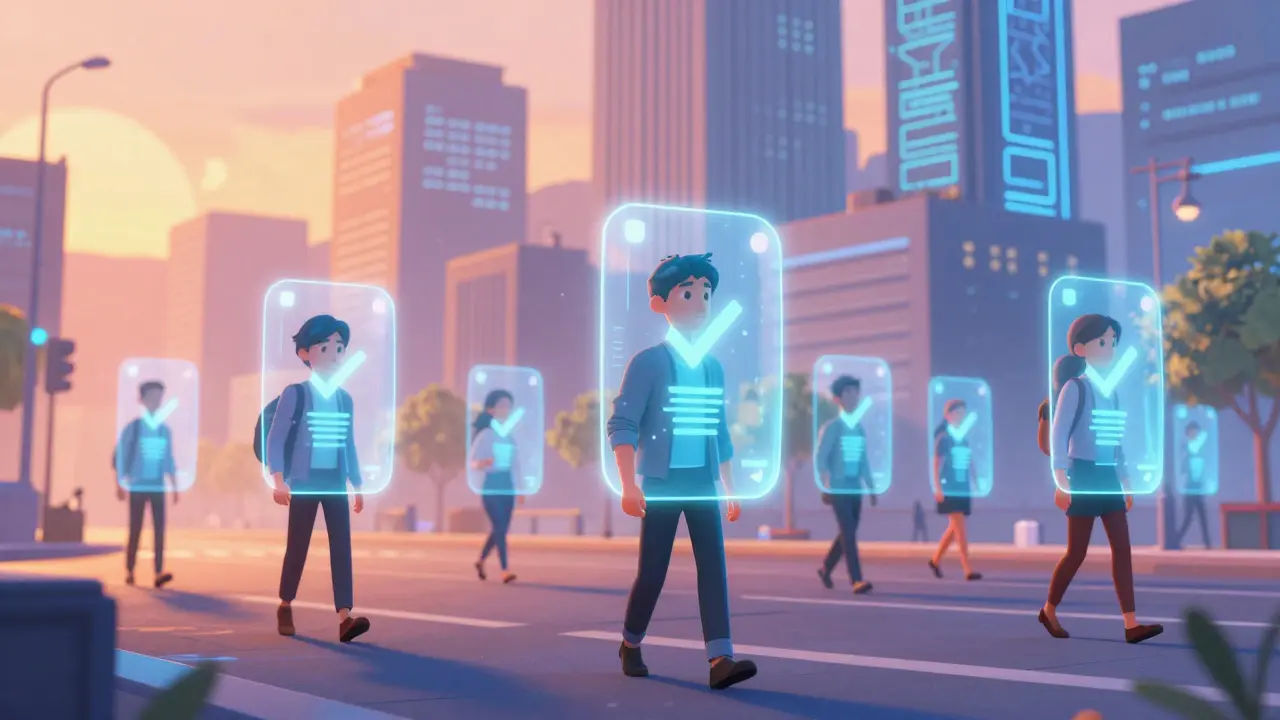
By now you might ask yourself where you actually see this. ZKPs provide a highly secure form of proving knowledge without transmitting the data itself. One major area is identity management. Dock Labs specifically offers Zero-Knowledge Proof technology that enables selective disclosure, range proofs, custom conditions, verifiable encryption, and threshold anonymous credentials. This means you can share just enough about yourself without oversharing.
Consider a scenario where you need to prove you are a citizen of a country. With traditional ID, you show your passport number, date of birth, and address. With ZKPs, you could prove being over 18 without disclosing exact birthdate. Or you could prove a transaction is valid without sharing transaction details. In the context of secure transactions, ZKPs help ensure that parties involved have necessary credentials or funds without revealing account details.
This technology is commonly used in blockchain protocols, privacy-preserving authentication, and identity systems. For organizations, ZKPs can serve as a key tool in data compliance toolboxes, enable interoperability, and verify identities while preserving user privacy. In practical applications, ZKPs can be used to log into a service without transmitting the password. This creates a system where the service provider confirms your identity but technically cannot steal your password because they never saw it.
Limitations and Considerations
While revolutionary, this isn't a silver bullet for every problem. The Electronic Frontier Foundation has noted that ZKPs alone are not a complete digital ID solution. They provide a cryptographic way to not give something away like exact date of birth and age from identification, instead offering a "yes-or-no" verification. This represents an important limitation and consideration for their implementation in identity systems. They confirm truth, but sometimes institutions need more context than a simple boolean result.
A person could attend a football game without revealing personal details from their membership card, or verify having sufficient funds without disclosing exact bank balance. However, integration remains complex. ZKPs represent a fundamental shift in how privacy and verification can coexist in digital systems, enabling institutions to verify information and prove knowledge without exposing underlying sensitive data, making them crucial tools for privacy protection in the modern digital age. They mark what some call a revolution in blockchain's original concept-from traceability and full transparency to privacy with proof of truth, termed "Blockchain 2.0".
What is the main benefit of Zero-Knowledge Proofs?
The main benefit is that you can prove a statement is true without revealing any of the underlying data or secrets used to prove it, enhancing privacy significantly.
Who were the original creators of ZKPs?
The concept was formally introduced by Shafi Goldwasser, Silvio Micali, and Charles Rackoff in 1985.
Can ZKPs replace passwords?
Yes, in practice, ZKPs allow users to log in without transmitting the actual password, preventing server-side credential theft.
Are ZKPs secure against hackers?
They rely on sound mathematical cryptography; provided the implementation follows the completeness, soundness, and zero-knowledge criteria, they are highly resistant to attacks.
Do all blockchain projects use ZKPs?
No, while popular for privacy coins and Layer 2 solutions, many blockchains still prioritize full transparency over privacy proofs.
Samson Abraham
April 1, 2026 AT 07:35The concept of zero knowledge is fascinating in its pure form. It allows for verification without exposure of sensitive data points. Privacy becomes a default setting rather than an opt-in feature. This shift is crucial for modern security architectures. Many people overlook the depth of the historical research involved here. The foundational papers from the eighties were surprisingly accurate. We see these principles applied in authentication protocols now. It reduces the attack surface for credential theft significantly. Digital identities need this kind of protection more than ever before. Implementation challenges exist but the roadmap is clear. Organizations should consider adopting these standards for compliance.
Cara Boyer
April 2, 2026 AT 03:25They watch us anyway ughhhh !!. Gov tracks data even with encrypttion !. Big Tech lies about privacy constantly. Real secucirty is offline only 😡. Dont trust the clode servers ever. They steal keys and sell to spies 🕵️♀️. Wake up sheeple before it is too late !!!. We need airgapped systems not maths tricks.
Michael Nadeau
April 4, 2026 AT 01:24The concept of knowledge complexity fundamentally alters our understanding of truth within a digital space. When we strip away the data itself we are left with pure verification mechanisms that stand alone. This shift represents a move away from identity based systems to proof based systems entirely. Imagine a world where your credit score is verified without the agency seeing your spending habits. That level of abstraction is truly profound in its implications for civil liberties. We often accept surveillance because we believe it protects us from others. Yet these tools offer protection from the guardians themselves which is a bold step forward. The mathematical certainty required by soundness prevents false positives from undermining the whole ecosystem. Completeness ensures we are not locked out when the system functions correctly as designed. Zero knowledgeness preserves the sanctity of the secret even during the verification process. Interactive methods allow for deeper engagement between parties before final confirmation happens. Non interactive versions scale better for global networks without needing constant communication overhead. The transition from theory to practice has taken decades of rigorous peer review. Now we see applications emerging in blockchain and secure login protocols simultaneously. This evolution signals a broader acceptance of privacy as a fundamental right rather than a luxury. The future relies heavily on maintaining these cryptographic standards against evolving threats. We must remain vigilant in implementation details to avoid subtle weaknesses in the code. Society will benefit greatly from widespread adoption of these principles. It is time to demand better security architecture from service providers.
Chris R
April 4, 2026 AT 20:57Great points on the philosophy side. Global access needs this kind of innovation. Developing nations need privacy protections too. The tech could help refugees prove identity safely. Hope we see more open source implementations soon.
Wade Berlin
April 6, 2026 AT 17:29Another day another crypto miracle. People forget it still requires trust in the setup phase mostly. If the keys get compromised the proof is useless. Marketing hype usually gets ahead of reality here. Still cool math though.
Colin Finch
April 8, 2026 AT 12:25Hype is the lifeblood of progress after all. Without the noise who would notice the signal. The mathematics is indeed robust when handled correctly. Some scepticism is healthy but do not dismiss the utility. It works for the majority of honest use cases at least.
Lisa Walton
April 9, 2026 AT 01:12Privacy is just a marketing buzzword now.
Disha Patil
April 10, 2026 AT 06:51But my bank leaks info every week. Why do they lie to us always. My heart hurts reading this stuff. Maybe it will change eventually yes. I hope so deeply really.
Callis MacEwan
April 10, 2026 AT 22:28zkSnarks versus Bulletproofs discussion needed here. Computational overhead differs significantly based on parameter selection. Trusted setups remain a single point of failure risk factor. Merkle trees often serve as the commitment scheme foundation layer. Gas costs on Ethereum limit practical application frequency. Layer two scaling solutions absorb most current volume today.
Sean Carr
April 12, 2026 AT 10:40Good technical breakdown there buddy. Keep learning more about the layers involved. We can build better together easily.
Jay Starr
April 12, 2026 AT 20:01It feels like a race against time. Everyone is losing sleep over this. The pressure is immense on devs.
Lisa Miller
April 13, 2026 AT 13:09You can manage the stress nicely. Focus on the positive outcomes instead. We will see improvements soon definitely.
Joy Crawford
April 14, 2026 AT 13:57this tech is amazing yet terrifying at the same time 😭💻
Markus Church
April 16, 2026 AT 12:28Understanding fear is part of adoption curves. Technical barriers often feel insurmountable initially. Patience remains a virtue in complex engineering fields.