You might have seen Elixir deUSD (DEUSD) listed in old articles or historical data. It promised to be a game-changer: a fully collateralized, yield-bearing stablecoin that combined the safety of cash with the flexibility of blockchain. But here is the hard truth you need to know right now: deUSD no longer exists as an active protocol. It was shut down by its creators, Elixir Network, following a catastrophic failure involving a major lending partner. If you are holding these tokens or researching them for investment, this article explains exactly what happened, why it collapsed, and what it means for your assets today.
Key Takeaways
- Status: Elixir deUSD (DEUSD) has been discontinued and is no longer operational.
- The Cause: A massive counterparty risk event involving Stream Finance, which defaulted on a $68 million loan while holding $75 million in deUSD.
- The Mechanism: DEUSD used a complex delta-neutral strategy, shorting ETH against stETH collateral to capture funding rates.
- Current Action: Former holders were directed through a redemption process to exchange remaining tokens for USDC, though full recovery depends on legal and liquidation outcomes.
- Lesson: Even "fully collateralized" stablecoins can fail if they rely too heavily on a single borrower or counterparty.
What Was Elixir deUSD?
To understand the crash, we first need to look at the ambition behind it. Elixir deUSD was not just another copy of USDT or USDC. It was marketed as a "synthetic dollar" built on the Elixir Network. Unlike traditional stablecoins that hold fiat currency in bank accounts, deUSD aimed to generate yield automatically. How? By using a sophisticated financial engineering trick called a delta-neutral strategy.
Here is how it worked in theory. You would deposit stETH (liquid staked Ethereum) into the system. The protocol would then use that collateral to mint deUSD. Simultaneously, it would take that same amount of value and short ETH on the open market. Because the long position (stETH) and the short position (ETH) move together in price, the net exposure to Ethereum’s price volatility is near zero-hence, "delta-neutral." The goal wasn't to bet on ETH going up or down. The goal was to collect the funding rates paid by traders who were betting on ETH. In a bull market, these rates are often positive, meaning deUSD holders could earn interest just by holding the stablecoin.
This design sounded perfect on paper. It offered stability like a dollar but with the yield of a savings account, all secured by blockchain technology rather than a corporate balance sheet. However, complexity is often the enemy of security in decentralized finance (DeFi).
The Fatal Flaw: Counterparty Risk
If the mechanism was so smart, why did it fail? The answer lies in one word: concentration. While deUSD was technically "fully collateralized," the collateral was lent out. And it was lent out to almost one person.
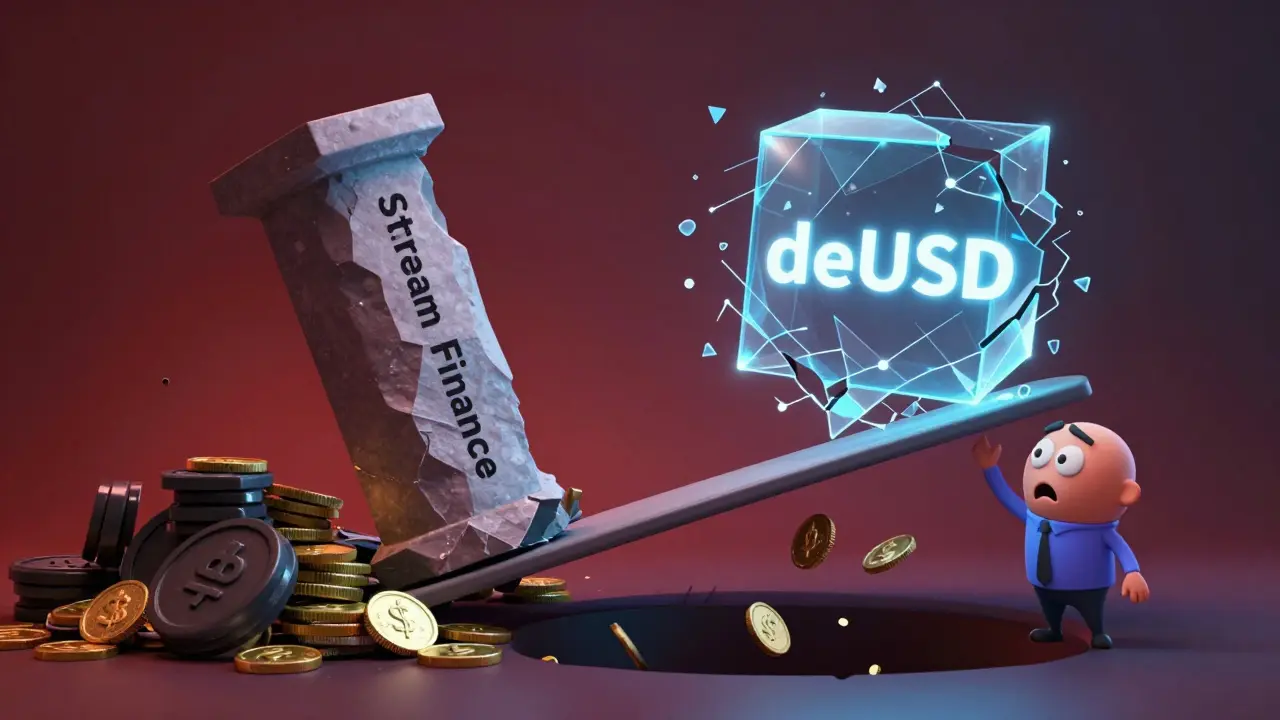
According to reports from early 2024, Stream Finance, a prominent lending protocol, accounted for over 99% of the lending positions within the Elixir ecosystem. Stream borrowed roughly $68 million from Elixir and held approximately $75 million worth of deUSD as collateral. This created a dangerous circular dependency. Elixir relied on Stream to repay its loans to maintain liquidity, and Stream relied on the stability of deUSD to secure its own operations.
In finance, this is known as counterparty risk. It doesn’t matter how strong your vault is if you lend all your gold to one neighbor who goes bankrupt. When Stream Finance halted operations and announced losses exceeding $93 million, the entire foundation of deUSD crumbled. Stream decided not to repay or close its positions, leaving Elixir with illiquid assets and a broken protocol.
| Feature | Traditional (USDC/USDT) | Synthetic (Elixir deUSD) |
|---|---|---|
| Collateral Type | Fiat reserves & Treasuries | Crypto assets (stETH, sDAI) |
| Yield Generation | None (usually) | Yes (via funding rates & yield farming) |
| Risk Profile | Regulatory & Bank risk | Smart contract & Counterparty risk |
| Complexity | Low | High (Delta-neutral hedging) |
| Current Status | Active | Discontinued |
The Collapse and Redemption Process
The incident broke the peg. At one point, data showed deUSD trading at mere fractions of a cent ($0.0041 USD), a stark contrast to its intended $1.00 value. This panic selling was inevitable when the market realized the primary lender had vanished.
Elixir Network acted quickly to mitigate further damage. They announced the discontinuation of deUSD. Instead of letting the token trade freely on exchanges where it was worthless, they initiated a controlled redemption process. Holders were instructed to redeem their deUSD for USDC (USD Coin). This step was crucial because it prevented Stream Finance from potentially cashing out their deUSD without repaying their massive debt.
However, redemption does not always mean getting 100% of your money back. The ability of Elixir to pay out full value depended on the liquidation of Stream Finance’s assets. Since Stream owed more than it likely could cover immediately, many users faced partial losses or lengthy waits for recovery funds. This highlights a harsh reality of DeFi: there is no FDIC insurance. When a protocol fails, you are part of the creditor queue.
Why Did Institutions Trust It?
It seems odd that a project with such high risk attracted attention from giants like BlackRock and Hamilton Lane. Early marketing positioned deUSD as a bridge for Real World Assets (RWA) entering DeFi. The idea was that institutions could park capital in a stable asset that still generated yield, bypassing traditional banking inefficiencies.
The allure was the "universal ticket" concept. deUSD was designed to work across multiple chains and platforms, allowing seamless participation in staking and lending. For institutional investors looking at the $16 billion RWA tokenization market, this interoperability was valuable. But trust in the brand blinded many to the underlying structural weakness: the over-concentration of risk in Stream Finance. As the saying goes, if something sounds too good to be true, check the fine print. In this case, the fine print was hidden in the lending pool distribution.

Lessons for DeFi Investors
The death of Elixir deUSD serves as a critical case study for anyone navigating cryptocurrency markets in 2026. Here are three concrete lessons:
- Diversify Your Exposure: Never put all your capital into a protocol that relies on a single large borrower. If 99% of a pool is lent to one entity, you are not diversified; you are leveraged on that entity’s solvency.
- Understand the Collateral: "Fully collateralized" does not mean "risk-free." Ask yourself: What backs the collateral? Is it volatile crypto? Are there smart contracts involved? Can the collateral be seized or frozen?
- Beware of High Yield Traps: If a stablecoin offers significantly higher yields than standard options, ask why. Usually, that extra yield is compensation for taking on extra risk-in deUSD’s case, the risk of complex hedging strategies and counterparty default.
Today, safer alternatives exist. Protocols like Aave or Compound offer transparent lending markets where you can see exactly who is borrowing and how much collateral is posted. While they don’t offer the automated delta-neutral magic of deUSD, they provide clarity and control over your risk.
Final Thoughts
Elixir deUSD was an ambitious experiment in financial engineering. It tried to merge the best of both worlds: fiat stability and crypto yield. But it failed because it underestimated the fragility of centralized dependencies within a decentralized system. For current holders, the focus is now on monitoring the official Elixir channels for any updates regarding the final settlement of the Stream Finance debt. For everyone else, let deUSD be a reminder that in crypto, innovation must never outpace risk management.
Is Elixir deUSD (DEUSD) still active?
No, Elixir deUSD has been discontinued. The protocol was shut down by Elixir Network following the collapse of its primary lending partner, Stream Finance. Users were directed to redeem their tokens for USDC through a specific process.
Why did deUSD lose its peg to the US Dollar?
deUSD lost its peg due to a massive counterparty risk event. Stream Finance, which held the majority of the lending positions, defaulted on its debts. This caused a loss of confidence and liquidity crisis, leading to severe de-pegging where the token traded far below $1.00.
How can I redeem my remaining deUSD tokens?
Redemption processes were managed directly by Elixir Network. You should check the official Elixir website or their verified social media channels for the latest instructions on exchanging deUSD for USDC. Do not trust third-party sites claiming to offer redemption.
What is the difference between deUSD and USDC?
USDC is backed by fiat currency and short-term US Treasuries held in reserve banks. deUSD was a synthetic stablecoin backed by crypto assets (like stETH) and generated yield through complex delta-neutral trading strategies. USDC is simpler and generally considered lower risk regarding counterparty exposure.
Was deUSD hacked?
It was not a traditional hack where code was exploited by external attackers. Instead, it was a financial failure due to counterparty risk. Stream Finance, a major user of the platform, went insolvent and failed to repay its loans, causing the protocol to become insolvent as well.