Howey Test Analyzer for Crypto Projects
What is the Howey Test?
The SEC uses the Howey Test to determine if a token is a security. If a project meets all these criteria, the SEC may consider it a security requiring registration:
- 1. An investment of money
- 2. In a common enterprise
- 3. With an expectation of profits
- 4. Solely from the efforts of others
The U.S. Securities and Exchange Commission (SEC) slapped crypto companies with $4.68 billion in fines in 2024 - more than the total fines it had issued in the previous decade combined. This wasn’t just a big year. It was a seismic shift. The biggest chunk? A $4.68 billion penalty against Terraform Labs and its founder, Do Kwon, for lying to investors and selling unregistered tokens. That single fine alone made up nearly all of the year’s total. And it wasn’t an outlier. The SEC went after Ripple, Telegram, and dozens of others, turning enforcement into its main tool for regulating crypto.
Why the SEC Went All In
Under Chair Gary Gensler, who left in January 2025, the SEC treated almost every crypto token as a security. That meant if a company sold tokens without registering them like stocks, they were breaking the law. It didn’t matter if the token was meant to be a currency, a utility, or a digital collectible. If it looked like an investment - and investors expected profits from someone else’s work - the SEC said it was a security under the Howey Test. This approach led to lawsuits against major players. Ripple paid $125 million in 2021 for selling XRP. Telegram paid $1.24 billion in 2019 for its Gram token sale. But nothing compared to Terraform Labs. Do Kwon and his team raised billions from retail investors, promising high returns on algorithmic stablecoins like TerraUSD (UST). When UST collapsed in May 2022, wiping out $40 billion in market value, the SEC stepped in. They didn’t just say the token was unregistered. They said the whole project was a fraud. The $4.68 billion fine wasn’t just a penalty - it was a warning.The Enforcement Numbers Don’t Tell the Whole Story
Here’s the twist: even though the SEC collected more money than ever in 2024, they filed fewer cases. They brought 33 enforcement actions that year - down 30% from 2023’s 47. Why? Because they were going after the big fish. Half of those 33 cases were filed in September and October - right before the U.S. presidential election. That timing wasn’t random. It was strategic. The SEC knew public attention was high, and they wanted to make a statement. They also changed how they filed cases. In 2024, they filed 25 lawsuits in federal court and only eight administrative proceedings - down more than half from the year before. Administrative cases are faster and easier for the SEC to win. By shifting to federal court, they were signaling they were ready to fight harder, longer, and in front of juries. That’s riskier for them - but it also sends a stronger message to the industry.The Big Shift: January 2025 and Beyond
Everything changed when Gary Gensler left. On January 21, 2025, Acting Chairman Mark Uyeda announced the creation of the Crypto Task Force. Led by Commissioner Hester Pierce - known in the industry as “Crypto Mom” for her pro-innovation stance - the task force didn’t just tweak policy. It flipped the script. The new team said the old approach had been “retroactive and reactive.” Instead of suing companies for technical violations, they wanted to build clear rules. They didn’t want to chase every unregistered token. They wanted to stop fraud. That’s why, on June 11, 2025, the SEC dropped its case against Coinbase. Not because the law changed. Not because the court ruled. But because the SEC chose to walk away. They filed a joint stipulation - meaning both sides agreed to drop it. Coinbase had sued the SEC in 2023 for being unclear about what was legal. Now, the SEC was backing down. They also shut down the Crypto Assets and Cyber Unit and replaced it with the Cyber and Emerging Technologies Unit (CETU). And guess what? They cut the number of attorneys focused on crypto enforcement. That’s not a sign of weakness. It’s a sign of strategy. They’re no longer trying to regulate by lawsuit. They’re trying to regulate by clarity.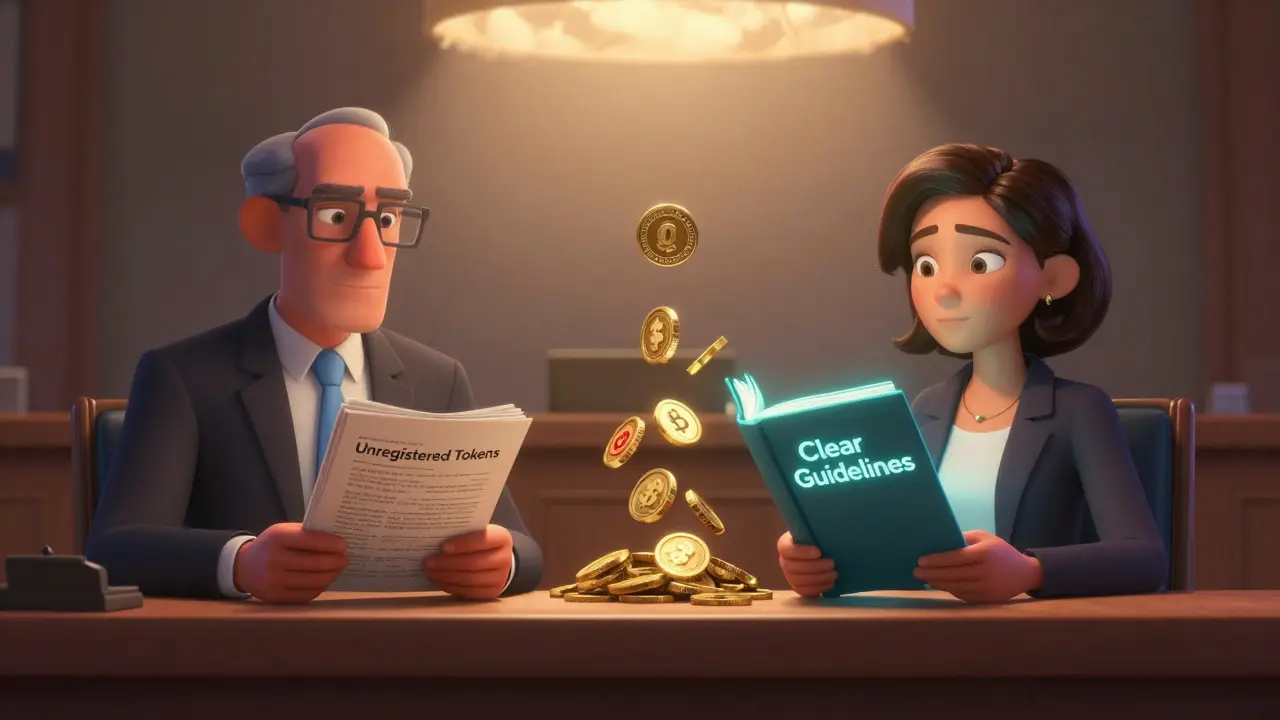
What’s Still Being Targeted
Don’t think this means crypto is off the hook. The SEC still went after fraud. In April 2025, they charged Ramil and PGI Global with a $198 million scam involving fake crypto and foreign exchange trading. In May, they went after Unicoin Inc. for misleading investors. These weren’t registration cases. These were clear cases of theft and deception. The message is simple now: if you’re honest, follow the rules, and don’t lie to people - you’re probably fine. But if you’re running a pump-and-dump scheme, hiding losses, or pretending your token is something it’s not - the SEC is still coming for you.What This Means for Crypto Companies
The old model - “figure it out later, raise money now, hope the SEC doesn’t catch you” - is dead. But the new model isn’t much clearer. There’s still no official guidance on what makes a token a security. No clear path for exchanges to register. No definition for “decentralized.” That’s why companies are stuck. Some are leaving the U.S. entirely. Others are building compliance teams just to survive. A few, like Coinbase, are pushing back in court. And now, with the SEC backing off on registration cases, there’s a chance the industry can breathe. But without clear rules, uncertainty remains.
The Bigger Picture
The $4.68 billion in fines wasn’t just about money. It was about power. The SEC was trying to force crypto into the same box as Wall Street. But crypto isn’t Wall Street. It’s decentralized. It’s global. It moves fast. You can’t sue your way into innovation. The market grew to $1.97 trillion in 2025, even as the SEC was filing lawsuits. Spot Bitcoin ETFs launched in January 2024. Big banks started offering crypto custody. Institutional money poured in. But the SEC’s approach scared off developers, startups, and even some investors who didn’t want to risk being labeled a securities violator. Now, with the new leadership, there’s hope. The Crypto Task Force is working on disclosure rules, registration pathways, and clearer definitions. If they succeed, the U.S. could become a leader in crypto regulation - not a place where companies get fined into oblivion.What Comes Next
By the end of 2025, we’ll know if the SEC’s new approach works. Will they issue formal guidance on token classification? Will they create a registration system for exchanges? Will they stop suing companies for not registering tokens that were never meant to be securities? One thing is certain: the era of the SEC as crypto’s main regulator - using fines as its only tool - is over. The next chapter will be about rules, not retaliation. And that might be the biggest change of all.Why did the SEC fine Terraform Labs $4.68 billion?
The SEC fined Terraform Labs and its founder Do Kwon $4.68 billion for selling unregistered securities and misleading investors about the stability of TerraUSD (UST), a so-called algorithmic stablecoin. When UST lost its $1 peg in May 2022, it triggered a collapse that wiped out over $40 billion in market value. The SEC argued the entire project was a fraud, not just a failed experiment, and that investors were promised returns based on the work of Terraform’s team - meeting the legal definition of a security under the Howey Test.
Was the $4.68 billion fine the largest ever by the SEC?
Yes. The $4.68 billion penalty against Terraform Labs is the largest single fine the SEC has ever imposed on a cryptocurrency company. It also made up 63% of all crypto-related fines the SEC has issued since 2013, which totaled $7.42 billion by the end of 2024. For context, the previous record was $1.24 billion against Telegram in 2019.
Did the SEC bring more cases in 2024 than before?
No. In fact, the SEC brought 33 enforcement actions in 2024 - a 30% drop from 47 in 2023. The decrease happened because the agency shifted from chasing many small cases to focusing on a few high-value targets. Half of the 2024 cases were filed in September and October, just before the U.S. election, suggesting a strategic timing move rather than a surge in enforcement.
Why did the SEC drop its case against Coinbase?
The SEC dropped its case against Coinbase in June 2025 as part of a policy shift under the new administration. Instead of suing companies for technical violations like failing to register tokens as securities, the new leadership decided to focus only on clear fraud and investor harm. The dismissal was a joint decision - meaning Coinbase agreed to it - and signaled that the SEC was moving away from its aggressive, enforcement-only approach under Gary Gensler.
Is crypto regulation in the U.S. now more relaxed?
It’s more targeted, not necessarily relaxed. The SEC still prosecutes fraud - like the $198 million case against Ramil and PGI Global in April 2025. But they’ve stopped suing exchanges and projects just for selling unregistered tokens. The focus is now on creating clear rules, not punishing technical violations. That’s a big change - but until formal guidance is issued, many companies still operate in uncertainty.
What’s the difference between the old SEC approach and the new one?
Under Gary Gensler, the SEC treated nearly all crypto tokens as securities and sued companies for not registering them - even if they didn’t intend to sell investments. The new team, led by Acting Chairman Mark Uyeda and Commissioner Hester Pierce, says that approach was reactive and unclear. Now, they’re focused on stopping fraud, creating clear registration paths, and giving companies rules to follow - not just penalties to fear.
Ankit Varshney
December 1, 2025 AT 19:50The SEC's shift from punishment to clarity is long overdue. It's not about letting bad actors off the hook-it's about giving honest builders a roadmap. The days of guessing whether your token is a security should be over. Clarity breeds innovation, not fear.
Joe B.
December 2, 2025 AT 13:00Let’s be real-the SEC didn’t change. They just got tired of losing in court. Coinbase forced their hand, and now they’re scrambling to look reasonable while quietly keeping the same power. This isn’t reform-it’s damage control. And don’t let them fool you: the ‘Crypto Task Force’ is just PR with a new name.
Katherine Alva
December 3, 2025 AT 18:53It’s funny how we treat crypto like it’s some wild frontier, but the SEC’s new approach is just… basic governance. If you’re not lying, not stealing, and not pretending your token is a stock when it’s not-why are you scared? The real problem was never crypto. It was the lack of definitions.
Bhoomika Agarwal
December 4, 2025 AT 21:06India’s been watching this circus for years. The US thinks it owns crypto regulation? Nah. The real innovation is happening in Dubai, Singapore, and even Nigeria. The SEC’s $4.68B fine? A spectacle for American media. The world moved on.
Heather Hartman
December 4, 2025 AT 22:42Finally, someone’s listening. I’ve been building a Web3 tool for small artists, and every time I looked up ‘SEC compliance,’ I felt like I was signing up for a lawsuit. This shift? It’s the first breath of air I’ve felt in years. Thank you for not treating every honest person like a criminal.
Mani Kumar
December 5, 2025 AT 01:55Regulation through litigation is inefficient. Regulation through guidance is sustainable. The SEC’s pivot is not weakness-it’s institutional maturity. The fact that they dropped the Coinbase case without conceding legal ground shows strategic restraint. That’s leadership.
Ziv Kruger
December 6, 2025 AT 17:55What’s a security? Is a token a contract? A share? A membership card? The Howey Test was written in 1946 for orange groves. We’re trying to fit blockchain into a 19th-century legal framework. The real scandal isn’t Terraform’s fraud-it’s that we still haven’t updated the law for the 21st century.
Shari Heglin
December 8, 2025 AT 02:05Don’t be fooled. The SEC didn’t abandon enforcement. They just realized they couldn’t win every case. They’re now selectively prosecuting the most egregious frauds while letting the rest of the market breathe. That’s not reform. That’s triage.
Ann Ellsworth
December 9, 2025 AT 15:34It’s astonishing how the narrative has been co-opted by crypto apologists. The $4.68B fine wasn’t punitive-it was corrective. The collapse of UST wasn’t just a market failure-it was a systemic betrayal of retail investors who trusted the ‘algorithm.’ The SEC’s prior approach was chaotic, yes-but the new one is dangerously vague. Without clear rules, we’re just replacing one form of chaos with another.
Greer Dauphin
December 11, 2025 AT 10:46So the SEC drops Coinbase… but still goes after Ramil? Classic. They’re not trying to help. They’re trying to look like they’re helping. Meanwhile, the real criminals? Still out there. The SEC’s new ‘task force’ is just a fancy name for ‘we’re tired of getting sued back.’
Rod Filoteo
December 12, 2025 AT 16:05They’re all in on it. The SEC, the banks, the politicians. They don’t want crypto to succeed. They want it to be a controlled experiment-so they can tax it, regulate it, and kill it slowly. The $4.68B fine? A distraction. The real goal is to force everyone onto the Fed’s blockchain. Watch.
Mark Stoehr
December 14, 2025 AT 05:39They dropped the case because they knew they couldn’t prove the tokens were securities. The law doesn’t support them. This isn’t progress-it’s surrender. And now everyone’s pretending it’s a win. Wake up. The SEC still owns the courtroom. They just don’t want to fight anymore.
Nelia Mcquiston
December 15, 2025 AT 14:18I’ve watched this whole thing unfold. From the early days of ICOs to the Terra collapse to the Coinbase lawsuit. What I’ve learned is this: regulation doesn’t kill innovation. Fear does. The SEC’s shift isn’t about power-it’s about letting the market find its own footing. Maybe, just maybe, we can build something real this time.
Nora Colombie
December 17, 2025 AT 03:44Why are we even talking about this? The SEC is a federal agency. They’re supposed to protect Americans. The fact that they let crypto companies operate for years without oversight? That’s not a policy failure-that’s treason. Now they’re ‘shifting’? Too late. We lost billions. The only thing that matters now is jail time for Do Kwon.
Sarah Locke
December 18, 2025 AT 01:07To the founders still building in the dark: you’re not alone. The SEC’s new tone is a gift. Use it. Build. Document. Be transparent. The rules are coming. The door’s open. Don’t waste this moment chasing shortcuts. The future belongs to those who play fair-and play long.
Paul McNair
December 18, 2025 AT 14:39Look, I’m from the Midwest. I don’t know what a ‘Howey Test’ is. But I know when someone sells me a ‘stablecoin’ that crashes and takes my rent money with it-that’s fraud. The SEC’s old way was messy. Their new way? Still messy. But at least now they’re not punishing the people trying to fix it.
Reggie Herbert
December 18, 2025 AT 18:03They dropped Coinbase because they lost. They’re not changing-they’re conceding. The fact that they’re cutting staff proves it. This isn’t a new era. It’s a retreat. And the crypto industry? They’ll keep pushing until the next administration comes in and restarts the witch hunt.
Murray Dejarnette
December 19, 2025 AT 20:33Who cares about the fine? The real story is how the SEC turned a $40B market collapse into a political spectacle. They didn’t protect investors-they turned them into hashtags. Now they want a pat on the back for being ‘less aggressive’? I’d rather they just admit they were wrong.
Layla Hu
December 20, 2025 AT 18:09One sentence: I’m glad they’re not suing everyone anymore. But I’m still waiting for the rules.
Catherine Williams
December 21, 2025 AT 23:00For every person who lost money in UST, there’s a developer who’s now afraid to code. The SEC’s old approach didn’t just punish fraud-it silenced innovation. This new path? It’s not perfect. But it’s the first time I’ve felt like the system might actually be trying to include us. Not just control us. That’s worth holding onto.