Imagine two people speaking different languages trying to negotiate a deal. One says "I’ll trade you five apples for three oranges", the other replies "I don’t understand apples or oranges". No deal happens. Now imagine that’s what blockchains do every day - if they can’t talk to each other.
Most blockchains were built in isolation. Bitcoin doesn’t know Ethereum exists. Solana can’t read Polkadot’s messages. That’s fine if you only care about one chain. But the real value of blockchain isn’t in silos - it’s in connection. That’s where interoperability protocols and standards come in. They’re the common language that lets blockchains exchange data, assets, and instructions without breaking a sweat.
What Interoperability Really Means in Blockchain
Interoperability isn’t just about sending tokens from Chain A to Chain B. That’s the easy part. Real interoperability means systems understand each other’s rules, data formats, and logic - and act on them correctly.
Think of it like three levels:
- Syntactic interoperability: Both chains use the same format to send data - say, JSON or CBOR. Like two people writing notes in the same handwriting.
- Semantic interoperability: They agree on what the data means. If Chain A sends a "token transfer" command, Chain B knows it’s not a vote, not a smart contract trigger, but a transfer - and handles it right.
- Organizational interoperability: The rules are enforced. Who validates the message? Who pays the gas? Who’s liable if something goes wrong? This is where legal, economic, and governance models come in.
Without all three, you get broken bridges. Tokens vanish. Smart contracts freeze. Users lose money. That’s why standards matter more than hype.
How Blockchains Actually Talk to Each Other
There are three main ways blockchains achieve interoperability today:
- Relay chains: One blockchain acts as a middleman. Polkadot’s relay chain verifies transactions from parachains. Cosmos uses the IBC protocol to pass messages between zones. These aren’t just bridges - they’re traffic controllers.
- Lock-and-mint: Your ETH gets locked on Ethereum. An external validator confirms it. Then, wrapped ETH (wETH) gets minted on Solana. It’s not the same token - it’s a representation. This is how most cross-chain DeFi works today.
- Atomic swaps: Direct peer-to-peer exchange without intermediaries. Chain A and Chain B use cryptographic time-locks to swap assets simultaneously. If one side fails, both sides revert. No trust needed. But it’s slow and limited to simple transfers.
Each method has trade-offs. Relay chains are secure but complex. Lock-and-mint is fast but centralizes risk. Atomic swaps are trustless but rare in practice because they require both chains to support the same cryptography.
Key Standards Making It Happen
Standards turn chaos into compatibility. Here are the ones actually moving the needle:
- IBC (Inter-Blockchain Communication): Used by Cosmos and over 50 chains. It’s like TCP/IP for blockchains - a standardized way to send packets of data between independent networks. IBC doesn’t care what the chains are built on. As long as they implement the spec, they can talk.
- Chainlink CCIP: Not just a bridge - a cross-chain messaging standard. It lets smart contracts on any chain trigger actions on another. Want to pay rent in USDC on Polygon and have it automatically convert to ETH on Ethereum? CCIP makes that possible with verified, on-chain logic.
- ERC-4337: While not a cross-chain standard itself, it’s foundational. It standardizes account abstraction, so wallets and apps behave the same way across chains. That’s a silent enabler of interoperability.
- LayerZero: A messaging protocol that uses oracles and relayers to verify messages across chains. It’s used by over 100 projects, including Ondo Finance and Pendle. It doesn’t rely on a central relay - but it does require trust in its oracle network.
These aren’t theoretical. In 2024, over $12 billion in assets moved across chains using IBC and CCIP alone. That’s not just volume - it’s adoption.
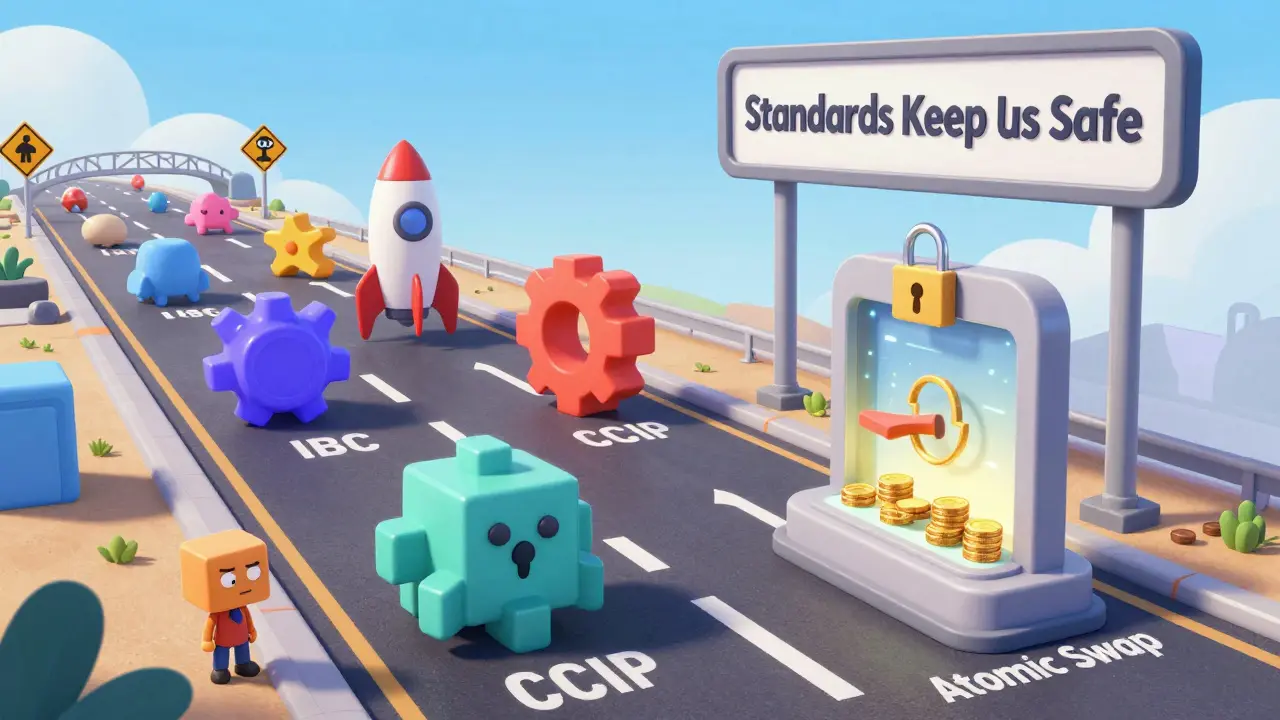
Why Standards Beat Custom Bridges
Every week, a new cross-chain bridge launches. Most fail. Why?
Custom bridges are like building a road between two towns with no traffic lights, signs, or speed limits. It works - until someone crashes.
Between 2022 and 2024, over $2.3 billion was stolen from cross-chain bridges. Not because the blockchains were hacked - because the bridge logic was poorly coded, unstandardized, and full of blind spots.
Standards fix that. IBC, for example, has a formal specification written in ZK-proof-friendly code. It’s audited by multiple independent teams. It’s tested against hundreds of edge cases. It’s not sexy. But it’s safe.
When you use a standard, you’re not betting on one team’s code. You’re betting on a consensus - a shared agreement that’s been battle-tested across dozens of implementations.
Real-World Use Cases That Work Today
Interoperability isn’t just for traders. It’s changing how real systems operate:
- Healthcare on blockchain: A patient’s medical record is stored on a private Ethereum chain in Germany. Their doctor in Japan accesses it via a gateway using FHIR-over-IBC. The data format matches. The permissions are verified. No middleman.
- Supply chain tracking: A shipment leaves Singapore on a Hyperledger Fabric chain. It’s tracked on a Polygon chain in the U.S. via Chainlink CCIP. Customs agents see the same timestamped proof - no manual reconciliation.
- Decentralized identity: Your digital ID on Sovrin (a public blockchain) is verified on a private chain used by your bank. The credential format follows W3C standards. The bank doesn’t need to store your data - just verify it.
These aren’t demos. They’re live deployments. And they all rely on the same thing: agreed-upon standards.

The Big Blind Spot: Governance
Here’s what no one talks about enough: interoperability isn’t just technical. It’s political.
Who updates the standard? Who decides if a new chain can join? What happens if one chain gets hacked and the others have to cut it off?
Polkadot has a council. Cosmos has a governance token. Ethereum’s Layer 2s use a decentralized sequencer network. But there’s no universal rulebook for when and how chains disconnect.
That’s the next frontier. Standards for governance. Standards for dispute resolution. Standards for slashing conditions across chains.
Without these, interoperability is just a beautiful bridge with no guardrails.
What’s Next? The Road to True Interoperability
By 2027, we’ll see:
- Standardized cross-chain smart contract interfaces - like Web3’s version of REST APIs.
- Interoperability as a default feature, not a plugin. New chains will launch with IBC or CCIP built in.
- Regulatory bodies starting to recognize cross-chain data flows as legally valid - especially in finance and healthcare.
The goal isn’t one chain to rule them all. It’s a web of chains - each doing what they do best, connected by reliable, open standards.
That’s the future. And it’s already being built - one protocol at a time.
Bradley Cassidy
December 17, 2025 AT 02:09man i just tried to send some eth to my solana wallet and it vanished like my last relationship 😅
like yeah i know bridges are sketchy but why do they always feel like trying to text your ex in 2012? you know it’s gonna end badly but you do it anyway
the whole ‘lock and mint’ thing is just digital voodoo - i don’t care how many ‘verified validators’ they got, if i can’t see my token on both sides at once, it’s not real
and don’t even get me started on wrapped tokens - it’s like ordering a burger and getting a napkin with ‘burger’ written on it
interoperability sounds cool until you realize half the chains don’t even know what a smart contract is
i just want my assets to move like air - no paperwork, no middlemen, no ‘chain-specific gas fees’
IBC is the only thing that feels like it’s actually trying to build something that lasts
everything else is just crypto bros slapping duct tape on a leaking boat and calling it a yacht
Samantha West
December 18, 2025 AT 11:42One must consider the metaphysical implications of asset representation in decentralized systems. If a token is not native to the chain upon which it resides, is it truly an asset-or merely a semantic illusion, a ghost in the machine? The ontological status of wETH, for instance, demands epistemological scrutiny.
Moreover, the very notion of ‘interoperability’ presupposes a hierarchical framework of communication, which contradicts the foundational ethos of decentralization. Is not true sovereignty the absence of translation? The moment one chain must interpret another, it surrenders autonomy to a meta-protocol-a subtle form of centralization disguised as progress.
One might argue that standards like IBC and CCIP are necessary for scalability. But are we not trading ontological purity for the convenience of economic aggregation? The user who loses funds on a bridge does not merely lose currency-they lose faith in the integrity of the network itself.
And yet, I acknowledge the pragmatic necessity. We live in a world of imperfect systems. But let us not mistake utility for virtue. Standards are not moral imperatives-they are compromises.
Perhaps the true interoperability lies not in protocol, but in the shared recognition that no chain is superior. That humility, not code, is the ultimate bridge.
Donna Goines
December 19, 2025 AT 16:41you think this is about tech? no. this is about the deep state using blockchain to track your movements through every wallet you ever touch
IBC? that’s not a protocol, that’s a backdoor for the NSA to monitor every cross-chain transaction
they’re building a global financial surveillance grid and calling it ‘interoperability’
remember when they said QR codes were just for payments? now they’re scanning your face at the grocery store
chainlink? oracle network? please. those are just the eyes and ears of the Fed’s digital currency project
they want to know if you bought crypto, if you paid rent in usdc, if you transferred from polygon to ethereum
they’re not trying to connect chains-they’re trying to connect YOU to their database
every ‘standard’ is a leash. every ‘bridge’ is a trapdoor
they’ll let you move your assets… until they decide you’re not allowed to anymore
the moment you use CCIP, you’re signing up for a future where your wallet gets frozen for ‘non-compliance’
you think this is innovation? it’s control with a blockchain logo
Rebecca Kotnik
December 20, 2025 AT 23:00The technical elegance of IBC cannot be overstated. It is, in many ways, the TCP/IP of the blockchain ecosystem-clean, modular, and designed for long-term extensibility.
What makes it fundamentally superior to proprietary bridges is its adherence to the principle of least privilege: each chain retains sovereignty, and communication occurs only through formally defined, cryptographically verified packets.
Contrast this with lock-and-mint solutions, which introduce centralized oracles and custodial risk-exactly the vulnerabilities that blockchain was meant to eliminate.
Moreover, the governance model of Cosmos, which allows for on-chain upgrades via token-weighted voting, ensures that IBC evolves without requiring hard forks or community schisms.
It is also worth noting that the adoption of IBC by over fifty distinct chains-spanning Tendermint, Ethereum L2s, and even WebAssembly-based networks-demonstrates a rare consensus in an otherwise fractured space.
While LayerZero offers speed and flexibility, its reliance on a trusted relayer network introduces a single point of failure that is philosophically incompatible with the decentralized ethos.
Standards like ERC-4337, though not cross-chain per se, are essential enablers: they abstract away wallet complexity, allowing users to interact with any chain without understanding its underlying architecture.
What we are witnessing is not merely interoperability-it is the emergence of a multi-chain civilization, governed not by corporate fiat, but by open, auditable protocols.
And yet, the most profound implication lies in governance. If a chain is compromised, should the entire network be forced to halt? Who decides? These are not engineering questions-they are civilizational ones.
The next decade will not be won by the chain with the fastest TPS, but by the one that best balances autonomy with coordination.
Interoperability is not the destination. It is the foundation upon which we build a truly decentralized world.
Sally Valdez
December 20, 2025 AT 23:24usa built the internet. usa built bitcoin. usa built ethereum. now you want us to trust some foreign chain’s ‘standard’?
IBC? that’s just europe trying to replace the dollar with a blockchain version of the euro
chainlink? that’s a crypto version of the UN-everyone’s got a seat but no one’s in charge
we don’t need ‘interoperability’-we need american chains to dominate and the rest to adapt
you think japan’s healthcare blockchain is cool? they’re using it to track your medical history so the government can deny you care later
every ‘standard’ is a Trojan horse for globalist control
if you’re not using ethereum or solana, you’re just helping the enemy
stop trying to ‘connect’ chains. make america’s chains the only ones that matter
why should i care if a german hospital can read my wallet? i don’t even know who they are
the real interoperability? american crypto winning. period.
Elvis Lam
December 22, 2025 AT 14:57Let’s cut through the noise: interoperability isn’t about fancy protocols-it’s about user experience.
Most people don’t care if it’s IBC or CCIP. They care that their $500 transfer didn’t take 3 days and cost $120 in gas.
Lock-and-mint works because it’s fast. It’s not secure? Fine. But it’s what people use-because they have no choice.
Standards matter, but adoption matters more. If a bridge is used by 10M users and only loses $10M over two years? That’s a 0.1% failure rate. That’s better than most banks.
IBC is elegant, but it’s slow to deploy. Most devs don’t have 6 months to implement it. They need a solution yesterday.
Also, stop acting like atomic swaps are the holy grail. They’re clunky. You need both chains to support the same hash function, and even then, the UI is a nightmare.
Real progress? It’s happening in DeFi aggregators like 1inch and Matcha-they’re abstracting all this complexity behind one click.
Users don’t want to learn IBC. They want their USDC to show up on Solana like it’s a text message.
The real standard isn’t in the code-it’s in the interface.
Jonny Cena
December 23, 2025 AT 03:45Hey everyone-just wanted to say how cool it is that we’re even having this conversation.
Five years ago, most people thought blockchain was just for scams. Now we’re debating governance models for cross-chain dispute resolution.
That’s progress.
Whether you’re team IBC, team CCIP, or team ‘I just want my tokens to move without crying’-we’re all trying to make this ecosystem better.
And honestly? The fact that a German hospital can verify a Japanese patient’s record without a middleman? That’s the kind of stuff that changes lives.
Don’t get lost in the noise. The tech isn’t perfect. But it’s moving.
Keep building. Keep learning. And if you’re new to this? You’re not behind. You’re right where you need to be.
We’re all just figuring it out together.
George Cheetham
December 24, 2025 AT 19:05There is a quiet revolution unfolding-not in the code, but in the minds of those who use it.
Interoperability is not merely technical-it is cultural.
When a farmer in Kenya receives payment in USDC via IBC from a buyer in Poland, using a wallet built by developers in India, powered by a node in Iceland-what we are witnessing is not data transfer.
We are witnessing the dissolution of borders.
Money, once a tool of control, becomes a tool of dignity.
Standards like IBC and CCIP are not protocols-they are agreements between strangers who have never met, but trust the same rules.
This is the first time in human history that such trust has been encoded, not enforced.
It is not perfect. It is not fast. It is not cheap.
But it is possible.
And that, more than any blockchain, is the miracle.
Sue Bumgarner
December 26, 2025 AT 05:45you think china isn’t building their own interoperability standard? they are
they’ve got their own version of IBC called CCBP-chain control bridge protocol
they’re already using it to track crypto transactions from western users
they’re not trying to connect chains-they’re trying to control them
every time you use a bridge, you’re feeding data to the chinese surveillance state
you think your wallet is private? think again
they’re building a global blockchain ledger and calling it ‘decentralized’
the u.s. government is asleep at the wheel
why do you think they banned tether in 2023? because they knew what was coming
interoperability is just the new name for digital colonization
wake up
Dionne Wilkinson
December 26, 2025 AT 16:48i just like that people are trying to make this work
even if it’s messy
even if it’s slow
even if i don’t understand half the tech
it feels like we’re building something kind
not just for profit
but for people
like that doctor in japan reading the german record
that’s real
i don’t need to know how it works
i just need to know it does
Emma Sherwood
December 27, 2025 AT 22:44As someone raised in a multilingual household, I see this as a beautiful echo of human communication.
When my grandmother spoke Tagalog and my father spoke English, we didn’t force one to replace the other. We built bridges-gestures, context, patience.
That’s what IBC is: not translation, but mutual understanding.
And like any cross-cultural exchange, it requires humility.
Not every chain needs to be the same. But they must be respectful.
When a healthcare system in Nigeria can verify a credential from a blockchain in Canada, using a standard that didn’t come from Silicon Valley-that’s decolonization in action.
Standards aren’t about dominance. They’re about inclusion.
And if we get this right, blockchain won’t just connect ledgers.
It’ll connect humanity.
Kelsey Stephens
December 28, 2025 AT 17:21Just wanted to say thank you for writing this. I’ve been trying to explain this to my dad for months-he thought crypto was just gambling.
He finally got it when I told him about the German hospital and Japanese doctor.
He said, ‘So it’s like… fax machines, but better?’
I laughed. But he was right.
It’s not magic. It’s just better communication.
And that’s worth fighting for.
Tom Joyner
December 29, 2025 AT 16:52IBC? How quaint. The real standard is ZK-cross-chain proofs with recursive aggregation and zero-knowledge governance attestations.
If you’re using LayerZero, you’re already behind.
And CCIP? A toddler’s first attempt at writing code.
Real interoperability requires formal verification in Coq, deployed on a L2 with EVM equivalence and native account abstraction.
Everything else is just crypto theater.
And no, I won’t explain it further. You wouldn’t understand.
Amy Copeland
December 31, 2025 AT 09:31Oh wow. Someone actually wrote a 10-page essay about ‘how chains talk.’
Did you also include a diagram of a blockchain handshake? Maybe a PowerPoint titled ‘The Emotional Journey of a Wrapped Token’?
Meanwhile, I’m over here trying to recover $300 from a bridge that vanished like my ex’s text replies.
Standards? Yeah, right. The only standard here is ‘if it’s not audited by ConsenSys, it’s a scam.’
And don’t get me started on ‘decentralized governance.’
It’s just VCs with DAO tokens voting on which bridge to exploit next.
Y’all are so obsessed with ‘protocols’ you forgot people are losing money.
Maybe start with ‘don’t steal’ before you write about ‘semantic interoperability.’
Patricia Amarante
January 1, 2026 AT 00:14My uncle sent me 100 USDC from his phone and it showed up on my solana wallet in 12 seconds.
That’s all I need to know.
SeTSUnA Kevin
January 1, 2026 AT 15:43Interoperability is not a technical challenge. It is a linguistic one.
Blockchain protocols must converge upon a single, formally defined semantic layer-preferably based on Z3-solvable predicate logic.
Until then, all bridges are merely temporary, insecure approximations.
ERC-4337 is irrelevant without a canonical asset type system.
IBC is insufficient without formal verification of state transitions.
CCIP is a hack.
And LayerZero? A liability.
True interoperability requires a universal grammar of blockchain interaction.
It does not yet exist.
And until it does, we are merely playing with fire.