Imagine buying a slice of a skyscraper in downtown Manhattan without needing millions in cash. Or investing in fine art that you can trade instantly, rather than waiting weeks for an auction house to process the sale. This is the promise of RWA tokenization, which is the process of converting real-world assets into digital tokens on a blockchain to enable fractional ownership and instant liquidity. It bridges the gap between traditional finance (TradFi) and decentralized finance (DeFi), turning illiquid physical assets into programmable digital assets.
The market is moving fast. As of late 2024, the tokenized RWA market reached $13.5 billion, growing over 60% year-over-year. McKinsey projects this could explode to $16 trillion by 2030. But how does it actually work? It’s not just magic code; it’s a complex interplay of legal structures, smart contracts, and data verification. Here is exactly how the machinery operates under the hood.
The Core Concept: From Physical to Digital
At its heart, RWA tokenization takes an asset-like a commercial building, a government bond, or even intellectual property rights-and creates a digital representation of it on a blockchain. This isn't about creating a fake copy; it's about creating a verifiable claim to the underlying value.
Traditionally, buying into high-value assets requires massive capital and involves slow, paper-heavy processes. Settlements for real estate can take 30 days. Bond trades might take two days. With tokenization, these transactions settle in seconds or minutes. The key benefit is fractional ownership. If a $1 million property is tokenized into 1,000 units, each unit costs $1,000. Suddenly, retail investors who were previously locked out can participate.
This process relies on three main pillars:
- Liquidity: Turning hard-to-sell assets into easily tradable tokens.
- Accessibility: Lowering the entry barrier for investment.
- Transparency: Every transaction is recorded on an immutable ledger.
The Five-Step Technical Process
Tokenizing an asset isn't as simple as clicking a button. It follows a rigorous five-step methodology, often detailed by infrastructure providers like Chainlink. Here is the workflow from start to finish.
- Asset Selection: First, you identify what you are tokenizing. This could be physical assets like real estate, commodities (gold, oil), or art. It could also be financial instruments like treasury bonds or corporate equities. The asset must have clear legal title and verifiable value.
- Token Specification: You decide how the token behaves. Most RWAs use ERC-20 standards because they are fungible-meaning one token is identical to another, perfect for divisible assets like shares of a building. For unique items like a specific painting, you might use ERC-721 non-fungible tokens (NFTs). Emerging standards like ERC-3643 are also gaining traction for security tokens that include built-in compliance checks.
- Blockchain Selection: You choose where the tokens live. Public blockchains like Ethereum offer high security and liquidity but face regulatory scrutiny regarding privacy. Private or permissioned blockchains offer more control but less transparency. Ethereum remains the dominant choice for major institutional players due to its robust ecosystem.
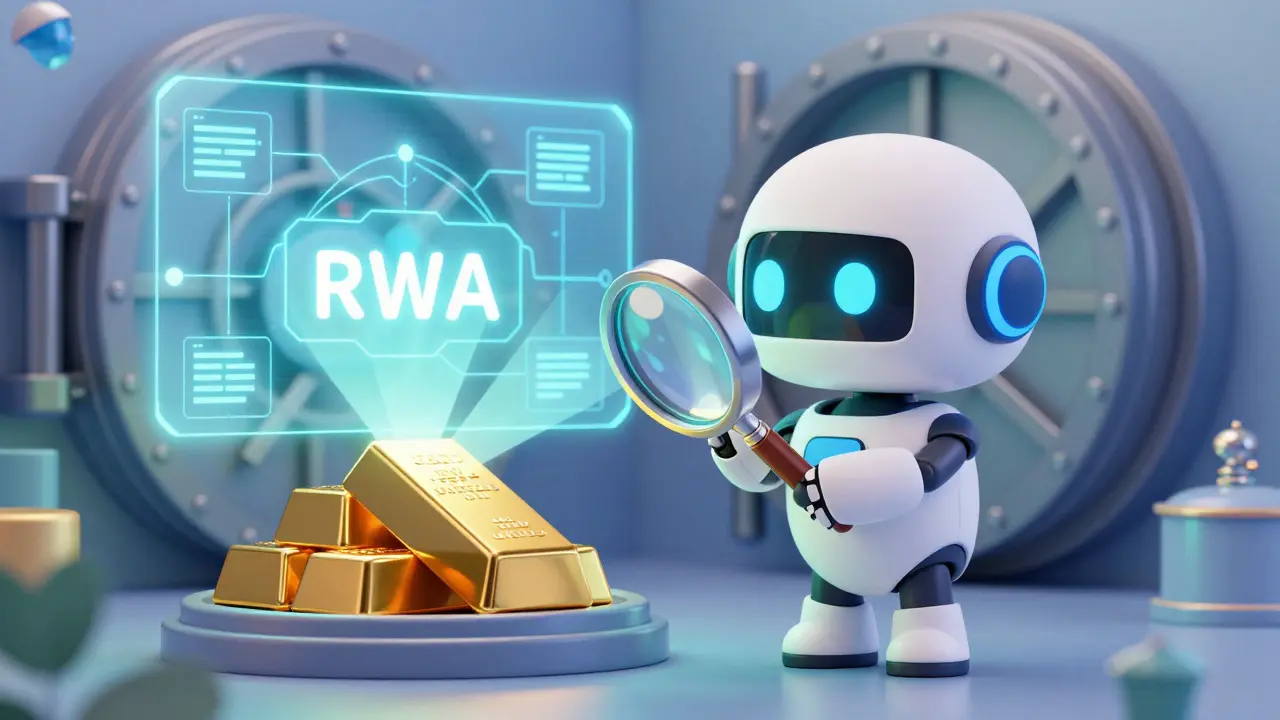
- Offchain Connection (Oracles): This is the critical link. Blockchains cannot see the real world. They need Oracle networks to feed them verified data. For example, an oracle confirms that the gold backing the tokens is actually in the vault. Chainlink’s Proof of Reserve service has become the industry standard for this verification.
- Issuance and Custody: Smart contracts are deployed to mint the tokens. Crucially, the physical asset must be held in custody, often within a Special Purpose Vehicle (SPV). This legal entity holds the actual asset, ensuring that token holders have a legitimate legal claim to it.
The Role of Oracles and Legal Structures
You cannot separate the tech from the law in RWA tokenization. The biggest risk isn't the code breaking; it's the disconnect between the digital token and the physical reality.
If a token says it represents $1,000 of gold, but the vault is empty, the token is worthless. This is why Chainlink Oracles are vital. They act as secure bridges, pulling real-world data (like warehouse receipts or bank balances) onto the blockchain in a tamper-proof way. Without reliable oracles, trust collapses.
On the legal side, the SPV structure is non-negotiable for serious projects. An SPV is a subsidiary company created to isolate financial risk. When you buy a token representing a piece of real estate, you don't own the brick-and-mortar directly. You own a share of the SPV that owns the property. This simplifies transferability-you don't need to redraw deeds every time someone buys a token. You just transfer the digital token.
Comparison: Traditional vs. Tokenized Assets
| Feature | Traditional Finance (TradFi) | RWA Tokenization |
|---|---|---|
| Settlement Time | 3-5 business days (or weeks for real estate) | Seconds to minutes |
| Transaction Costs | High (5-7% for real estate, plus intermediaries) | Low (1-2%, mostly gas fees) |
| Minimum Investment | High (often $100k+) | Low (can be as low as $10) |
| Liquidity | Illiquid (hard to sell quickly) | High (tradable on secondary markets 24/7) |
| Transparency | Opaque (private records) | Transparent (public ledger) |
| Custody | Centralized banks/law firms | Smart contracts + regulated custodians |
Market Reality: Challenges and Adoption
While the potential is huge, the current landscape is messy. Only about 15% of announced RWA projects have reached full production deployment as of mid-2024. Why? Regulation.
Regulatory uncertainty is the biggest hurdle. In the U.S., the Securities and Exchange Commission (SEC) has taken enforcement action against numerous projects, arguing that many tokenized assets are unregistered securities. In Europe, the Markets in Crypto-Assets (MiCA) regulation, effective June 2024, provides a clearer framework, encouraging institutional adoption.
Despite this, giants are entering the space. BlackRock launched its BUIDL tokenized fund in March 2024. Franklin Templeton tokenized $340 million in money market funds. JPMorgan uses its JPM Coin for institutional settlements. These moves signal that the technology is maturing, even if the rules are still being written.
User feedback highlights specific pain points. On forums like Reddit’s r/defi, common complaints include:
- Custody Verification: Users worry about whether the issuer truly holds the underlying assets.
- Liquidity Fragmentation: Tokens issued on one chain may not be easily traded on another, limiting buyer pools.
- Complexity: The legal wrapper around the token can be confusing for average investors.
Future Outlook: Interoperability and CBDCs
The next phase of RWA tokenization focuses on connectivity. Currently, tokens are often stuck on single blockchains. Solutions like Chainlink’s Cross-Chain Interoperability Protocol (CCIP) are changing this, allowing tokens to move securely between different networks like Ethereum, Polygon, and Solana. This unlocks deeper liquidity.
Another major frontier is integration with Central Bank Digital Currencies (CBDCs). Trials in Singapore and Switzerland suggest that settling RWA trades using digital fiat currencies could eliminate settlement risk entirely. Instead of waiting for bank transfers to clear, payment and asset transfer happen simultaneously. The Bank for International Settlements estimates this could reduce settlement risk by 90%.
By 2030, we expect to see tokenization expand beyond real estate and bonds into supply chain financing, carbon credits, and intellectual property royalties. The infrastructure is being built now. The question is no longer *if* it will happen, but *how quickly* regulators will catch up.
What is RWA tokenization?
RWA tokenization is the process of converting ownership rights of real-world assets (like real estate, bonds, or art) into digital tokens on a blockchain. This allows for fractional ownership, faster settlement times, and increased liquidity compared to traditional methods.
Is RWA tokenization legal?
It depends on the jurisdiction. In the EU, the MiCA regulation provides a clear legal framework. In the U.S., regulations are stricter, and many tokenized assets are classified as securities by the SEC, requiring strict compliance. Projects typically use Special Purpose Vehicles (SPVs) to ensure legal clarity.
How do oracles fit into RWA tokenization?
Oracles, such as those provided by Chainlink, bridge the gap between the blockchain and the real world. They verify that the underlying asset exists and is backed appropriately (e.g., confirming gold is in a vault), providing the data necessary for the smart contract to function trustlessly.
What are the risks of investing in tokenized assets?
Key risks include regulatory changes, counterparty risk (the issuer failing to hold the underlying asset), smart contract bugs, and liquidity fragmentation. Unlike traditional stocks, there may be fewer buyers available at any given moment, leading to price volatility.
Which blockchains are best for RWA tokenization?
Ethereum is currently the most popular due to its security and large user base. However, Layer 2 solutions like Arbitrum and Optimism are gaining traction for lower fees. Permissioned chains like Hyperledger are also used by institutions for privacy. Cross-chain protocols like CCIP are making interoperability easier.
Jerry CUNNINGHAM SR
May 13, 2026 AT 04:34It is fascinating to see how the integration of traditional finance and decentralized systems is evolving. The concept of fractional ownership through tokenization offers a promising avenue for democratizing investment opportunities. I appreciate the detailed breakdown of the technical processes involved.
Tobias Gjerlufsen
May 14, 2026 AT 12:43you are missing the point entirely. this is just another way for elites to control assets while pretending it helps the little guy. the regulatory hurdles exist because these things are fundamentally flawed. stop dreaming about utopian tech solutions.
Ruben Michel
May 15, 2026 AT 11:50The distinction between ERC-20 and ERC-721 standards is crucial here. One must understand that fungibility dictates the utility of the token in specific market contexts. It is not merely a technicality but a foundational element of asset representation.
Gavin Wonnacott
May 16, 2026 AT 22:13I find the notion of trusting oracles to be laughable. You expect me to believe that a digital bridge can verify physical gold? It is naive at best. The entire premise relies on trust in intermediaries which defeats the purpose of decentralization.
Sheldon Friesen
May 18, 2026 AT 16:00Let’s face it! The real issue isn’t the technology, it’s the human element! We keep building complex systems only to trip over our own greed! Isn’t it ironic? We want transparency but hide behind SPVs!
Tricia Alach
May 18, 2026 AT 22:03i think its really cool how we can buy parts of buildings now. it feels like magic sometimes when you think about it. maybe i will try investing in some art tokens soon. who knows what might happen.
Jan Gilmore
May 19, 2026 AT 04:11Everyone needs to realize that Ethereum is the only viable option for serious RWA projects. The security and liquidity provided by the network are unmatched. Other chains are just distractions for those who don't understand the underlying infrastructure.
Caique Muniz
May 19, 2026 AT 22:56another buzzword heavy article. sure if you have millions you can play with this stuff. rest of us are still trying to figure out why our crypto wallets lost half their value. typical hype cycle nonsense.
Bradley Geldenhuys
May 20, 2026 AT 03:29look at the bigger picture here folks. this is about changing how we view ownership itself. its not just money its philosophy. we need to embrace the chaos to find the order within. dont let fear stop you from exploring new frontiers.
robert Whitehead
May 21, 2026 AT 13:42The moral implications of fractionalizing high-value assets are often overlooked. Who truly benefits from this system? Is it the average investor or the institutions creating these structures? We must scrutinize the power dynamics at play.
Mike S
May 21, 2026 AT 14:00Drama alert! Everyone thinks they’re going to get rich quick from tokenized real estate. Spoiler: most of you will lose everything. The complexity alone should scare off the casual investors. Wake up sheeple.
H F
May 23, 2026 AT 05:33This is absolutely brilliant! I love seeing innovation drive progress. The potential for cross-chain interoperability is huge. Let's support these developments and push for clearer regulations to make it safe for everyone.
Michael Berggren
May 24, 2026 AT 17:12Great overview! 🚀 The role of Chainlink oracles is indeed critical. Without reliable data feeds, the whole system collapses. I’m optimistic about the future of RWAs as more institutional players enter the space. Keep learning! 💡
Kiran CS
May 25, 2026 AT 12:07How utterly tedious. The masses flock to these shiny new toys without understanding the legal intricacies. It is amusing to watch them stumble into regulatory traps. Only the sophisticated mind can navigate this minefield.
Bijan Das
May 25, 2026 AT 16:30boring stuff. just another way for banks to charge fees. why bother with all this tech when you can just buy a house normally. seems like a lot of trouble for very little gain honestly.
Ashley Rodriguez
May 26, 2026 AT 23:22i was reading about how settlement times are faster and it made me think about how much time we waste waiting for transactions to clear. it would be nice if everything was this efficient in daily life too. maybe we could save hours every week.
Bridget Coogle
May 27, 2026 AT 10:15it sounds like a great opportunity for people who want to invest small amounts. i hope more platforms become user-friendly so everyone can participate safely. lets keep an eye on the regulations though.
Zara Zaman
May 28, 2026 AT 07:25We need to protect our national interests first. Foreign entities using blockchain to move assets around is a security risk. We cannot allow unregulated financial instruments to undermine our economic stability. This needs strict oversight.
Larry Port
May 28, 2026 AT 10:45I’ve been following the development of CCIP closely. It seems like a solid solution for the fragmentation problem. Curious to see how it performs under stress during high-volume trading periods. The theory looks sound enough.
Jocelyn Garcia
May 28, 2026 AT 11:07The alpha here is clearly in the oracle layer. If you’re not monitoring the data feed integrity, you’re flying blind. Most retail investors don’t grasp the importance of the off-chain connection. Stay sharp.
beti macedo
May 30, 2026 AT 00:14this is very interesting information. i am always happy to learn about new technologies that can help people. hopefully it will become safer and easier to use in the near future for everyone.
Bianca Vilas Boas Lourenço
May 31, 2026 AT 03:29Ugh, another day another crypto scam waiting to happen 😒. I bet my last dollar that this ends in tears. Why do people fall for this garbage? It’s exhausting watching everyone get played again and again. 🙄
Destiny Kilby
June 1, 2026 AT 01:32I hear your concerns about regulation. It is understandable to feel cautious given the history of volatile markets. Perhaps focusing on education and gradual adoption would help ease some of the anxiety surrounding these new financial tools.
Tobias Gjerlufsen
June 1, 2026 AT 03:44education won't fix broken incentives. you are deluding yourself if you think regulation will come from a place of fairness. it will come from a place of control. wake up.