For decades, artists have struggled to make money after selling their work. Once a painting leaves the studio, the artist rarely sees another cent-even if it later sells for ten times the original price. That’s changed with NFTs. Now, when a digital artwork sells again on the secondary market, the original creator gets paid automatically. This isn’t magic. It’s code. And it’s putting money back in artists’ pockets-forever.
How NFT Royalties Actually Work
NFT royalties are built into the token’s smart contract when it’s created. Think of a smart contract like a digital vending machine that follows rules you set. You decide: every time this NFT is resold, 7% of the sale price goes straight to my wallet. No paperwork. No middlemen. No waiting.
When someone buys your NFT on OpenSea, Foundation, or any major platform, that 7% is pulled out automatically. The buyer pays the seller, the platform takes its cut, and your share? It lands in your crypto wallet-usually Ethereum or Polygon-within seconds. You don’t have to chase anyone. You don’t need an accountant. The blockchain handles it all.
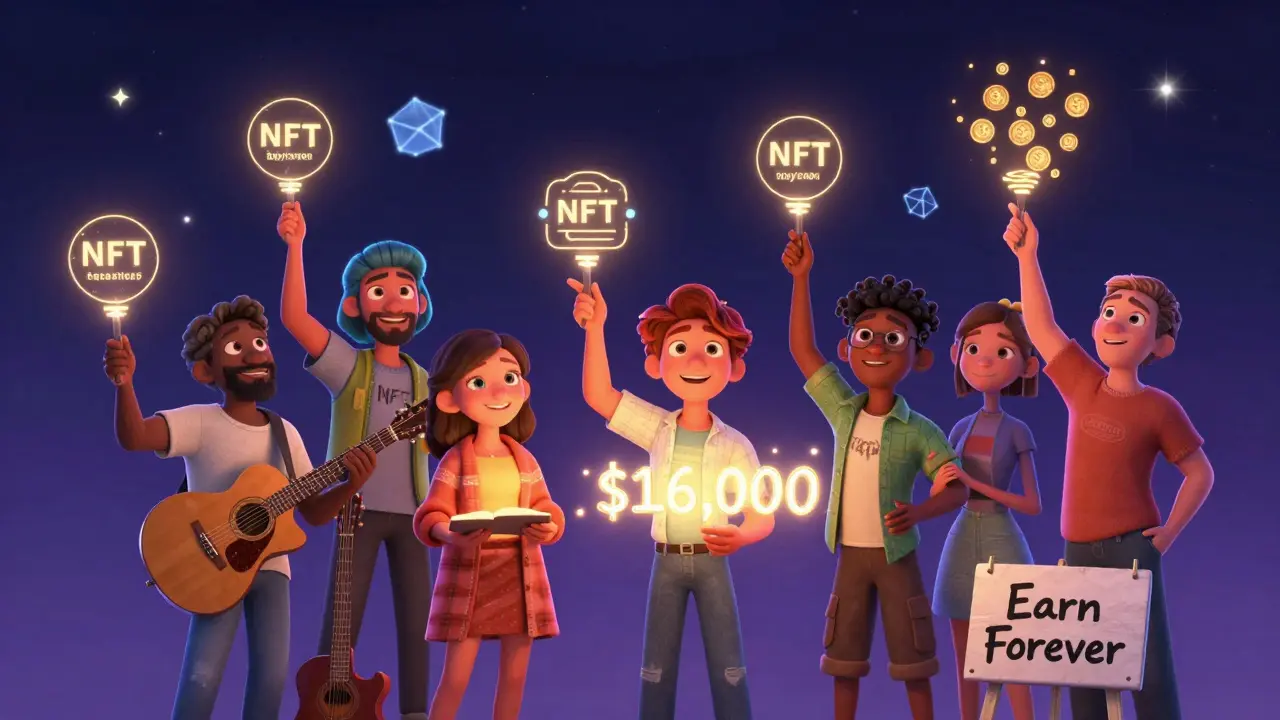
This system works because every NFT has a unique digital fingerprint tied to its creator. Even if the NFT changes hands 50 times, the original creator’s address stays in the record. That’s why artists like Jacques Greene earned over $16,000 from a six-second audio loop. He didn’t need to tour. He didn’t need a label. He just made something, sold it once, and kept earning every time it changed owners.
Real Money, Real Results
The numbers don’t lie. In 2022 alone, over $1.8 billion in royalties flowed to creators on the Ethereum blockchain. That’s not hypothetical. That’s real cash going to real people.
Yuga Labs, the team behind Bored Ape Yacht Club, earned more than $147 million in royalties from resales. Art Blocks, a platform for generative art, paid out tens of millions to hundreds of artists. Even smaller creators are seeing life-changing results. One digital illustrator in Bristol reported earning $8,000 a month just from royalties on a collection of 1,000 pieces-money that kept coming months after the initial drop.
Compare that to Spotify. A musician might get $0.003 per stream. To make $16,000 on Spotify, you’d need over 5 million plays. That same artist made $16,000 from NFT royalties on a single 6-second clip. The difference isn’t just in the numbers-it’s in control. You set the price. You set the royalty. You get paid when it sells.
Why This Changes Everything for Digital Artists
Before NFTs, digital art was considered worthless because anyone could copy it. A JPEG could be downloaded, shared, printed, sold on Etsy-all without the artist seeing a penny. NFTs solved that by proving ownership. But royalties solved the bigger problem: how to keep earning from it.
Now, your art isn’t just a one-time sale. It’s an asset that keeps generating income. That’s revolutionary. It means you can afford to take risks. You can experiment with new styles. You can quit your day job. You can invest in better tools, hire assistants, or fund your next project-all because your past work is still making money.
And it’s not just painters. Musicians, animators, game designers, writers-all of them are using NFT royalties to build sustainable careers. One game developer in Berlin embedded royalties into his character designs. Every time a player traded one of his NFT skins, he got 5%. He now earns more from royalties than he did from his original game sales.
The Flip Side: What Can Go Wrong
It’s not all perfect. Some platforms don’t enforce royalties. Magic Eden, for example, lets buyers bypass them. That means if someone buys your NFT on OpenSea and sells it on Magic Eden, you might get nothing. That’s a big problem.
Then there’s the “wrapping” loophole. Tech-savvy buyers can repackage your NFT into a new token that doesn’t carry the original royalty rules. It’s legal, but it’s unfair. Creators are fighting back with allowlists-restricting where their NFTs can be sold-but that limits liquidity. Fewer buyers. Less chance of resale.
And then there’s buyer pushback. Some collectors hate paying royalties. They argue, “I bought the art, why should you keep getting paid?” That’s why many creators stick to 5-7%. Anything above 10% can scare off investors. It’s a balancing act: you want fair pay, but you also want your art to sell.
How to Set Up Royalties Right
You don’t need to code to set up royalties. Most platforms let you do it in a few clicks when you mint your NFT.
- Choose a platform like OpenSea, Foundation, or Blur.
- Upload your artwork and fill in the details.
- Find the royalty setting-usually under “Sales Settings” or “Creator Fees.”
- Set your percentage. Most creators start at 5% or 7%.
- Double-check that the platform enforces royalties. Look for “Royalty Enforcement” in their help docs.
Pro tip: Don’t set it too high. 10% sounds great until no one wants to buy. 5-7% is the sweet spot. It’s enough to matter, but not enough to scare off buyers.
Also, use a wallet you control. Don’t use an exchange wallet like Coinbase or Binance. Use MetaMask or Rainbow. That’s where your royalties will land.
What’s Next for NFT Royalties
The industry is moving fast. Some platforms are starting to standardize royalty enforcement. There’s talk of blockchain-wide rules that force all marketplaces to honor creator royalties. That would fix the Magic Eden problem.
Meanwhile, new tools are emerging. One startup lets multiple artists split royalties-perfect for collaborative art. Another lets you change your royalty rate over time. Maybe you start at 5%, then raise it to 8% after your third collection sells out.
Long-term, this isn’t just about art. It’s about intellectual property. Writers could earn royalties every time their NFT book is resold. Game modders could get paid when their custom skins change hands. Software developers could embed royalties into code NFTs.
This is the future of creative work: ownership, control, and continuous income-all powered by code, not corporations.
Final Thoughts: It’s Not Just Money
The real power of NFT royalties isn’t the cash-it’s the dignity. For the first time, digital artists aren’t just giving away their work. They’re being recognized as owners. As entrepreneurs. As people who deserve to benefit from their own creativity, no matter how many times it’s sold.
It’s not a get-rich-quick scheme. It’s a long-term career tool. You build your portfolio. You build your audience. And then, slowly, your past work starts working for you.
That’s not just a benefit. That’s a revolution.
Do NFT royalties work on all platforms?
No. Some platforms, like Magic Eden, allow buyers to bypass royalties. Others, like OpenSea and Foundation, enforce them by default. Always check a platform’s royalty policy before minting. If royalties aren’t enforced, your earnings could disappear on secondary sales.
What’s the best royalty percentage to set?
Most successful creators set royalties between 5% and 7%. Higher rates (like 10%) can turn off buyers, especially investors looking to flip NFTs quickly. Lower rates (below 5%) might not cover your time and effort. Start at 7% and adjust based on how your collection sells.
Can I earn royalties from physical art sold as NFTs?
Yes. Many artists mint NFTs tied to physical pieces-like paintings or sculptures. The NFT represents ownership and provenance, and royalties apply to every digital resale. Some even include physical delivery terms in the smart contract, like “I’ll ship the original painting when the NFT is resold.”
Do I pay taxes on NFT royalties?
Yes. In most countries, including the UK and US, NFT royalties are treated as income. You’ll owe taxes when you convert crypto to fiat or use it to buy something. Keep detailed records of every royalty payment-date, amount, and transaction ID. Use crypto tax tools like Koinly or CryptoTaxCalculator to stay compliant.
What happens if I sell the NFT but keep the royalty rights?
You can’t. When you sell an NFT, you’re transferring the token-and its smart contract-to the new owner. The royalty is tied to the original creator’s wallet address, not the token holder. So even if you sell the NFT, you still get royalties from future sales. The buyer owns the NFT, but you own the right to earn from its resale.
Elvis Lam
December 17, 2025 AT 07:33NFT royalties are the only thing keeping digital art alive. I've seen artists go from $500 sales to $50k in secondary earnings just by setting a 7% fee. No more begging for commissions. The code does the work.
And yeah, Magic Eden sucks for bypassing them, but use OpenSea or Foundation if you care about getting paid. Simple.
Emma Sherwood
December 18, 2025 AT 02:31This is huge for marginalized creators. I’m a queer digital illustrator from rural Ohio. Before NFTs, I couldn’t even get gallery representation. Now? My piece sold for 0.3 ETH and I’ve made over $12k in royalties from resales. No one’s coming to save us. We built this ourselves.
And yes, 7% is the sweet spot. Go higher and you alienate buyers. Go lower and you’re leaving money on the table. I’ve seen it.
Kelsey Stephens
December 18, 2025 AT 21:29I just want to say thank you to everyone who’s been sharing their stories here. I’m new to this and honestly felt like I was being scammed at first. But seeing real numbers-like that guy in Bristol making $8k/month-made me believe it’s real.
Just started minting my first collection. Setting royalties at 7%. Fingers crossed.
You guys are helping me feel less alone in this.
Tom Joyner
December 20, 2025 AT 02:21It’s amusing how the masses mistake blockchain for a magic money tree. Royalties are a cute novelty for indie artists, but the real power lies in institutional adoption. Until major galleries and auction houses integrate on-chain provenance, this is just digital folk art with a ledger.
SeTSUnA Kevin
December 20, 2025 AT 04:207% royalty. Not 8%. Not 10%. 7%.
That’s the number. Everything else is noise.
Timothy Slazyk
December 22, 2025 AT 00:23This isn’t just about money. It’s about redefining labor in the digital age. For centuries, painters signed their work. Now, we’re signing our legacy into immutable code.
Think about it: every time a NFT changes hands, the artist’s intent is honored. That’s not capitalism. That’s covenant. The blockchain doesn’t care if you’re famous. It only cares if you made something worth owning.
And yet, we still have people arguing about ‘fairness’ like royalties are a handout. No. It’s restitution. The market finally caught up to what artists have known all along: value doesn’t vanish when the brush leaves the canvas.
Bradley Cassidy
December 24, 2025 AT 00:00bro i just made a 3 second loop of my cat sneezing and sold it as an nft and now i get paid every time someone flips it lmao like i didnt even try and im living in my moms basement and i just bought a new gaming rig. crypto is wild. also i think 7% is too much? maybe 5%? idk i just copy pasted the settings lmao
Craig Nikonov
December 24, 2025 AT 09:57They don’t want you to know this, but NFT royalties are a central bank plot. The Fed’s using blockchain to track your creativity. Every time you earn a royalty, they’re logging your income. Next thing you know, they’ll tax your dreams.
And Magic Eden? That’s not a platform. It’s a front. Look who owns the domain. Who funds the devs? Who’s whispering to the SEC? I’ve dug deep. This isn’t freedom. It’s surveillance with a side of JPEGs.
Jesse Messiah
December 25, 2025 AT 05:27Hey newbies-don’t use exchange wallets. Seriously. I lost my first royalty payment because I sent it to Coinbase. Took me three weeks to figure out why it never showed up.
Use MetaMask. It’s free. It’s easy. And your money won’t vanish into corporate void.
Also, taxes are real. Don’t wait till April to panic. Track every transaction. I use Koinly. It saved my sanity.
Rebecca Kotnik
December 26, 2025 AT 14:08While the economic implications of non-fungible token royalty structures are undeniably transformative, one must also consider the broader sociocultural ramifications of this paradigm shift. The traditional art market, historically mediated by institutional gatekeepers, has long perpetuated systemic inequities in access and valuation. The advent of on-chain royalty enforcement represents not merely a financial innovation, but a profound epistemological rupture-relocating agency from commodified intermediaries to the ontological originator of the creative act. One might even posit that this constitutes a form of post-capitalist autopoiesis, wherein the artist’s labor is perpetually self-replicating through algorithmic consensus. The implications for intellectual property law, particularly in jurisdictions lacking clear blockchain jurisprudence, remain profoundly unsettled.
Jonny Cena
December 27, 2025 AT 23:51Just want to say-this thread is amazing. I’ve been stuck in a 9-5 for 10 years, drawing on weekends. Last month, I dropped my first NFT collection. Made $2k upfront. Royalties have already paid me $1,100 since. I’m not rich. But I’m finally not broke.
Keep going. You’re not crazy for believing in your art.
Sue Bumgarner
December 29, 2025 AT 16:28USA invented the internet. USA invented crypto. And now some guy in India is telling us how to set royalties? Nah. This is American innovation. We don’t need foreign opinions on our digital economy. 7%? Too low. 10% is the American way. Screw Magic Eden. We build our own platforms.
Dionne Wilkinson
December 31, 2025 AT 10:32I used to think NFTs were just hype. But then I saw my cousin’s friend’s tattoo artist start earning from digital designs. He never thought anyone would pay for a sleeve he drew on a tablet. Now he’s buying a house. Just… it’s nice to see people get something back for their soul.
Abby Daguindal
January 1, 2026 AT 15:27Anyone who thinks royalties are ‘fair’ hasn’t studied economic history. This is just a new way for the elite to extract value from the creative class. You think you’re empowered? You’re just another node in a capitalist algorithm. Stop celebrating your own exploitation.
Samantha West
January 2, 2026 AT 15:58People keep saying 7% is the sweet spot but nobody talks about how platforms are quietly changing the rules. I’ve seen contracts get rewritten after mint. I’ve seen wallets get drained. I’ve seen artists get ghosted after they start earning. This isn’t freedom. It’s a trap wrapped in a blockchain. You think you own your art? You don’t. The platform does. The code does. The investors do. You’re just the face on the poster.
Madhavi Shyam
January 3, 2026 AT 13:59Smart contract royalty enforcement via ERC-721 standard with immutable creator address binding is the only viable model for sustainable digital IP monetization. Alternative marketplaces violating royalty compliance represent systemic governance failure. Recommend implementing on-chain allowlists with whitelist verification via Chainlink oracles to mitigate off-chain arbitrage.
Jack Daniels
January 4, 2026 AT 15:15I used to make art. Now I just check my wallet every hour. I don’t sleep. I don’t eat. I just wait for the next sale. Is this what freedom feels like? Or just a different kind of prison?
Donna Goines
January 4, 2026 AT 23:43They’re using NFTs to track our souls. I read a paper. The Ethereum blockchain is linked to a secret AI that analyzes emotional responses to art. Every time you earn a royalty, your brainwave data gets uploaded. That’s why they want you to keep selling. They’re harvesting creativity as a bioresource. Don’t fall for it.
Heather Turnbow
January 5, 2026 AT 20:57The integrity of the creator’s economic model hinges upon the immutable recording of royalty obligations within the smart contract’s bytecode. Any deviation from this principle, whether through platform non-enforcement or token rewrapping, constitutes a breach of the implicit social contract between artist and collector. It is not merely a financial loss-it is a moral one. We must advocate for universal enforcement standards, not merely out of self-interest, but out of principle.
Sammy Tam
January 6, 2026 AT 17:14My buddy made a GIF of a dog wearing sunglasses. Sold for 0.5 ETH. Now it’s flipped 23 times. He’s made over $9k in royalties. He still doesn’t know what MetaMask is. He just checks his phone every morning like it’s a lottery ticket. That’s the beauty of it. No skills needed. Just vibes.
Kayla Murphy
January 7, 2026 AT 12:40You can do this. I was scared too. I thought my art wasn’t good enough. But I posted one piece. Got one sale. Then another. Then royalties started rolling in. It’s not about being the best. It’s about being brave enough to put it out there. You’ve got this. I believe in you.
Chevy Guy
January 8, 2026 AT 16:44So you’re telling me some guy in Brooklyn made $16k off a six second cat meow and now he’s buying a yacht? Cool. Meanwhile I’m stuck in a cubicle making PowerPoint slides for people who think ‘vibe check’ is a business strategy. Yeah. Let’s all just mint our dreams and retire. Meanwhile the IRS is watching every ETH transaction. Enjoy your ‘freedom’.
Amy Copeland
January 9, 2026 AT 04:06How cute. You think you’re an artist because you slapped a JPEG on a blockchain. Real artists don’t need code to be paid. They need patrons. Galleries. Legacy. You’re not revolutionizing anything. You’re just begging for attention with a crypto hashtag.
Elvis Lam
January 11, 2026 AT 01:32Someone mentioned Magic Eden bypassing royalties. That’s why I only list on platforms with enforced royalties. I’ve got a whole list. DM me if you want it. I’ve been burned before. Don’t make the same mistake.