When you look for a place to trade tokens on the Fantom blockchain, you usually see names like SpookySwap or SpiritSwap dominating the charts. But what about Fraxswap? Specifically, the version deployed on Fantom? If you’ve been digging into DeFi lately, you might have heard of Frax Finance’s broader ecosystem. You might even know that their Ethereum deployment is getting some buzz for its unique features. But the Fantom side of things? That’s a different story.
Here is the hard truth: as of early 2026, Fraxswap on Fantom is barely visible. It is classified as an “Untracked Listing” by major data aggregators like CoinMarketCap. The trading volume is so low it registers as fractions of a cent in daily activity. So, why would anyone care? Well, if you are a DAO treasury manager or an institutional trader looking to move large amounts of capital without crashing the price, there is one feature here that makes it interesting: TWAMM. Let’s break down whether this platform is a hidden gem or just a ghost town.
What Exactly Is Fraxswap on Fantom?
To understand Fraxswap (Fantom), you first need to understand its parent protocol. Fraxswap is a decentralized automated market maker (AMM) developed by Frax Finance. Think of it as a sibling to Uniswap, but with a twist. While Uniswap lets you swap tokens instantly, Fraxswap introduced a mechanism called Time-Weighted Average Market Maker (TWAMM).
The Fantom deployment is essentially a port of this technology onto the Fantom Opera network, which is known for its incredibly fast transaction speeds and near-zero fees. Technically, it uses the standard $xy=k$ AMM model for instant swaps, meaning liquidity providers deposit pairs of tokens, and traders swap against those pools. However, the standout feature is the TWAMM integration. This allows trades to execute slowly over time rather than all at once. For regular retail traders buying $10 worth of tokens, this doesn’t matter much. But for someone trying to sell $1 million worth of assets, it prevents massive slippage.
The Reality Check: Volume and Liquidity Data
Let’s talk numbers, because they tell a stark story. When I checked the latest data from sources like CoinCodex and CoinMarketCap for May 2026, the results were startling. Fraxswap V1 on Fantom recorded a 24-hour trading volume of approximately $0.66. Yes, less than a dollar.
| Platform | Network | Daily Volume (Approx.) | Liquidity Status | Primary Use Case |
|---|---|---|---|---|
| Fraxswap | Fantom | $0.66 | Extremely Low / Untracked | Niche Institutional / TWAMM |
| SpookySwap | Fantom | $Millions | High | Retail Trading / Yield Farming |
| SpiritSwap | Fantom | $Millions | High | Retail Trading / Staking |
| Beethoven X | Fantom | $Millions | Very High | Bonding Curve Trading |
This lack of volume means two things for you as a user. First, price discovery is poor. If you try to buy a token that isn’t heavily traded, your order could significantly move the price against you. Second, there is minimal arbitrage activity. Arbitrage bots keep prices aligned across exchanges; without them, Fraxswap prices can drift away from the real market value.
The most active pair currently is WFTM/FRAX, followed by FXS/FRAX. Even then, the depth is shallow. If you are looking to park stablecoins and earn yield, the fee share you’d get from these tiny volumes would likely be negligible compared to the gas costs (even though Fantom gas is cheap, it’s not free) and the opportunity cost of using a more liquid DEX.
The TWAMM Feature: Why It Matters
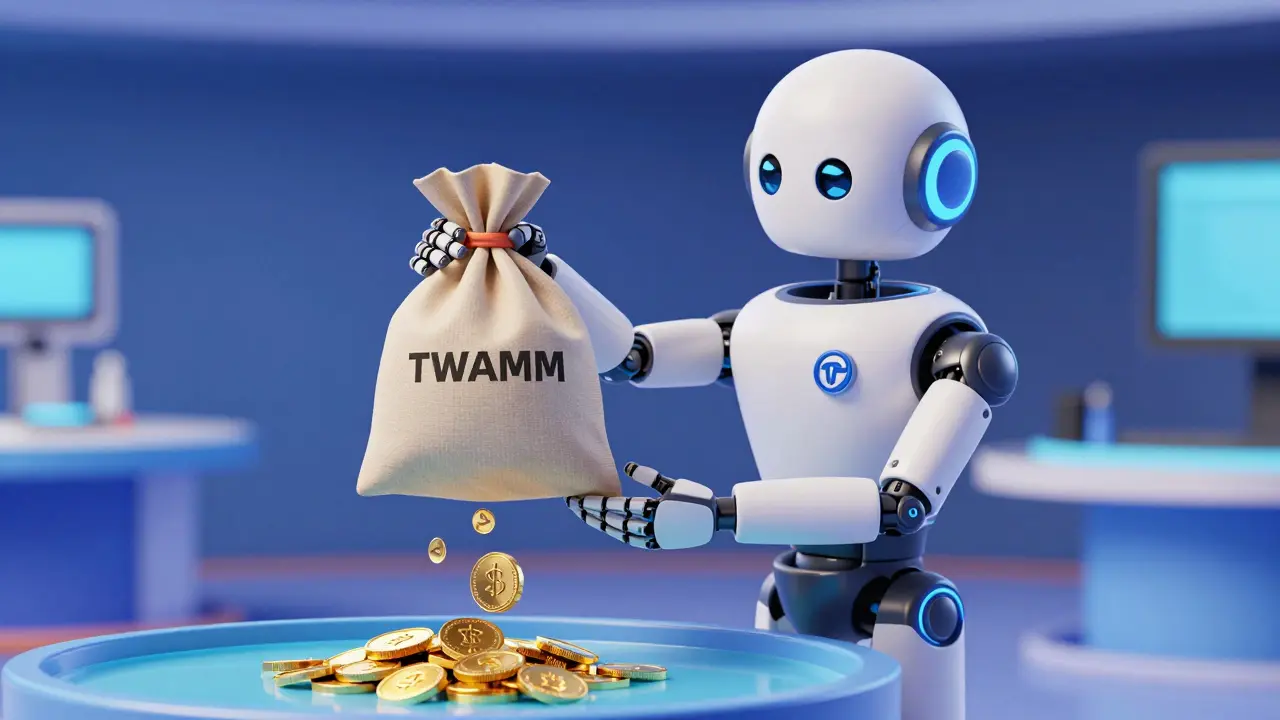
If the volume is this low, why does Fraxswap exist? The answer lies in its unique selling proposition: TWAMM (Time-Weighted Average Market Maker). Unlike traditional AMMs where a trade happens in a single block, TWAMM spreads the execution of a large order over a set period-say, 24 hours or a week.
Imagine a DAO needs to sell 10 million FRAX tokens. On a standard DEX like SpookySwap, dumping that amount at once would crash the price, resulting in a terrible exit rate for the DAO. With Fraxswap’s TWAMM, the sale is automated and gradual. It sells small chunks continuously, minimizing market impact. This is a sophisticated tool designed for treasuries, venture capital firms, and large institutions.
However, adoption has been slow. Most users on Fantom are retail traders looking for quick flips or yield farming opportunities. They don’t need TWAMM; they need instant liquidity. Because the retail crowd ignores Fraxswap, the liquidity remains low, creating a vicious cycle. The tech is innovative, but the product-market fit on Fantom specifically hasn’t clicked yet.
Security and Smart Contract Risks
When dealing with any decentralized exchange, security is paramount. Fraxswap’s smart contracts are open-source, which is a good sign. Transparency allows developers and auditors to inspect the code for vulnerabilities. The Frax development team regularly reviews the codebase, and community contributors often participate in audits.
However, specific audit reports for the *Fantom* deployment are not prominently displayed or easily accessible in public documentation. This is a red flag for cautious investors. While the core logic is shared with the Ethereum version (which has undergone rigorous scrutiny), cross-chain deployments can introduce new variables. Always verify the contract addresses yourself before connecting your wallet. Never trust links from social media posts blindly.
Also, remember that low liquidity can sometimes be a security risk in itself. In a “rug pull” scenario, attackers exploit thin order books. While Fraxswap is backed by the reputable Frax Finance brand, the lack of deep liquidity means that even legitimate large trades can suffer from high slippage, effectively acting as a loss for the trader.
User Experience and Interface
Using Fraxswap on Fantom follows the standard Web3 playbook. You need a compatible wallet like MetaMask or Trust Wallet. You must hold FTM (Fantom native token) to pay for transaction fees. Although Fantom transactions are nearly instantaneous and cost fractions of a penny, you still need some FTM in your wallet.
The interface mirrors other AMMs. You connect your wallet, select the token pair, and enter the amount. However, due to the low activity, you might find that the UI feels static. There aren’t many live updates, price charts, or active trading pairs to explore. Compared to the vibrant, gamified interfaces of competitors like SpookySwap-which offer staking rewards, NFTs, and complex yield strategies-Fraxswap feels utilitarian and bare-bones.
There is no fiat gateway. You cannot buy FRAX or FXS directly with a credit card on Fraxswap. You must acquire tokens elsewhere and bridge them to Fantom first. This adds friction for new users who are just entering the ecosystem.

How It Compares to the Competition
Fantom’s DeFi landscape is crowded. To decide if Fraxswap is right for you, you need to compare it against the giants.
- SpookySwap: The original major DEX on Fantom. It has massive liquidity, a wide variety of tokens, and a strong community. If you want to trade obscure altcoins or farm yields, this is your go-to.
- SpiritSwap: Known for its robust staking mechanisms and diverse pool options. It offers better incentives for liquidity providers.
- Beethoven X: A newer contender that focuses on bonding curves rather than constant product formulas. It handles multi-token pools better than traditional AMMs.
- Fraxswap (Ethereum): Note that the Ethereum version of Fraxswap is much more active. If you are bullish on the Frax ecosystem, you might get better utility and liquidity by using the Ethereum mainnet version instead of the Fantom fork.
Fraxswap on Fantom doesn’t compete on volume or variety. It competes on niche functionality. If you don’t need TWAMM, there is virtually no reason to use it over SpookySwap.
Who Should Use Fraxswap on Fantom?
Based on the current data, Fraxswap on Fantom is suitable for only a very specific group of users:
- DAO Treasuries: Organizations holding large amounts of FRAX or FXS that need to rebalance portfolios without causing market shock.
- Institutional Traders: Entities executing large-scale strategies where slippage is a critical cost factor.
- Frax Ecosystem Die-Hards: Users who specifically want to support the Frax brand on Fantom and are willing to accept lower liquidity for ideological alignment.
For everyone else-the average retail trader, the yield farmer, the meme coin hunter-Fraxswap on Fantom is likely not the best tool. The risks of slippage and the lack of incentives outweigh the benefits.
Future Outlook: Will It Recover?
The future of Fraxswap on Fantom looks uncertain. The classification as an “untracked listing” suggests that either the project is being deprioritized by the Frax team, or it has simply failed to gain traction. The broader Fantom network has seen volatility in Total Value Locked (TVL) throughout 2024 and 2025, with many projects migrating to other chains like Solana or Base.
Unless Frax Finance introduces significant incentives-such as boosted yields for liquidity providers or exclusive token emissions-to attract users to the Fantom deployment, the status quo is likely to continue. The innovative TWAMM feature is valuable, but innovation alone doesn’t drive liquidity. Network effects do. And right now, the network effect is missing.
Is Fraxswap on Fantom safe to use?
The smart contracts are open-source and reviewed by the Frax team, which reduces the risk of malicious code. However, the extremely low liquidity poses a financial risk. Large trades may experience severe slippage, and the lack of prominent audit reports for the specific Fantom deployment means you should exercise caution. Always verify contract addresses independently.
Why is the trading volume on Fraxswap (Fantom) so low?
Fraxswap on Fantom lacks the marketing push, liquidity incentives, and user base of competitors like SpookySwap and SpiritSwap. Its focus on institutional tools like TWAMM means it appeals less to retail traders who drive most DEX volume. Consequently, it remains an "untracked listing" with minimal daily activity.
What is TWAMM and how does it work?
TWAMM stands for Time-Weighted Average Market Maker. It is a trading mechanism that executes large orders gradually over a specified period (e.g., 24 hours) rather than instantly. This minimizes market impact and slippage, making it ideal for large institutional trades or DAO treasury management.
Can I earn yield by providing liquidity on Fraxswap Fantom?
Technically yes, you can provide liquidity and earn a share of swap fees. However, given the near-zero trading volume (approx. $0.66/day), the fees earned would be negligible. You would likely earn more by providing liquidity on higher-volume DEXs like SpookySwap or Beethoven X.
Should I use Fraxswap on Ethereum instead?
If you are interested in the Frax ecosystem, the Ethereum version of Fraxswap is significantly more established and liquid. It has higher trading volumes and better integration with the broader DeFi landscape on Ethereum. The Fantom version is a niche deployment with limited utility for most users.
Sarah C
May 5, 2026 AT 22:56Thanks for putting this together, it's really helpful to see the hard numbers laid out like that. I've been watching Fantom DeFi closely and the liquidity drought on Fraxswap is definitely real. It's interesting how TWAMM remains such a niche feature despite its theoretical benefits for large orders.
Sharada Vakkund
May 6, 2026 AT 19:13I think we should all remember that just because a protocol isn't popular right now doesn't mean it's useless. For those of us managing smaller DAOs or even personal portfolios with significant FRAX holdings, the ability to sell without crashing the price is actually pretty valuable. We shouldn't dismiss tools just because they aren't flashy or have high volume charts. It's about finding the right tool for the specific job you need to do.
Tobias Gjerlufsen
May 8, 2026 AT 01:54You're all missing the obvious point here. The market doesn't care about your feelings or your 'niche needs'. If there's no volume, the platform is dead. Period. Fraxswap on Fantom is a ghost town because the tech stack is inferior to what Ethereum offers anyway. Why bother with a second-rate chain for a second-rate DEX? It's inefficient and stupid.
Sheldon Friesen
May 9, 2026 AT 19:34Oh look, another person who thinks being loud makes them right! Seriously though, Tobias, while the volume is low, the utility exists for specific use cases. Not everyone wants to dump their bags instantly. Some people want to preserve value. That's not 'stupid', it's basic financial prudence. You can't just ignore the mechanics of slippage because you're too busy typing angry comments.
Tobias Gjerlufsen
May 10, 2026 AT 05:48Don't lecture me on financial prudence when you're defending a protocol that earns less than a dollar a day. It's pathetic. The only thing preserving value here is the delusion of the users who stick around. Move to Ethereum or Solana if you want actual efficiency. This is just nostalgia for a dead ecosystem.
Destiny Kilby
May 12, 2026 AT 00:05I find the situation quite unfortunate but understandable. The lack of marketing and incentives has clearly hurt the platform. I worry about the security implications of such low liquidity as well. It seems risky to trust any platform that isn't actively maintained or monitored by a larger community. One would hope the team addresses these concerns soon.
Ruben Michel
May 13, 2026 AT 10:20The distinction between retail trading and institutional execution is often misunderstood by the general public. Fraxswap's TWAMM mechanism is not designed for the casual trader seeking quick profits. It is a sophisticated instrument for treasury management. To critique its lack of retail volume is to misunderstand its fundamental purpose entirely. The elitist nature of its user base is a feature, not a bug.
Gavin Wonnacott
May 14, 2026 AT 08:54Ruben, stop pretending you're part of some exclusive club. You're just talking about empty wallets. And frankly, your pretentious tone is exhausting. Who cares about 'institutional execution' if the contract hasn't been audited properly on this chain? It's a scam waiting to happen. Don't try to dress up negligence as sophistication.
Ruben Michel
May 15, 2026 AT 15:48Your emotional outburst is noted and dismissed. The code is open source. Due diligence is expected from serious participants. Those who cannot distinguish between a lack of retail hype and a security vulnerability are simply not qualified to comment on the matter.
Samara McCallum
May 15, 2026 AT 22:03why does everyone have to be so dramatic about a few dollars of volume? it's just a dex. if you don't like it don't use it. but calling it a scam is wild. i guess the drama king in me loves the tension though lol. honestly i think the whole defi space is just a big game of chicken anyway.
Tricia Alach
May 17, 2026 AT 00:40i totally agree with samara here. people get way too worked up over these metrics. its just crypto stuff. fraxswap might be quiet but thats okay. maybe its resting. i dont know much about twamm but sounds cool. typos aside i think we should chill out and let the protocols breathe.
Jan Gilmore
May 18, 2026 AT 08:05Let's get one thing straight: SpookySwap is the king of Fantom for a reason. Liquidity depth matters more than fancy features like TWAMM for 99% of users. If you can't execute a trade quickly without massive slippage, the DEX is broken. Fraxswap is irrelevant for anyone who isn't moving millions. Stop trying to revive a corpse.
Caique Muniz
May 20, 2026 AT 00:48jan is right again. spooky swap wins. fraxswap is boring. i tried it once and felt nothing. literally nothing. just gas fees and regret. why do we even talk about this? its like reviewing a restaurant that closed ten years ago. waste of time.
Bradley Geldenhuys
May 21, 2026 AT 21:14Hey hey lets not trash everything so fast. There is beauty in simplicity sometimes. Fraxswap might be quiet but it is stable. Maybe that is what some people need. A place to park tokens without the noise. Also spelling mistakes dont make you smarter jan. Keep it positive guys!
robert Whitehead
May 23, 2026 AT 05:01The moral decay of this community is evident in the defense of suboptimal protocols. Fraxswap on Fantom represents a failure of market discipline. Resources should flow to the most efficient platforms, not to legacy systems propped up by ideological loyalty. It is irresponsible to suggest otherwise.
Shelby Cantu
May 24, 2026 AT 09:39Short answer: no. Use Spooky.
Ankush Pokarana
May 25, 2026 AT 10:11It is important to consider the broader philosophical implications of liquidity distribution. When a protocol fails to attract users, it reflects a deeper disconnect between the technology offered and the human desire for immediate gratification. TWAMM requires patience, a virtue increasingly rare in modern finance. Perhaps the silence of Fraxswap is a testament to our collective impatience rather than a technical failure. We must ask ourselves what kind of financial system we truly wish to inhabit.
Bianca Vilas Boas Lourenço
May 26, 2026 AT 13:35Ugh, why is this thread so depressing? 😩 I just wanted to check my bags and instead I'm reading about dead chains and zero volume. It's giving major FOMO vibes but in reverse. Like, anti-FOMO? Whatever. Just ignore the haters and keep holding your gems 💎🚀 #FraxArmy
Yash Lodha
May 28, 2026 AT 06:50Do you really believe the official narrative? CoinMarketCap untracking it is a classic suppression tactic. The elites don't want you to know about TWAMM because it allows true decentralization of large capital movements away from their centralized exchanges. Fraxswap is a shadow network for the wise. Wake up sheeple.
Kimberly Herbstritt
May 29, 2026 AT 18:17I actually think the low volume is a good thing. Less competition means less stress. I like having a quiet corner of the internet where nobody is screaming about rug pulls. It's peaceful. Plus, if it ever gets popular, I'll be early. So thanks for the heads up!
Sudarshan Anbazhagan
May 30, 2026 AT 07:19The analysis presented herein is superficial at best. One must delve into the intricacies of the underlying smart contract architecture to truly appreciate the potential of Fraxswap. The lack of volume is merely a temporary phenomenon caused by inadequate user education. Those who dismiss it based on current metrics are displaying a profound ignorance of blockchain economics.
John Gonzalez Bentham
May 30, 2026 AT 22:54everyone is wrong. fraxswap is the future. you guys just dont get it. i made money on it last year so shut up. also typo is intentional. deal with it.
Ellie Riddell
May 31, 2026 AT 12:59Sigh. Here we go again with the cult of personality around dead protocols. Look, if you're not using it for TWAMM, you're wasting your time. But let's be real, how many of you actually have enough FRAX to need TWAMM? Probably none. So yeah, it's a ghost town. Embrace it.
Mike S
June 1, 2026 AT 16:13This article is garbage. The author clearly has no idea what they're talking about. Fraxswap is fine. It's perfect. The fact that it has zero volume proves it's secure because no one can attack it. Brilliant logic. I'm going to invest my life savings here. Thanks for the tip.