Most crypto traders have a love-hate relationship with gas fees. You want the security of Ethereum, but you don’t want to pay $50 just to swap some tokens. That is why platforms built on Polygon-a layer-2 scaling solution for Ethereum-have become so popular. They offer fast transactions and pennies-worth of fees. But not all decentralized exchanges (DEXs) on Polygon are created equal. Some handle billions in volume; others are tiny niche projects.
Enter Firebird Finance, a decentralized finance platform that markets itself as a three-in-one solution: an exchange, a yield aggregator, and a vault system. It operates primarily on Polygon and Binance Smart Chain (BSC). If you are looking for a place to park your stablecoins or farm yields without draining your wallet on network fees, Firebird Finance might catch your eye. But does it actually deliver value, or is it just another small-cap project trying to survive in a crowded market?
In this review, we break down what Firebird Finance offers, how it compares to giants like SushiSwap, and whether its native HOPE token is worth your attention in 2026.
What Exactly Is Firebird Finance?
At its core, Firebird Finance is a decentralized exchange (DEX). Unlike centralized exchanges like Coinbase or Binance, you never hand over custody of your funds. You connect your wallet, approve the transaction, and trade directly from smart contracts. However, Firebird tries to do more than just facilitate swaps.
The platform bundles three main services:
- Swap Page (AMM): An Automated Market Maker where you trade tokens against liquidity pools.
- OneSwap: A specialized pool for stablecoins (USDC, USDT, DAI) designed to minimize slippage.
- Vaults & Farms: Mechanisms to auto-compound rewards and stake tokens.
This "all-in-one" approach aims to simplify the user experience. Instead of hopping between Uniswap for trading, Yearn for yield optimization, and a separate staking site, Firebird attempts to house everything under one roof. For advanced users who already know their way around DeFi, this can save time. For beginners, however, the interface assumes a certain level of comfort with concepts like liquidity provision and impermanent loss.
Key Features and How They Work
To understand if Firebird Finance fits your strategy, let’s look at its specific tools.
1. The Swap Engine and OneSwap
The standard swap function works like most AMMs. You input a token, select the output token, and the protocol calculates the price based on the ratio of assets in the liquidity pool. Where Firebird adds a twist is with OneSwap. Stablecoin trading often suffers from high slippage on general pools because the price difference between USDC and USDT should theoretically be zero. OneSwap creates dedicated liquidity pools for these assets, ensuring you get a near-exact 1:1 rate when swapping between major stablecoins. This is crucial for arbitrageurs and traders who move capital frequently between chains.
2. Yield Vaults and Auto-Compounding
Yield farming involves providing liquidity to earn trading fees and reward tokens. Usually, you have to manually harvest those rewards and reinvest them to compound your earnings. Firebird’s vaults automate this process. When you deposit into a vault, the smart contract periodically sells a portion of the earned rewards to buy more of the underlying asset, then reinvests everything back into the pool. This "auto-compounding" can significantly boost annual percentage yields (APY) compared to manual farming, provided the underlying strategy remains profitable.
3. Farms-as-a-Service
This is perhaps Firebird’s most unique feature. Most DeFi protocols launch their own farms independently. Firebird offers infrastructure that allows other projects to spin up their own yield farms on the Firebird platform within minutes. This democratizes access to yield farming infrastructure, potentially bringing new tokens and incentives to the Firebird ecosystem quickly. For users, this means a wider variety of farming opportunities, though it also requires careful due diligence on the quality of those third-party projects.
Firebird Finance vs. The Giants: A Reality Check
You cannot review a DEX without comparing it to the competition. On Polygon, the undisputed heavyweight is SushiSwap. Let’s put them side-by-side.
| Feature | Firebird Finance | SushiSwap |
|---|---|---|
| Total Value Locked (TVL) | $4.79 Million | $5.04 Billion |
| Primary Focus | Niche Yield Optimization & Aggregation | General Purpose Trading & Governance |
| Native Token | HOPE | SUSHI |
| User Base Size | Small / Specialized | Mainstream / Global |
| Unique Selling Point | Farms-as-a-Service & Auto-Compound Vaults | Liquidity Depth & Brand Recognition |
The TVL gap is staggering. SushiSwap locks over five billion dollars, while Firebird sits below five million. What does this mean for you? Liquidity depth. On SushiSwap, you can swap large amounts of ETH or USDC with minimal price impact. On Firebird, large trades might suffer from higher slippage because the pools are smaller. Firebird is not trying to compete on volume; it is competing on yield efficiency and specialized tools. If you are moving millions, stick to the giants. If you are optimizing smaller positions for maximum APY through auto-compounding, Firebird’s model may offer better returns.

The HOPE Token: Staking and Risks
Like many DeFi protocols, Firebird relies on a governance and utility token called HOPE. Users can lock HOPE tokens to receive additional incentives. This is a common mechanism to encourage long-term holding and reduce sell pressure.
However, there is a lack of transparent data regarding HOPE’s current market performance. Price prediction algorithms require significant historical trading volume to generate reliable forecasts, and HOPE appears to have limited liquidity on major charts. This suggests two possibilities: either the token is very new, or it is traded on a highly fragmented set of venues. For investors, this means higher volatility and potential difficulty exiting large positions without impacting the price. Always check the current liquidity of the HOPE token on a block explorer before committing significant capital to staking.
Security and Trust Factors
In DeFi, code is law, but bad code is expensive. Firebird Finance operates on Polygon and BSC, both of which have robust ecosystems. However, the platform’s smaller size means it has likely undergone less public scrutiny than established protocols like Uniswap or Curve.
Key security considerations include:
- Smart Contract Audits: Reputable DeFi projects publish audit reports from firms like CertiK or OpenZeppelin. Check Firebird’s official documentation for recent audit status. If audits are missing or outdated, proceed with extreme caution.
- Team Transparency: While the team behind Firebird is not widely detailed in public sources, the use of "farms-as-a-service" implies a technical team capable of building complex infrastructure. Look for active development repositories (like GitHub) to verify ongoing work.
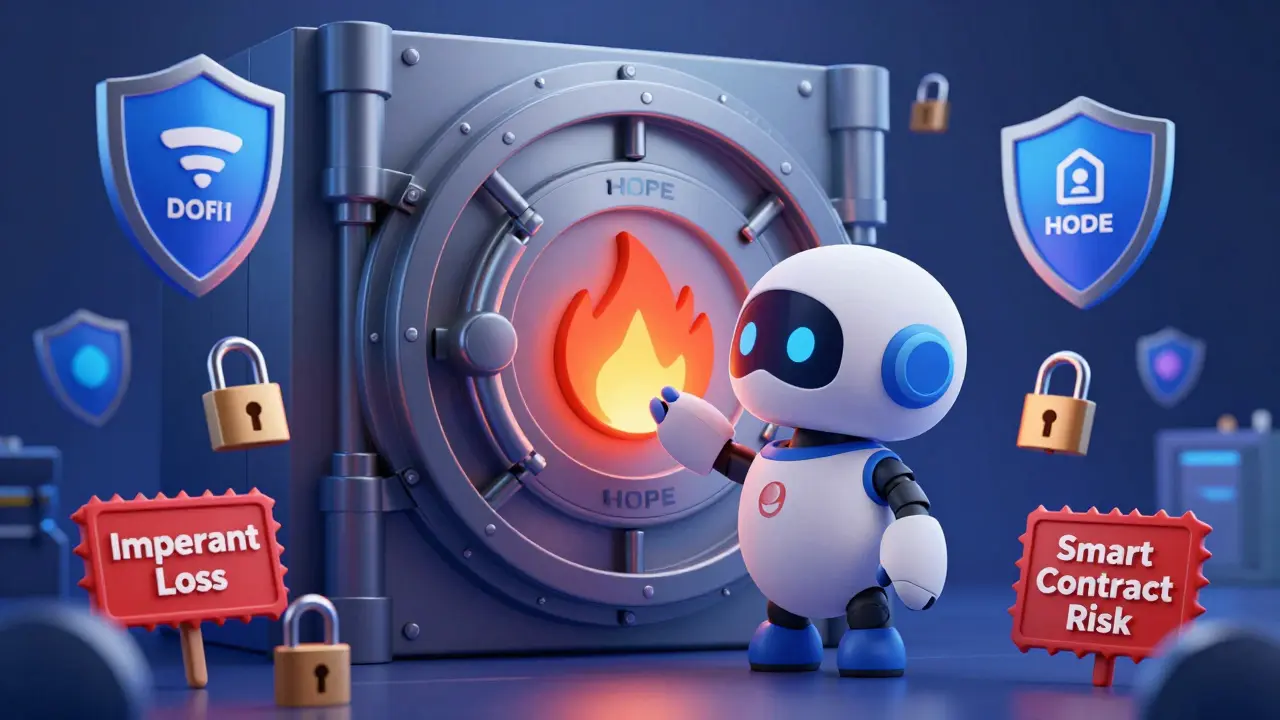
- Impermanent Loss: Regardless of the platform, providing liquidity carries the risk of impermanent loss. If the price of your deposited tokens diverges significantly from when you deposited them, you may end up with less value than if you had simply held the tokens in your wallet. Firebird’s auto-compounding helps mitigate this slightly by boosting yield, but it does not eliminate the risk.
Who Should Use Firebird Finance?
Firebird Finance is not for everyone. Here is who benefits most:
- Yield Farmers: Users comfortable with moderate risk who want to maximize APY through auto-compounding vaults rather than simple spot trading.
- Stablecoin Arbitrageurs: Traders who need low-slippage swaps between USDC, USDT, and DAI on Polygon.
- DeFi Developers: Projects looking to launch yield farms quickly using the "farms-as-a-service" model.
If you are a beginner looking for a safe place to store Bitcoin or Ethereum, Firebird is probably too complex and risky. Stick to major centralized exchanges or deeply liquid DEXs. If you are an advanced user seeking niche yield opportunities on Polygon, Firebird deserves a spot in your toolkit-but always start with small amounts to test the waters.
Final Verdict
Firebird Finance carves out a specific niche in the Polygon DeFi landscape. It is not trying to be the next Uniswap; it is trying to be a more efficient yield optimizer. With a TVL of $4.79 million, it remains a mid-to-small-tier player, which brings both opportunity (higher yields, less competition for incentives) and risk (lower liquidity, less brand recognition).
The platform’s integrated approach-combining swaps, vaults, and farming infrastructure-is genuinely useful for experienced DeFi users. The OneSwap feature for stablecoins is a practical addition that solves a real pain point. However, the lack of extensive user reviews and the relatively obscure status of the HOPE token mean you must do your own homework. Verify the smart contract addresses, check for recent audits, and never invest more than you can afford to lose. In the world of DeFi, diversification across multiple protocols is the best insurance policy.
Is Firebird Finance safe to use?
No DeFi platform is 100% safe. Firebird Finance operates on secure networks like Polygon, but its smaller size means it has less public scrutiny than giants like SushiSwap. Always verify smart contract audits and start with small amounts to test functionality before committing significant capital.
What is the minimum amount to start using Firebird Finance?
There is no strict minimum set by the protocol, but you need enough funds to cover transaction fees (gas) on Polygon and meet the minimum liquidity requirements for any specific pool you wish to join. Typically, starting with $10-$50 is sufficient for testing swaps and small stakes.
How does Firebird Finance compare to SushiSwap?
SushiSwap is much larger with deeper liquidity, making it better for large trades. Firebird Finance focuses on yield optimization through auto-compounding vaults and specialized stablecoin swaps (OneSwap). Firebird may offer higher APYs for niche strategies, but SushiSwap offers greater stability and ease of exit for large positions.
What is the HOPE token used for?
HOPE is the native token of Firebird Finance. It is primarily used for governance and staking. Users can lock HOPE tokens to receive additional incentives and rewards from the platform's yield farming mechanisms.
Can I use Firebird Finance on mobile devices?
Yes, Firebird Finance is accessible via web browsers on mobile devices. Since it is a decentralized application (dApp), you interact with it through your browser-connected wallet (like MetaMask) rather than downloading a standalone app.
What are the risks of using auto-compounding vaults?
The primary risks are smart contract bugs and impermanent loss. Auto-compounding increases exposure to the underlying assets. If the value of the assets drops significantly, the compounded gains may not offset the principal loss. Additionally, if the smart contract managing the vault is exploited, funds could be lost.
Does Firebird Finance support Ethereum Mainnet?
Firebird Finance is primarily built on Polygon and Binance Smart Chain (BSC). To use it, you typically need to bridge your assets from Ethereum Mainnet to Polygon first, which involves a one-time fee and time delay.