Most people still think blockchain is just about Bitcoin and crypto trading. But that’s like thinking the internet is only about email. In 2026, blockchain is quietly reshaping how we pay for things, track medical records, trade energy, and even buy a house-all without middlemen. The key? Diversifying across blockchain sectors. If you’re putting all your time, money, or effort into one corner of this space, you’re leaving money on the table-and risking big losses when one sector hits a bump.
Why Diversification Isn’t Optional Anymore
In 2025, the blockchain market hit $31.18 billion. By 2032, it’s expected to hit $1,000 billion. That’s not growth. That’s a revolution. But not every part of this revolution moves at the same speed. Some sectors are booming. Others are still testing the waters. If you only focus on one, you’re gambling on luck instead of strategy. Take payments. It’s still the biggest slice of the pie, making up 26% of the market in 2025. Bitcoin and Ethereum are used daily by retailers like Newegg, which now accepts crypto in 73 countries. But payments are getting crowded. Regulation is tightening. Profit margins are shrinking. Meanwhile, other sectors are exploding.The Big Five Sectors You Can’t Ignore
1. Banking, Finance, and Insurance (BFSI) This is where blockchain made its first real impact-and still leads the pack. It captured 24% of the market in 2024 and drives 40% of all blockchain revenue. Why? Because banks hate slow settlements. Blockchain cuts cross-border payments from days to seconds. Companies like Ripple and Stellar aren’t just startups-they’re being adopted by major banks in Europe and Asia. DeFi (decentralized finance) is growing fast too. Experts predict it’ll hit $231 billion by 2030. That’s not speculation. It’s happening now. 2. Healthcare This sector is growing the fastest. Why? Because medical data is broken. Hospitals still use paper records. Insurance claims get lost. Patients can’t access their own history across clinics. Blockchain fixes this by giving patients control. Your medical record lives on a secure, encrypted chain. Doctors, pharmacies, and insurers get access only if you say so. No central server to hack. No middleman to slow things down. Companies are already building systems compliant with GDPR and HIPAA. The University of Nicosia issues diplomas on blockchain. MIT does the same with degrees. Healthcare blockchain isn’t futuristic-it’s here. 3. Energy Imagine selling excess solar power to your neighbor without a utility company in between. That’s what Powerledger does. It uses blockchain to let homeowners trade renewable energy directly. In Australia and Japan, people are already earning cash from their rooftop panels by selling to nearby homes. This isn’t just eco-friendly-it’s economic. The peer-to-peer energy market is small now, but growing fast. It’s the perfect fit for IoT devices too. Your smart thermostat could automatically pay for electricity using tiny crypto payments. No bills. No delays. Just clean energy moving where it’s needed. 4. Real Estate Buying property is slow. Paperwork takes weeks. Fraud happens. Blockchain changes that. Tokenization lets you buy a fraction of a building-not the whole thing. Platforms like Atlant let you invest in real estate with as little as $50. Ownership records are stored on-chain, so no one can forge deeds. Sweden and Georgia already use blockchain for land registries. It’s cut fraud by over 70% in those countries. This isn’t speculation. It’s legal, verified, and working. 5. Supply Chain and Logistics Ever wonder how your coffee got from Colombia to your local shop? Most supply chains are black boxes. Blockchain makes them transparent. Each step-from farm to warehouse to store-is recorded on a shared ledger. If a shipment gets delayed or tampered with, you know instantly. Walmart uses this to track food safety. Maersk uses it to cut shipping paperwork by 40%. This isn’t about crypto. It’s about trust. And trust is what businesses pay for.What You’re Missing: The Quiet Winners
Most people overlook these sectors-but they’re quietly building the foundation for the next decade. Education Universities are issuing diplomas on blockchain. Employers verify them in seconds. No more fake degrees. No more calling schools to check transcripts. The University of Nicosia and MIT aren’t outliers-they’re pioneers. Government Services Estonia runs its entire public system on blockchain. Voting, tax filing, identity verification-all done securely online. The EU is testing its Digital Euro. China’s Digital Yuan is already in use by millions. These aren’t experiments. They’re national infrastructure projects. IoT and Microtransactions Your smart fridge could pay for groceries. Your car could pay for parking. IoT devices are starting to use blockchain for tiny, automated payments. This sector is growing at 46.56% per year. It’s the silent engine behind the next wave of automation.
How to Start Diversifying-Without Going Broke
You don’t need to invest millions. You don’t need to code smart contracts. Start small.- Put 30% of your blockchain exposure into established sectors: payments, DeFi, BFSI
- Put 25% into high-growth sectors: healthcare, energy, IoT
- Put 20% into real estate tokenization platforms (like Atlant or RealT)
- Put 15% into blockchain-as-a-service (BaaS) stocks or ETFs-companies helping others build blockchain tools
- Keep 10% in stablecoins (USDC, USDT) for liquidity and safety
What to Watch in 2026
- 15 central banks are expected to launch digital currencies by 2030. That’s not a rumor. It’s a plan. - 81% of top public companies are already exploring blockchain in at least two sectors. - Stablecoins like USDC are becoming the backbone of global commerce-not just crypto trading. - Decentralized AI platforms are emerging, letting businesses use AI without handing data to Google or Microsoft. The biggest risk in 2026 isn’t blockchain failing. It’s betting on just one part of it.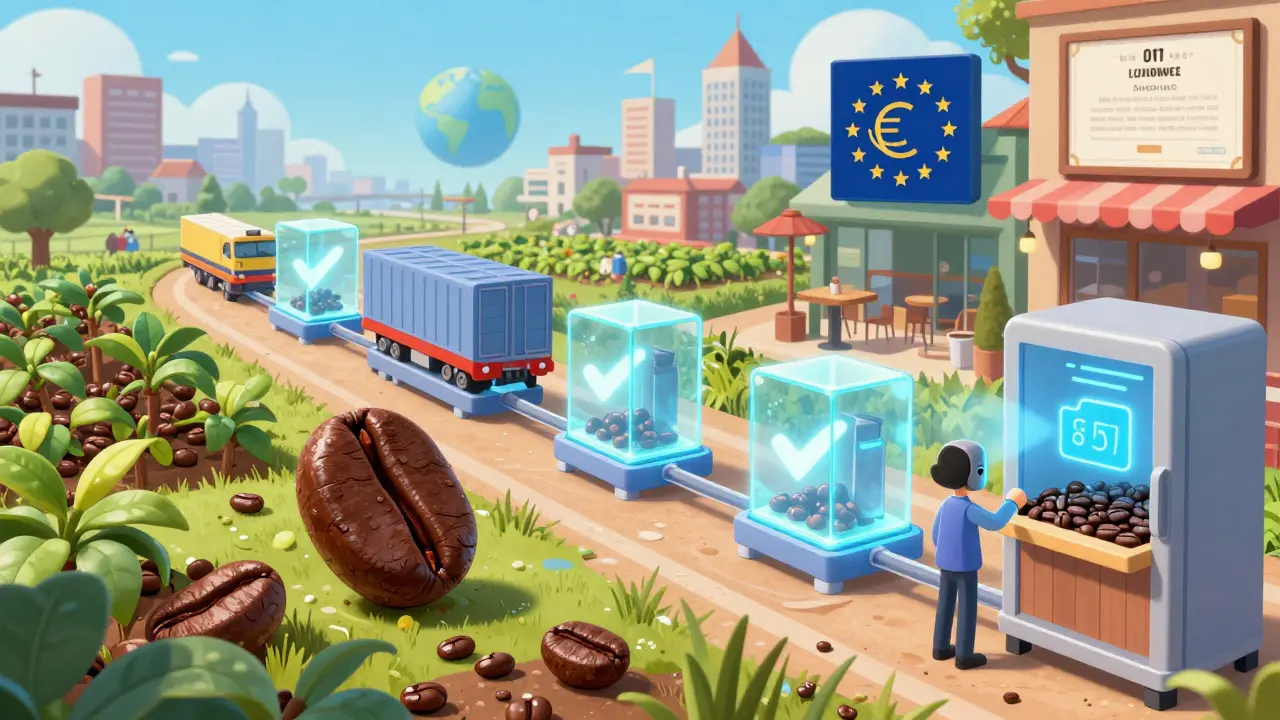
Common Mistakes People Make
- Thinking crypto = blockchain. They’re related, but not the same.
- Waiting for “the perfect time” to enter. The perfect time was 2020. The next best time is now.
- Ignoring regulation. Healthcare needs HIPAA. Finance needs KYC. Skip this, and you’ll get shut down.
- Putting all your money into one token. Diversify across sectors, not just coins.
- Assuming all blockchains are public. Many enterprise blockchains are private-permissioned, secure, and designed for corporations.
Final Thought: It’s Not About Crypto Anymore
Blockchain stopped being about speculation years ago. Now, it’s about systems. About efficiency. About trust. The companies winning aren’t the ones shouting the loudest on Twitter. They’re the ones quietly fixing real problems-in hospitals, in power grids, in supply chains, in land registries. If you’re still treating blockchain like a lottery ticket, you’re already behind. The real opportunity isn’t in buying a coin. It’s in understanding how the technology is changing the world-and positioning yourself where the change is happening fastest.What’s the safest blockchain sector to invest in right now?
There’s no single “safest” sector, but BFSI (banking and finance) has the most mature infrastructure, clear regulations, and proven use cases. Stablecoins like USDC and enterprise blockchain solutions in payments are lower risk than speculative DeFi protocols. Real estate tokenization is also relatively safe because it’s backed by physical assets and regulated in countries like Sweden and Georgia.
Can I diversify across blockchain sectors without buying crypto?
Yes. You can invest in companies offering blockchain-as-a-service (BaaS), like IBM or Oracle, which help businesses build blockchain tools. You can also buy ETFs that track blockchain technology stocks, not just cryptocurrencies. Real estate tokenization platforms let you invest in property using stablecoins, not volatile coins like Bitcoin. You don’t need to hold crypto to benefit from blockchain’s growth.
How long does it take to see returns from blockchain investments?
It varies. Payment systems and DeFi can show returns in months if you’re trading or staking. But real estate tokenization, healthcare systems, or supply chain upgrades take 1-3 years to scale. Think of blockchain like solar panels-you don’t see savings overnight, but the long-term payoff is strong. Patience is key.
Is blockchain in healthcare just hype?
No. Hospitals in the U.S. and EU are already piloting blockchain for patient records. The technology solves real problems: data silos, breaches, and slow access. MIT and the University of Nicosia are issuing diplomas on blockchain because it’s verifiable and tamper-proof. This isn’t theory-it’s being used in live systems right now.
What’s the biggest risk in diversifying across blockchain sectors?
The biggest risk isn’t the technology-it’s misunderstanding regulation. A healthcare blockchain project that ignores HIPAA will get shut down. A payment system that doesn’t comply with AML rules will be blocked. Diversification helps spread risk, but you still need to understand the rules in each sector. Don’t assume one size fits all.
Should I use a crypto wallet or a traditional brokerage to invest?
Use both, depending on what you’re buying. For tokens like ETH or stablecoins, use a secure wallet like Ledger or MetaMask. For stocks in blockchain companies or ETFs, use a traditional brokerage like Fidelity or Charles Schwab. For real estate tokenization, use platforms like RealT or Atlant-they handle the legal and technical side for you. Don’t put everything in one place.
Are central bank digital currencies (CBDCs) a threat to private blockchain projects?
Not necessarily. CBDCs like China’s Digital Yuan or the EU’s Digital Euro are government-backed digital cash. They’ll compete with crypto payments, but not with private blockchains used for supply chains, healthcare, or real estate. In fact, CBDCs could make the whole ecosystem more mainstream, helping businesses adopt blockchain faster because people are already comfortable with digital money.
Katie Teresi
February 1, 2026 AT 15:52This is the most naive financial advice I've seen all year. Blockchain isn't an investment portfolio-it's a tool. You're telling people to throw money at 'energy tokenization' like it's a mutual fund. Wake up. Most of these use cases are vaporware dressed up with buzzwords. If you're not coding smart contracts, you're not investing-you're gambling on hype.
Moray Wallace
February 1, 2026 AT 21:32There's merit in diversifying across sectors, but the risk profiles vary wildly. BFSI has regulatory clarity; healthcare has compliance nightmares. I'd caution against treating tokenized real estate as 'safe'-it's still nascent, and legal enforceability across borders remains murky. A balanced approach is wise, but don't confuse optimism with due diligence.
Dahlia Nurcahya
February 2, 2026 AT 10:22I love how this breaks down real-world use cases instead of just pushing coins. I’ve seen friends lose everything chasing meme tokens, but when I showed them how a hospital in Germany uses blockchain for patient records? That clicked. It’s not about getting rich overnight-it’s about being part of something that actually fixes things. Start small, stay curious, and don’t let the noise drown out the real progress.
William Hanson
February 4, 2026 AT 01:48Wow. Another crypto bro pretending he’s Warren Buffett. You think putting 20% in 'real estate tokenization' is smart? Atlant’s had 3 transactions last year. You’re not investing-you’re donating to a tech demo. And don’t even get me started on 'decentralized AI.' That’s just cloud computing with a blockchain sticker on it. Stop pretending you understand this.
Lori Quarles
February 5, 2026 AT 22:51YES. Finally someone gets it. This isn’t about Bitcoin doubling or crashing-it’s about rewriting how the world works. I’ve seen a small clinic in rural Texas use blockchain to finally share records with a pharmacy 200 miles away. No more faxes. No more lost files. That’s power. And it’s happening RIGHT NOW. Stop waiting for the moon. Build something useful.
Jeremy Dayde
February 7, 2026 AT 09:35Man I’ve been thinking about this a lot lately like I used to work in logistics and the amount of paper we went through just to track a single container was insane like we had binders the size of phone books and every time something got delayed we had to call five different people and hope they didn’t miss a signature and then the whole thing would fall apart like literally and now with blockchain you can just scan a QR code and see every single step from the factory to the dock like it’s real time and I saw a demo at a conference last year and it just blew my mind I mean we’re talking about cutting out weeks of back and forth and reducing errors by like 90 percent and it’s not even that expensive to implement anymore if you’re a mid sized company and I just wish more people understood that this isn’t about crypto it’s about efficiency like actual real world efficiency and I feel like we’re on the cusp of something huge
Steven Dilla
February 9, 2026 AT 03:58100% this. 🚀 I’ve been in crypto since 2017 and I’ve seen the hype cycle 5 times. But this? This is different. I bought into tokenized real estate last year with $2k. Got my first dividend last month. $17. But it was from a building in Atlanta that’s actually rented out. Not a dream. Not a token. A building. That’s real. 🏠💰
Pamela Mainama
February 9, 2026 AT 10:24Real change happens quietly. Not on Twitter. Not in whitepapers. In hospitals. In power grids. In warehouses. That’s where the future is being built.
Rachel Stone
February 10, 2026 AT 01:43So... you’re saying I should invest in my fridge paying for milk? Cool. I’ll just wait for the robot uprising then.
Will Pimblett
February 11, 2026 AT 22:21Interesting breakdown-but where’s the data on adoption rates? You cite market size projections, but how many of these use cases are actually live and scaling? I’ve seen 'blockchain for healthcare' demos since 2018. Most never leave the pilot phase. Don’t mistake ambition for adoption.
Christopher Michael
February 12, 2026 AT 17:43Important note: When investing in blockchain-as-a-service (BaaS), always check the underlying infrastructure. IBM’s Hyperledger Fabric is permissioned and enterprise-grade; Oracle’s blockchain cloud supports smart contracts with enterprise SLAs. Avoid platforms that don’t disclose their consensus mechanism or node architecture. Also, verify if the tokenized asset is custodied by a regulated entity-otherwise, you’re holding a digital promise, not an asset.
Parth Makwana
February 12, 2026 AT 20:17One must recognize the paradigmatic shift from centralized ledger systems to distributed consensus architectures as the foundational substrate for next-generation trust infrastructure. The BFSI sector’s adoption of permissioned blockchains is not merely an operational optimization-it represents a structural reconfiguration of financial intermediation. The emergent convergence of DeFi, CBDCs, and tokenized real assets is catalyzing a novel financial ecosystem wherein liquidity fragmentation is being systematically resolved through atomic settlement protocols.
Elle M
February 14, 2026 AT 13:34Stop calling it 'blockchain.' It’s not a magic wand. It’s a database with extra steps. And no, Estonia’s system doesn’t prove anything-it’s a tiny country with 1.3 million people. Try applying this to Texas or California. You’ll get lawsuits, not innovation.
Rico Romano
February 15, 2026 AT 17:17Anyone who thinks tokenized real estate is 'safe' hasn’t read the fine print. Most platforms are offshore. Most 'assets' are illiquid. And most 'investors' are retail speculators who think they’re buying shares when they’re actually buying a contractual right that may or may not be enforceable under U.S. securities law. This isn’t investing. It’s legal roulette.
Crystal Underwood
February 17, 2026 AT 03:12Oh wow. Another 'blockchain fixes everything' cultist. You’re literally telling people to put money into 'IoT microtransactions' like that’s a real asset class. Your 'safety' strategy is just a fancy way to say 'I don’t know what I’m doing.' And don’t get me started on 'decentralized AI'-that’s just a buzzword salad for people who think ChatGPT is magic. Wake up. This isn’t the future. It’s a scam with a whitepaper.
Raymond Pute
February 19, 2026 AT 01:48Look I get it you’re trying to sound smart and all but honestly this whole thing feels like someone took a TED Talk and threw it into a blender with a crypto newsletter and then added a sprinkle of 'I read a Forbes article once.' Real estate tokenization? Cool. But the platform you mentioned? Their website looks like it was built in 2017. And 'decentralized AI'? That’s not a thing. It’s just AI with a blockchain wallet attached. And don’t even get me started on 'CBDCs helping private blockchains'-that’s like saying electric cars will help horse stables thrive. It’s not a synergy. It’s a replacement. And you’re acting like this is all so revolutionary when really it’s just capitalism trying to rebrand itself with new tech jargon. Also I’ve seen this exact post five times already on Reddit. Can we move on?
Calvin Tucker
February 20, 2026 AT 05:38The real question isn’t where to invest-it’s who controls the narrative. Blockchain’s power lies not in its code but in who gets to define its rules. Central banks, corporations, and regulators are writing those rules. The 'decentralized' dream was always a myth. What we’re seeing isn’t innovation-it’s consolidation under new branding. The real opportunity isn’t in the tech. It’s in understanding who wins when the old systems collapse.