Imagine you just finished a song, a painting, or a short film. You want to protect it. But waiting months for the government to process your copyright application? That’s not practical. You need proof now. That’s where blockchain comes in.
Blockchain-based copyright registration lets you create a tamper-proof, time-stamped record of your work in minutes - for less than a dollar. No paperwork. No waiting. Just a digital fingerprint of your creation locked into a public ledger. But here’s the catch: it doesn’t replace official copyright. It just gives you something the government doesn’t: instant proof.
How Blockchain Proves You Created Something First
At its core, blockchain is a digital ledger that records transactions across many computers. Once data is added, it can’t be changed. That’s why it’s perfect for proving when something was created.
When you register your work on a blockchain, you don’t upload the full file - you upload a unique digital fingerprint called a hash. This hash is like a barcode for your file. Even a tiny change in the image, audio, or text creates a completely different hash. The system takes that hash, adds a timestamp, and records it on a blockchain like Ethereum. Anyone can verify that the hash existed at that exact time.
For example, a photographer uploads a photo. The system generates a hash. That hash is written to the blockchain. The original file stays on their hard drive. Later, if someone claims they made the photo first, the photographer can prove the hash was on the blockchain two weeks before the other person posted it. That’s it. No judge, no lawyer - just math and public records.
Most platforms use IPFS (InterPlanetary File System) to store the actual file or metadata. IPFS is decentralized, so the file isn’t hosted by one company. It’s spread across the network. Even if the platform shuts down, the file can still be retrieved as long as someone else is hosting it.
Speed and Cost: The Real Advantage Over Traditional Copyright
The U.S. Copyright Office charges between $45 and $125 per registration. Processing time? Three to nine months. That’s a long time to wait if you’re releasing music online or publishing art on Instagram.
Blockchain registration? You can do it in under five minutes. Fees? Usually under $1. Some platforms like Proof of Existence charge as little as $0.32. That’s not a subscription. Not a monthly fee. One-time cost. Instant proof.
This isn’t just convenient - it’s essential for creators who publish daily. A digital artist posting on Twitter or TikTok can’t wait months to prove ownership. If someone steals their work and posts it first, they’re already behind. With blockchain, they can timestamp their original before posting publicly. It’s a digital safety net.
According to a 2023 Creative Commons survey of 1,200 digital creators, 78% said blockchain registration gave them immediate peace of mind. For many, it’s the only way they feel protected in today’s fast-moving online world.
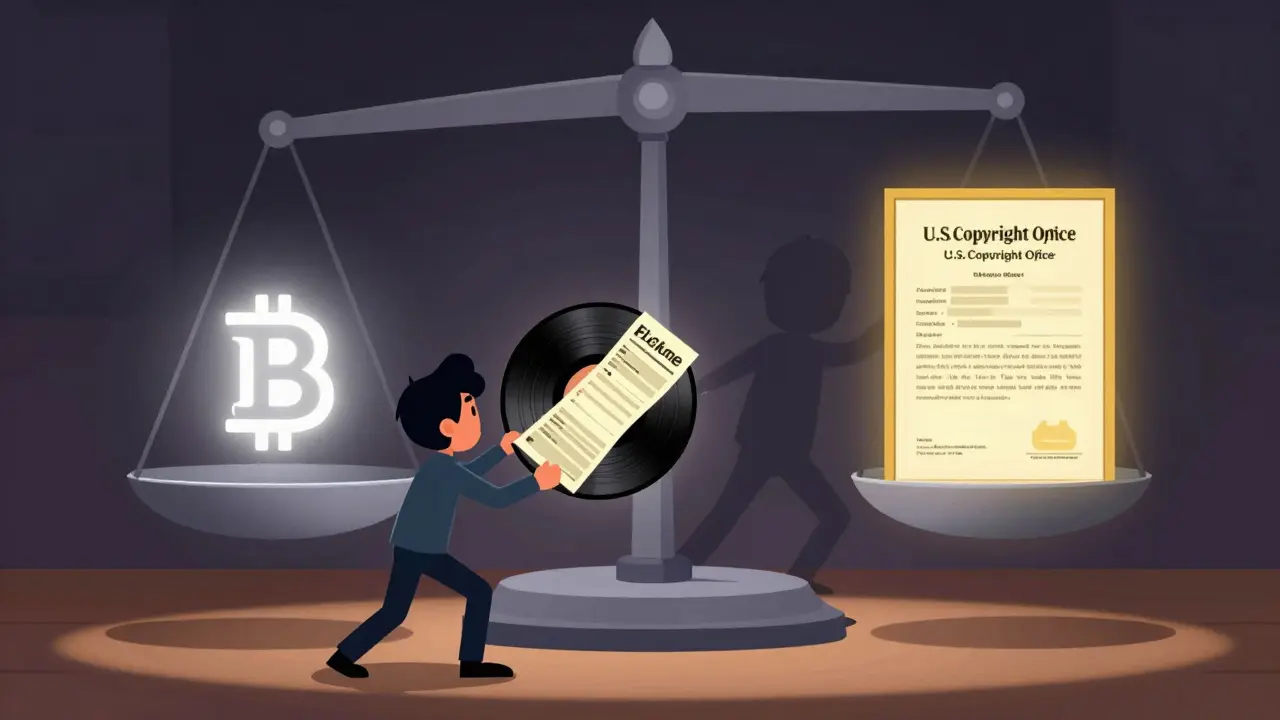
Why Blockchain Isn’t Legal Copyright - And What That Means
Here’s where things get tricky. In the U.S., you automatically own the copyright to your work as soon as you create it. But to sue someone for infringement and get statutory damages (which can be up to $150,000 per work), you need to have registered with the U.S. Copyright Office.
The U.S. Copyright Office is clear: blockchain registration does not count as official registration. In a 2022 court case, a musician used a blockchain timestamp as evidence. The judge allowed it - but gave it less weight than the official federal registration the other side had. The musician won on other grounds, but the blockchain record didn’t carry the legal punch.
Same thing in the EU and most other countries. Blockchain is admissible as evidence, but it’s not a substitute. Think of it like a notarized receipt. It proves you had something at a certain time. But it doesn’t give you the full legal rights that come with government registration.
That’s why experts like TechnoLlama warn: “Once you put a wrong name on the blockchain, it’s there forever.” If someone else registers your work as theirs, you can’t delete it. You have to prove you’re the real creator - which is harder if you didn’t register officially.
Who’s Using This - And How
Blockchain copyright tools are most popular among creators who publish frequently and need fast proof:
- Digital artists use it to timestamp paintings or illustrations before posting on NFT marketplaces.
- Music producers timestamp demos before sending them to labels or collaborators.
- Software developers use it to prove they wrote a line of code before a client claims ownership.
- Writers timestamp unpublished manuscripts before submitting to publishers.
Some big players are testing it too. Sony Music built an internal blockchain system to track royalties for 1.2 million artists. It doesn’t replace copyright registration - it automates payments when songs are streamed.
Platforms like Verisart and Bernstein offer blockchain registration with optional notarization for $15-$50. That adds a layer of legal validation. It’s not full copyright, but it’s stronger than a basic timestamp.
For most people, though, free or low-cost tools like Po.et, Copyrobo, or Ethereum-based services are enough. You don’t need to be tech-savvy. Many have one-click interfaces now. Just upload your file, pay a few cents, and get a receipt with a blockchain link.
The Technical Side: Hashes, Smart Contracts, and Networks
Behind the scenes, it’s not magic - it’s code. Most systems use Ethereum because it supports smart contracts: self-executing programs that run automatically.
Two smart contracts do the heavy lifting:
- Registry Contract - stores the hash and timestamp of your work.
- Authentication Contract - lets others verify if a file matches a registered hash.
Some advanced systems go further. A 2023 study from PMC used perceptual hashing (pHash) to compare video files. If a new upload is 50% similar to a registered video, the system flags it as a possible copy. That’s useful for platforms like YouTube or Vimeo trying to catch infringement automatically.
But there’s a limit. Ethereum handles only 15-30 transactions per second. If a million artists try to register at once, it slows down. That’s why some platforms use sidechains or other blockchains like Polygon to reduce costs and speed things up.
Real Stories: What Creators Actually Experience
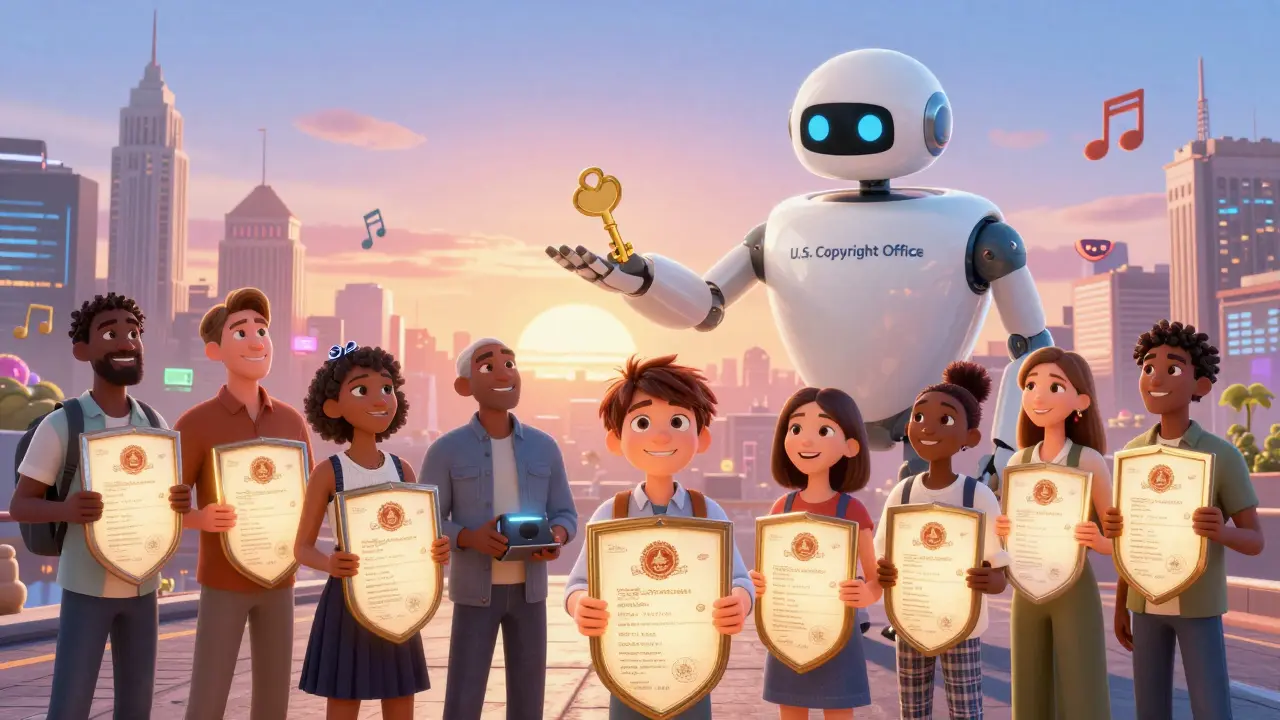
One photographer on Reddit used Ethereum to timestamp a photo before posting it on Instagram. Someone copied it and claimed it as their own. She shared the blockchain link. Instagram removed the fake post. No lawyer needed.
Another musician used blockchain to prove he wrote a melody before a pop star released a similar track. His lawyer said the blockchain record helped - but they still had to file for official copyright to proceed with the lawsuit. The blockchain record was evidence. The federal registration was the weapon.
But not everyone wins. A Trustpilot review from May 2023 said: “Great for personal records, but my lawyer said it’s useless in court without official registration.” That’s the reality. Blockchain gives you proof. But only official registration gives you legal power.
What’s Next? The Future of Copyright on Blockchain
The European Union is running a pilot program to connect blockchain timestamps with its official copyright system. The U.S. Copyright Office is studying the same thing. By 2027, experts predict 30-40% of countries will have clear rules on how to use blockchain evidence in IP cases.
Juniper Research forecasts that by 2027, 65% of digital creators will use blockchain for preliminary proof. But official registration rates won’t change much - they’ll stay around 5-7% of all creative works. That’s because the legal system moves slowly. Blockchain moves fast.
The real future isn’t blockchain replacing copyright. It’s blockchain feeding into copyright. Imagine registering your work on a blockchain, then clicking a button to auto-file with the U.S. Copyright Office. The blockchain record becomes the proof of your claim. That’s already being tested.
Should You Use It? A Simple Decision Guide
Ask yourself:
- Do you publish work online often? Yes → Use blockchain for instant proof.
- Are you planning to sue someone for stealing your work? Yes → Register officially with your government’s copyright office first.
- Are you an indie creator with no legal budget? Use blockchain. It’s cheap, fast, and better than nothing.
- Do you work with big companies or publishers? They’ll still require official registration. Use blockchain as backup.
There’s no downside to having both. Blockchain gives you proof today. Official registration gives you power tomorrow.
Don’t wait until someone steals your work to learn about this. Do it now. It takes five minutes. Costs less than a coffee. And in a world where content is copied in seconds, having proof matters.
Does blockchain copyright registration replace official copyright?
No. Blockchain registration provides immediate, tamper-proof proof of creation and ownership, but it does not replace official government copyright registration. In the U.S., you must register with the U.S. Copyright Office to claim statutory damages in an infringement lawsuit. Blockchain records can be used as supporting evidence, but courts give more weight to official registration.
How much does blockchain copyright registration cost?
Most blockchain registration services cost under $1, often as little as $0.30-$0.50 per work. This covers the transaction fee (gas fee) to record the file’s hash on a blockchain like Ethereum. Some platforms charge up to $5 for added features like notarization or metadata storage. This is far cheaper than the $45-$125 fee for official U.S. copyright registration.
Can I use blockchain to prove ownership in court?
Yes, but with limits. Courts in the U.S., EU, and other jurisdictions accept blockchain timestamps as evidence of when a work existed. However, they are not considered conclusive proof of ownership unless backed by official registration. In one 2022 case, a musician’s blockchain record was admitted but given less weight than his federal copyright registration. Blockchain helps - but it doesn’t win cases alone.
What happens if I register the wrong person on the blockchain?
The record becomes permanent. Blockchain is immutable - once data is written, it cannot be changed or deleted. If you accidentally register someone else’s work as yours, or someone else registers your work under their name, you cannot remove it. You’d need to prove your true ownership through other evidence (like drafts, emails, or official registration), which is harder if the blockchain shows the wrong name.
Do I need to be technical to use blockchain copyright tools?
Not anymore. Platforms like Copyrobo, Verisart, and Po.et offer simple one-click interfaces. You upload your file, pay a small fee, and get a link to your blockchain record. No wallet setup, no crypto knowledge required. However, if you want to verify your own records or understand how the system works, learning basic concepts like hashes and digital wallets helps - but it’s not mandatory.
Is blockchain copyright registration secure?
The blockchain record itself is secure - it’s encrypted and distributed across thousands of computers. But security depends on the platform you use. If a platform gets hacked or shuts down, you could lose access to your registration dashboard. Always download and save your blockchain receipt (with the transaction ID and hash) offline. Never rely only on a website to store your proof.
Ryan Depew
January 21, 2026 AT 18:12Sara Delgado Rivero
January 23, 2026 AT 07:28Arielle Hernandez
January 24, 2026 AT 10:56Kevin Pivko
January 25, 2026 AT 14:31Mathew Finch
January 25, 2026 AT 16:06Jessica Boling
January 25, 2026 AT 21:55Tammy Goodwin
January 26, 2026 AT 18:37Nadia Silva
January 27, 2026 AT 08:23tim ang
January 28, 2026 AT 17:20Julene Soria Marqués
January 30, 2026 AT 08:59Bonnie Sands
February 1, 2026 AT 08:06MOHAN KUMAR
February 1, 2026 AT 20:47Jennifer Duke
February 2, 2026 AT 03:12Andy Marsland
February 3, 2026 AT 01:05Anna Topping
February 3, 2026 AT 12:41Jeffrey Dufoe
February 5, 2026 AT 06:07Ashok Sharma
February 7, 2026 AT 05:50Margaret Roberts
February 8, 2026 AT 00:03Tselane Sebatane
February 8, 2026 AT 00:34Ryan Depew
February 8, 2026 AT 08:27Tselane Sebatane
February 9, 2026 AT 20:43